A DC power supply looks like the simplest instrument on the bench: set a voltage, limit the current and connect the circuit. Yet choosing the wrong programmable supply has real consequences: boards damaged by an overshoot at switch-on, current-draw measurements with errors because the drop in the leads was not compensated, slow production tests because the supply takes too long to settle, or noise leaking into a sensitive analogue circuit. This guide explains which specifications really matter, how to read a datasheet and what to ask before buying or renting a DC supply for the lab, maintenance or production testing.
First: define the application
Before comparing models, answer a few basic questions:
- Maximum voltage and current: what is the most demanding operating point? Leave a margin, but do not overdo it: a 0–60 V supply always used at 3.3 V makes poor use of its resolution and accuracy.
- Power: many “autoranging” supplies deliver their maximum power at a combination of voltage and current, but not maximum voltage and maximum current at the same time. Check the operating curve.
- Number of outputs: do you need to power several rails (for example 5 V, 12 V and 3.3 V) with outputs isolated from each other, or is one enough?
- Type of load: a digital circuit with current spikes, a motor, a battery or a low-level analogue circuit each ask different things of the supply.
- Use: design bench, repair, automated testing on a production line or field testing.
Linear or switching
| Characteristic | Linear supply | Switching supply |
|---|---|---|
| Ripple and noise | Very low | Higher, although good designs reduce them considerably |
| Efficiency, weight and size | Low efficiency; heavy and bulky at high power | High efficiency; compact even at several kW |
| Transient response | Generally fast | Varies with the design |
| Typical application | Analogue circuits, audio, RF, sensors, low-level measurements | High power, production testing, motor or battery loads |
Neither is better in general: for an analogue design bench a linear supply is usually preferred; for powering an inverter or testing power modules, a switching supply is the practical choice.
Constant voltage and constant current
A laboratory supply operates in two modes. In constant voltage (CV) it holds the set voltage as long as the load draws less than the current limit. If the load tries to draw more, the supply crosses over to constant current (CC) and lowers the voltage so the limit is not exceeded. This automatic crossover is your circuit’s first line of protection: always set a sensible current limit before connecting an unknown or freshly repaired board.
CC mode is also useful in its own right, for example to charge batteries with a controlled profile or to drive power LEDs.
Specifications worth reading carefully
Programming and readback accuracy
These are two different specifications. Programming accuracy tells you how close the actual output is to the set value; readback accuracy, how accurate the measurement shown by the supply is. Both are usually expressed as a percentage of the value plus a fixed term, much like a multimeter. If you plan to use the supply’s current readback to measure consumption, check the accuracy in the low current range carefully: some supplies offer low-current readback ranges for this purpose.
Load and line regulation
Load regulation indicates how much the output voltage changes when the current varies between no load and full load; line regulation, how much it changes when the AC mains voltage varies. Low values mean a more stable output.
Ripple and noise
These are specified as rms and peak-to-peak values, normally within a defined bandwidth (20 MHz is common). Always compare at the same bandwidth: a peak-to-peak figure measured at 20 kHz is not comparable with one measured at 20 MHz.
Transient response
This indicates how long the output takes to recover to within a tolerance band after a load step. It is critical for digital circuits with pulsed consumption and for automated tests where every millisecond counts.
Programming speed
The time the output takes to rise or fall to a new value. In production tests with many voltage points, a slow supply lengthens the test cycle.
Remote sense
At currents of several amperes, the drop in test leads and contacts can reach tenths of a volt. Remote sense uses an extra pair of wires that measure the voltage directly at the load, and the supply compensates for the drop. If your application needs a precise voltage at the board, choose a supply with this feature and connect the sense leads as close to the load as possible. Check the datasheet for the maximum drop it can compensate.
Protection features
- Overvoltage protection (OVP): shuts the output off if the voltage exceeds a threshold, for example because of a programming error. For delicate circuits it is essential.
- Overcurrent protection (OCP): unlike CC mode, it turns the output off instead of limiting it.
- Overtemperature protection (OTP) and, on some models, protection against reverse polarity or external voltage applied to the output.
- Behaviour at switch-on and switch-off: check that the output does not overshoot; some supplies let you program ramps or sequences between outputs.
When the supply must also sink current
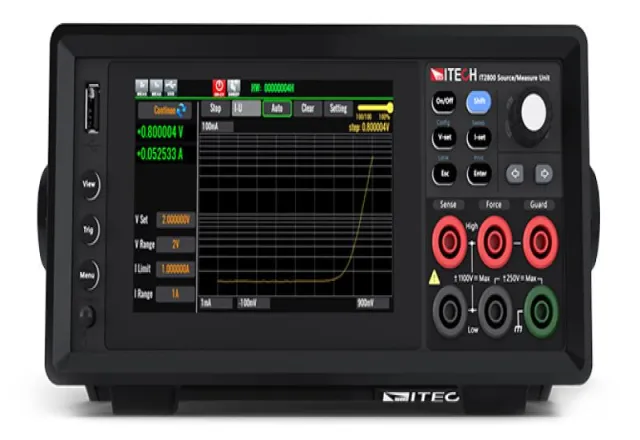
A conventional supply only sources current. If the load can return energy, such as a braking motor, a battery or a bidirectional converter, you will need another solution. DC electronic loads sink current in a controlled way and are used to test supplies, batteries and converters. For characterising semiconductors or devices that need sourcing and measuring in both directions at high resolution, there are four-quadrant source measure units (SMUs).
Interfaces and automation
For automated testing, check the available interfaces (USB, LAN, GPIB, RS-232), support for SCPI commands and the availability of drivers for your software. Features such as sequence lists, data logging and external triggering can greatly simplify a test station.
Buy or rent
If the need is temporary, for example a validation project, an audit or a failed supply on the line, renting a programmable power supply gives you the right equipment without capital investment. For daily use in the lab, buying usually makes sense. In either case, ask for a current calibration certificate if you will use the supply’s readback to make acceptance decisions.
How CreativeIT can help
At CreativeIT Group in Monterrey we sell DC power supplies and rent programmable supplies, electronic loads and other test equipment. We help you choose the equipment your application really needs. Contact us on (81) 4777 6921 or at info@creativeit.mx.