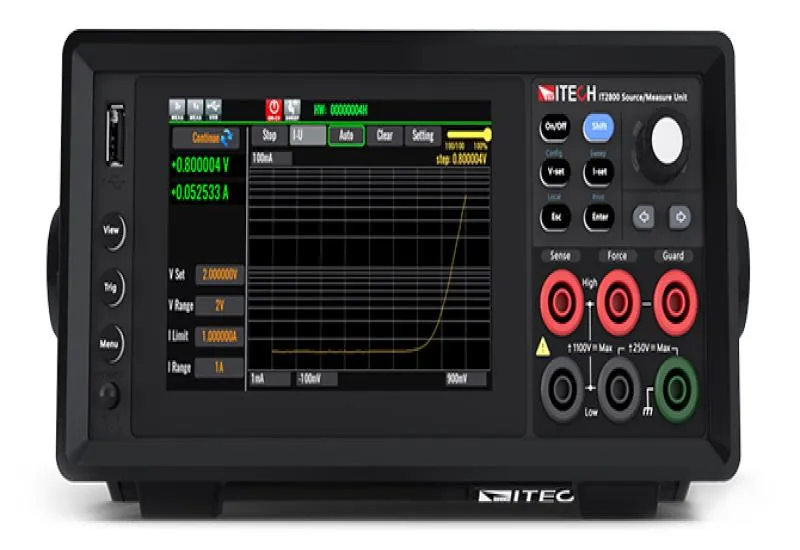
We can make measurements to characterize components, systems and subsystems with source measure units.
A source measure unit (SMU) is an instrument that combines a source function and a measurement function on the same pin or connector. It can source voltage or current and simultaneously measure voltage and/or current. It integrates the capabilities of a power supply or function generator, a digital multimeter (DMM) or oscilloscope, a current source and an electronic load in a single, tightly synchronized instrument.
4-quadrant source
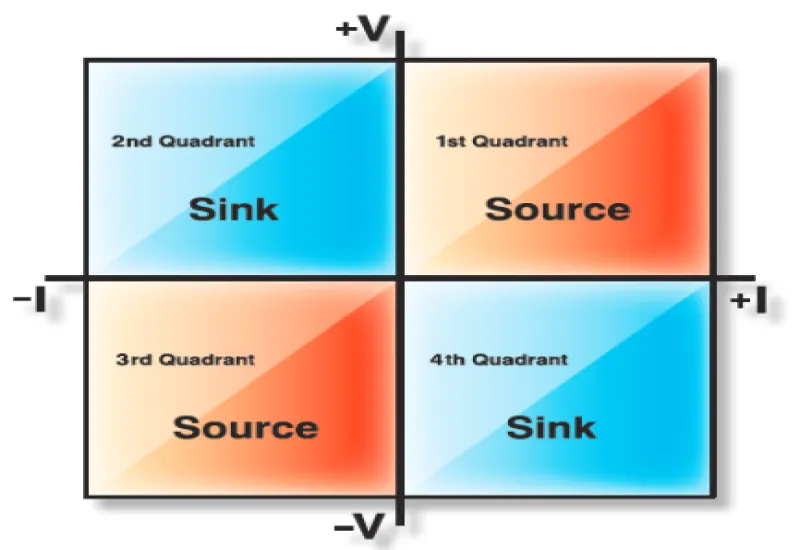
4-quadrant power supplies or 4-quadrant amplifiers are electronic modules that generate both positive and negative voltages, and that can also deliver and sink both positive and negative currents. They can therefore be used as a source or a sink.
Power supplies for laboratory use are mostly source-only supplies. They can only deliver power with a single polarity, meaning these instruments operate in only one quadrant of the voltage/current diagram.
Common amplifiers deliver voltages of both polarities, but generally cannot absorb the same power comparable to what they can deliver. They therefore operate mainly as 2-quadrant instruments
All four-quadrant power supplies in the series can also absorb power of both polarities corresponding to the delivered power.
A 4-quadrant power supply is therefore a bipolar voltage and current source, as well as a current sink, in a single instrument. It can also be used as a bipolar power amplifier.
 }