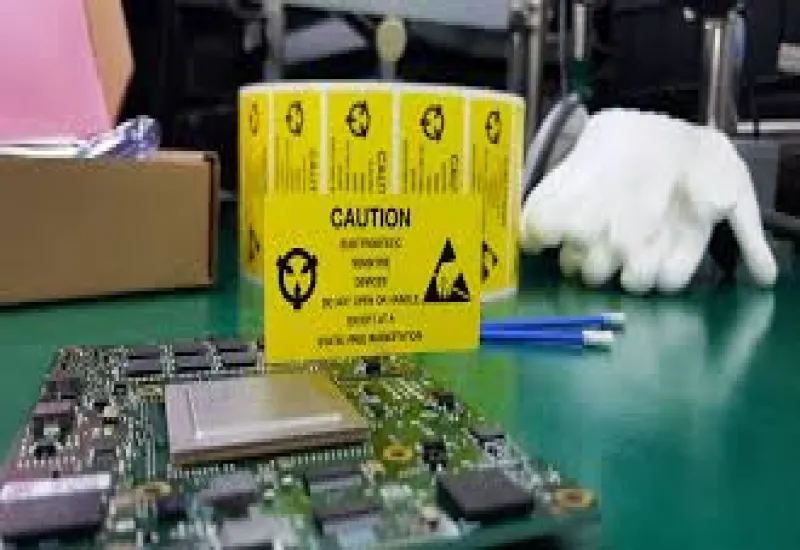
An electrostatic discharge lasts only a few nanoseconds, but that is enough to freeze a touchscreen, reset a PLC, wipe a controller’s configuration or permanently damage a communication port. Any equipment that people touch during normal operation, from an operator panel to a charger or a handheld instrument, will take discharges throughout its service life. That is why electromagnetic compatibility standards include a specific ESD immunity test, described in IEC 61000-4-2. This guide explains what the test simulates, how the setup is built, which levels are applied, how the performance criteria are interpreted and what to review before taking a product to formal testing.
What the IEC 61000-4-2 test simulates
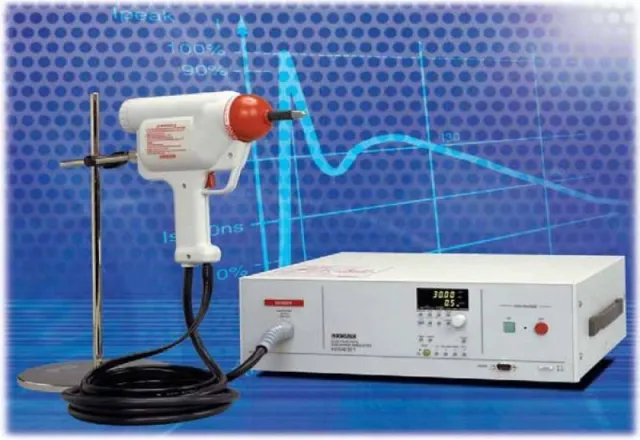
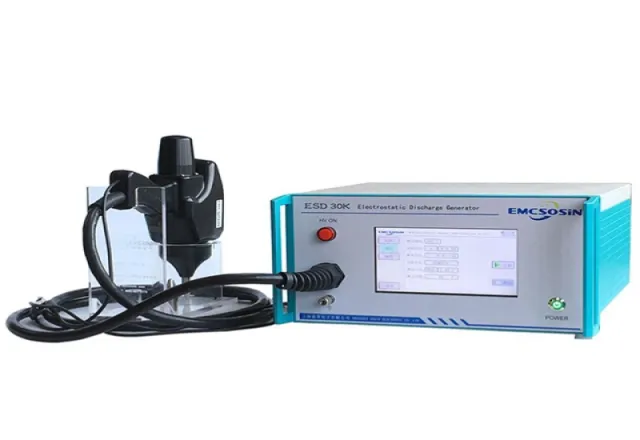
The test reproduces the discharge from a charged person who touches the equipment directly or touches a nearby metal object. To make results repeatable between laboratories, the standard defines a system-level human body model: a 150 pF capacitance discharged through a 330 Ω resistance. The ESD simulator, or “gun”, must produce a current waveform with a very fast rising edge, on the order of a nanosecond, followed by a slower tail. The standard specifies the peak current per kilovolt of charge and the values required at 30 ns and 60 ns, and it requires the gun to be verified with a current target and an oscilloscope of sufficient bandwidth.
It is important not to confuse this test with component ESD testing, such as the human body model in ANSI/ESDA/JEDEC JS-001. Those tests assess a bare integrated circuit during handling in manufacturing; IEC 61000-4-2 assesses the finished product, powered and operating, as the customer will use it. A component that meets its ESD classification does not guarantee that the complete equipment will pass the system-level test.
Contact discharge and air discharge
- Contact discharge: the gun tip touches the conductive part before firing and an internal relay produces the discharge. It is the preferred method because it is the most repeatable. It is applied to accessible metal parts: chassis, screws, connectors, metal knobs.
- Air discharge: the rounded tip approaches the surface until the arc jumps. It is used where there are no accessible conductive parts, for example at slots, seams in plastic enclosures, keypads or displays. Its result varies with approach speed, humidity and tip shape, so it is considered less repeatable.
- Indirect discharge: applied by contact to a horizontal and a vertical coupling plane placed near the equipment, to simulate discharges to neighbouring metal objects such as desks or cabinets.
Test levels
IEC 61000-4-2 defines four preferred levels. The table summarises the values in the current edition:
| Level | Contact discharge | Air discharge |
|---|---|---|
| 1 | ±2 kV | ±2 kV |
| 2 | ±4 kV | ±4 kV |
| 3 | ±6 kV | ±8 kV |
| 4 | ±8 kV | ±15 kV |
The basic standard does not say which level your product must pass. That is set by the applicable product or generic standard. For example, the generic immunity standards IEC 61000-6-1 (residential and commercial environments) and IEC 61000-6-2 (industrial environments) usually call for ±4 kV contact and ±8 kV air. Medical, automotive or rugged equipment may have its own, more severe requirements; always check the edition of the standard that applies to your product or your customer’s requirement. The test is also performed at the levels below the specified one, because some circuits fail at a low level and not at a high one.
How the setup is built
Repeatability depends as much on the setup as on the gun. The basic elements are:
- A metal ground reference plane on the floor, connected to the laboratory’s protective earth. The gun’s return cable is connected to this plane.
- Tabletop equipment: a wooden table 0.8 m high on the reference plane, with a horizontal coupling plane on top. The equipment under test and its cables sit on a thin insulating sheet, not directly on the metal.
- Floor-standing equipment: placed on a low insulating support above the reference plane, with the dimensions given in the standard.
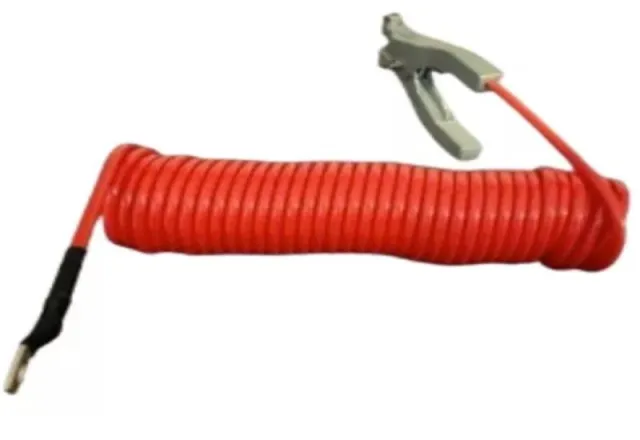
- Coupling planes connected to the reference plane through cables with 470 kΩ resistors at each end, which bleed off accumulated charge without creating a direct connection.
- Environmental conditions within the temperature, relative humidity and pressure range defined by the standard. Humidity has a strong effect on air discharges, so it should be recorded.
If the equipment is not earthed, as with many portable devices or units with a two-wire supply, the charge left by each discharge must be removed before the next one, for example with a bleeder cable with resistors or by waiting for it to dissipate. Otherwise, successive discharges are not equivalent.
Test procedure
- Define the test plan: equipment operating modes, application points, levels, polarities and expected performance criterion. Points are chosen where the user touches during normal use and user maintenance: buttons, displays, connectors, enclosure seams.
- Explore: it is good practice to run an initial sweep with repeated discharges to locate the most sensitive points.
- Apply the discharges: at each selected point at least ten single discharges of each polarity are applied, with an initial interval of at least one second between them, at all levels up to the specified one.
- Indirect discharges: applied to the edge of the horizontal plane and to the centre of the vertical plane, placed in different positions around the equipment.
- Observe and record: the behaviour of the equipment during and after each series, ideally while monitoring its critical functions (communication, outputs, readings, display).
Performance criteria
The result is not simply “pass” or “fail”: it is classified according to how the equipment behaves. The usual classification is:
- A: normal performance within the specified limits during and after the test.
- B: temporary loss of function or degradation that recovers on its own, without operator intervention.
- C: temporary loss of function that requires operator intervention or a restart.
- D: loss of function that cannot be recovered due to hardware or software damage, or loss of data.
The product standard states which criterion is acceptable. For ESD, criterion B is commonly accepted, but the manufacturer must define precisely what “normal performance” means for its equipment. A restart that goes unnoticed in a toy may be unacceptable in a process controller.
Typical failures and how to prevent them
- Plastic enclosures with gaps close to sensitive tracks or components, which let the arc jump inside.
- Poorly bonded shields and chassis: paint or anodising that prevents a low-impedance contact between metal parts.
- Unprotected connectors: USB, Ethernet or RS-485 ports without transient suppressors, or with protection tied to an earth through a long path.
- High-impedance reset, interrupt or enable lines without filtering, which interpret the transient as a command.
- Firmware without recovery: no watchdog or data checking, so a disturbance leaves the equipment hung instead of recovering.
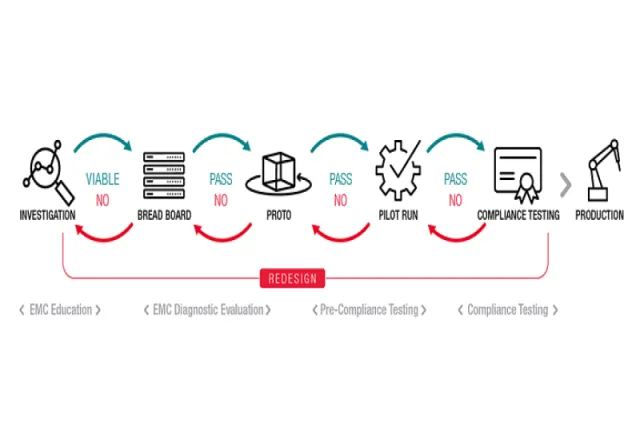
Most of these causes are cheaper to fix at the design stage than after failing a formal test. That is why many companies run a pre-compliance test on the prototype: apply the discharges, find the weak points and try solutions before paying for testing at an accredited laboratory.
How CreativeIT can help
At CreativeIT Group we carry out electrostatic discharge (ESD) immunity testing and EMC pre-compliance services to identify problems before certification. If you prefer to test at your own facility, we offer Kikusui KES4021A ESD simulator rental and ESD simulator guns for sale. Contact us at +52 (81) 4777 6921 or info@creativeit.mx, tell us the type of product and the standard it must meet, and we will propose a test plan.