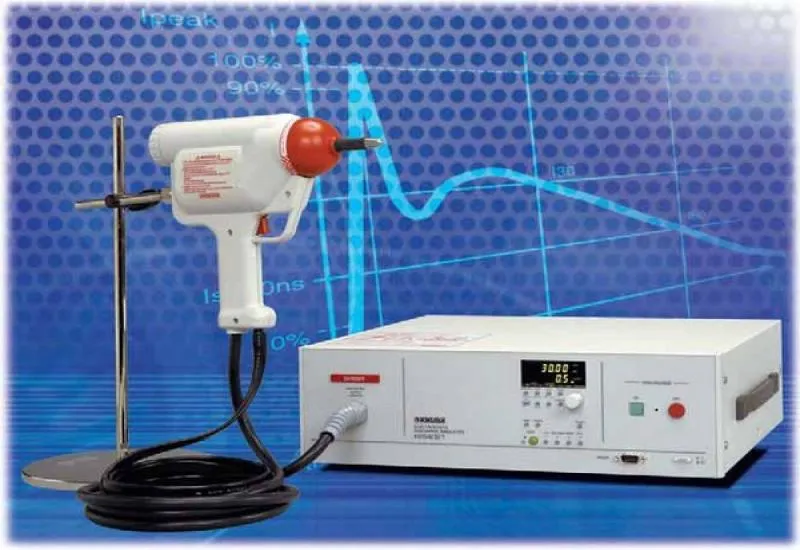
A small spark can cause a big problem in modern electronics; the Kikusui KES4021A lets you anticipate that risk and strengthen the reliability of your products.
The Kikusui KES4021A is an electrostatic discharge (ESD) simulator designed for immunity testing of electrical and electronic equipment. This instrument reproduces electrostatic discharges similar to those the human body can generate when it comes into contact with electronic devices, a common phenomenon that can cause failures, unexpected resets or permanent damage to sensitive circuits. This type of testing is essential in the modern electronics industry because of the increasing miniaturization of components and the widespread use of semiconductors, which are particularly vulnerable to the effects of static electricity.
The instrument is part of the specialized equipment used in electromagnetic compatibility (EMC) laboratories and in research, development and quality control areas. Its ability to reproduce controlled discharges makes it possible to evaluate how a product behaves under real operating conditions, ensuring that devices continue to function properly even when exposed to unexpected electrostatic discharges.
How does the instrument work?
The operating principle of the simulator is to generate a controlled high voltage that is then discharged into the device under test through an electrostatic discharge gun. This process reproduces the physical phenomenon that occurs when an electrostatically charged person touches an electronic device or a conductive surface.
The simulator system stores electrical energy in an internal capacitor that is then released in a controlled manner through a specific resistor. This process generates a discharge waveform that accurately reproduces the characteristics of a real electrostatic discharge. During the test, the operator can select different voltage levels, polarities and times between discharges to evaluate different risk scenarios.
The device supports two main test methods: contact discharge, in which the tip of the generator touches the equipment under test directly, and air discharge, in which the electric arc is generated by bringing the electrode close to the surface of the device. Both methods are needed to reproduce the different electrostatic interaction conditions found in real-world use environments.
Main Uses and Application Areas
The versatility of the KES4021A makes it applicable across a very broad range of industries. Its main use is to validate that an electronic product is not adversely affected by disturbances in its electromagnetic environment, ensuring continuous and safe operation. In the automotive sector, it is essential for testing the immunity of electronic control units (ECUs), infotainment systems, sensors and actuators against transients generated by the vehicle’s electrical system, such as those produced by the alternator or ignition. In the household appliance and industrial equipment field, the instrument verifies the robustness of motor controls, power supplies and automation systems against power line fluctuations and induced lightning surges. For the medical industry, where reliability is a life-or-death imperative, the KES4021A is used to certify that equipment such as patient monitors, infusion pumps or diagnostic imaging equipment does not fail or produce erroneous readings due to electromagnetic interference. Likewise, in the telecommunications and information technology sector, it is the reference tool for ensuring the immunity of servers, routers and communication equipment against electrostatic discharges and fast transients.
Technical data
Instrument type: Electrostatic discharge (ESD) simulator
Output voltage: 0.00 kV to approximately 30.5 kV
Guaranteed test voltage: 0.5 kV to 30 kV
Polarity: positive and negative
Discharge methods: contact discharge and air discharge
Storage capacitor: 150 pF ±10%
Discharge resistance: 330 Ω ±10%
Charging resistance: 50 MΩ
Interval between discharges: 0.05 s to 99.9 s
Number of discharges: 1 to 999 or continuous mode
Interface: RS-232C optional
Power supply: 100–240 V AC, 50/60 Hz
Technology architecture
The Kikusui KES4021A electrostatic discharge simulator is designed with an electronic architecture aimed at discharge pulse stability and test repeatability. The instrument incorporates an electronically controlled high-voltage generation system that charges an internal capacitor to the voltage level selected by the operator. This charging system is regulated by control circuits that continuously monitor the voltage to ensure that every discharge maintains the same electrical characteristics.
The discharge is generated through a calibrated RC network that reproduces the electrical behavior of a human-body electrostatic discharge. This electrical model makes it possible to simulate the real conditions experienced by electronic devices when an electrostatically charged person comes into contact with them. The resulting pulse has an extremely fast rise time and a high peak current, which is characteristic of ESD events in industrial and domestic environments.
The system’s internal electronics also integrate a monitoring circuit that supervises critical parameters during the test. This includes confirmation of the selected polarity, the stored voltage level and the number of discharges delivered. This continuous control allows the operator to run tests with a high degree of precision and safety.
Importance of ESD testing
Electrostatic discharges are one of the most common phenomena affecting electronic systems. Even small accumulations of electrostatic charge can generate potential differences of several thousand volts, which is enough to damage microcircuits or cause malfunction in sensitive electronic equipment.
The Kikusui KES4021A simulator makes it possible to study these phenomena in a controlled manner, providing valuable information about how circuits behave when facing fast discharge events. During a test, engineers can analyze whether the device under test continues to operate correctly, whether it experiences temporary resets or whether it suffers permanent damage.
This type of evaluation is
essential in the design of modern electronic systems, as it makes it possible to identify vulnerable points within the circuit, such as communication ports, external connectors or exposed metal surfaces.
Reliability and repeatability in testing
One of the most important aspects of electromagnetic compatibility testing is the repeatability of results. To ensure that the data obtained is reliable, the instrument must generate discharges with consistent electrical characteristics.
The Kikusui KES4021A simulator incorporates stabilization circuits that keep the voltage level constant before each shot. In addition, the internal control system allows the interval between discharges to be programmed, which avoids variations in the capacitor charge or in the thermal conditions of the instrument.
This precision allows comparative tests between different prototypes of the same product or between different versions of an electronic design. The results obtained help determine which configurations offer greater resistance to electrostatic discharges.
International standard IEC 61000-4-2: One of the most important standards related to electrostatic discharge testing is IEC 61000-4-2, part of the electromagnetic compatibility series of standards developed by the International Electrotechnical Commission. This standard defines the test method for evaluating the immunity of electronic equipment to electrostatic discharges generated by human contact or by the proximity of electrostatically charged objects. The standard sets the typical test levels used in the laboratory, which can reach up to ±8 kV for contact discharge and ±15 kV for air discharge. It also defines the test equipment setup, the geometry of the ground plane, the insulating surface on which the device under test is placed, and the sequence of discharges that must be applied. By using a simulator such as the Kikusui KES4021A, laboratories can accurately reproduce the conditions specified in this standard, making it possible to verify whether a device maintains normal operation or shows degradation during exposure to electrostatic events.
Automotive standard ISO 10605: The standard specifies different test configurations that simulate real conditions of use inside the vehicle, including direct discharges to user-accessible components and indirect discharges to nearby metal structures. Using the Kikusui KES4021A, these scenarios can be reproduced with different voltage levels and polarities, allowing automotive manufacturers to validate the robustness of their electronic systems before deployment in production vehicles.
Traceability as a Pillar
Confidence in KES4021A results is based on the traceability of its measurements. The instrument internally incorporates a self-calibration system that verifies the accuracy of its generators and sensors against high-stability internal references. For an external calibration with traceability to national or international standards, all critical parameters, such as pulse output voltage, current, rise times and frequency, are accessible through clearly defined measurement points. This allows metrology laboratories to perform a complete calibration of the instrument, issuing certificates that link the KES4021A measurements to the primary standards of CENAM (Centro Nacional de Metrología, Mexico’s national metrology institute) or other national institutes. This traceability chain is an indispensable requirement for test laboratories accredited under ISO/IEC 17025, as it ensures that the results issued are technically valid and internationally comparable.
Application in advanced industrial sectors
The electrostatic discharge simulator has applications in various technology sectors where the reliability of electronic systems is essential. In the automotive industry, for example, it is used to evaluate the resistance of electronic modules installed in modern vehicles, which include sensors, navigation systems and electronic control units.
In the telecommunications sector, the instrument is used to test devices such as routers, switches and data transmission equipment. These systems must keep operating even when exposed to electrostatic disturbances generated by users or environmental conditions.
The Kikusui KES4021A simulator is also used in the development of electronic medical equipment, where operational stability is an essential requirement to ensure patient safety and diagnostic accuracy.
Need Advice or a Quote?
Contact us today on WhatsApp at 8117860768 for pricing, availability and usage recommendations. At Creativeit Group, our specialized technical team can help you integrate it into your measurement processes.