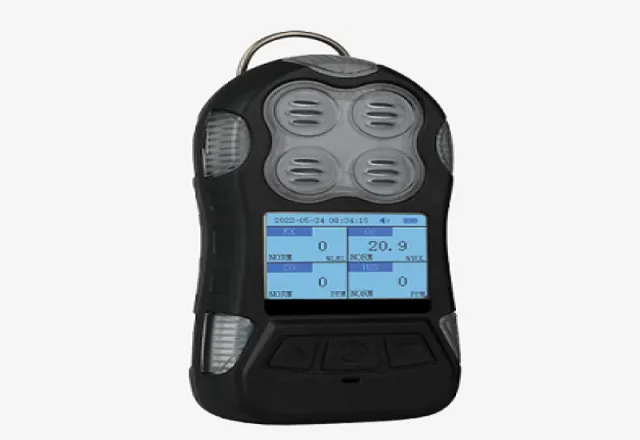
A multigas detector that switches on and shows 20.9% oxygen and zero on everything else looks like it is working. But that display only says the instrument reads “clean air”; it does not prove that its sensors will react to a hazardous gas. A poisoned, blocked or end-of-life sensor can read zero in a flammable or toxic atmosphere. That is why manufacturers and good safety practice distinguish between the bump test, the calibration check and full calibration. This guide explains what each one involves, how often it is done, what affects the sensors and how to organise a reliable maintenance programme for the detectors your staff use in confined spaces and hazardous areas.
Which sensors a multigas detector uses
A typical four-gas instrument combines different technologies, and each one ages and fails in its own way:
- Combustible gases (%LEL): usually a catalytic bead sensor, although some models use infrared. It measures concentration as a percentage of the lower explosive limit of the reference gas.
- Oxygen (% vol): an electrochemical sensor that detects both deficiency and enrichment.
- Carbon monoxide and hydrogen sulphide (ppm): electrochemical sensors specific to each gas.
Electrochemical sensors are consumed over time, and their service life depends on the type, the manufacturer and exposure. Catalytic sensors can lose sensitivity through poisoning (silicones, lead compounds, some sulphur or halogenated compounds) or through inhibition after high exposures. In both cases, the loss of sensitivity cannot be seen on the display in clean air.
Bump test, calibration check and calibration
| Activity | What it does | What it proves |
|---|---|---|
| Bump test | Briefly exposes the sensors to a gas of known concentration, high enough to exceed the alarm set points | That the sensors respond and the audible, visual and vibrating alarms activate |
| Calibration check | Exposes the sensors to calibration gas and compares the reading with the certified value | That the reading is within the tolerance set by the manufacturer |
| Full calibration | Adjusts zero with clean or zero air and span with certified gas | That the instrument is adjusted to read accurately |
The bump test is qualitative: it adjusts nothing. If the instrument does not respond or does not alarm, it must be calibrated; if it still fails after calibration, the sensor needs replacing and the detector must not be used.
How often to do each one
The reference most often cited in industry is the statement from ISEA, the US safety equipment association, which recommends a bump test or calibration check before each day’s use, in accordance with the manufacturer’s instructions, and calibration whenever the test is failed. Many manufacturers adopt the same recommendation in their manuals. Full calibration is done at the interval the manufacturer specifies and also whenever:
- The instrument fails a bump test or calibration check.
- A sensor is replaced.
- The detector has been exposed to a high gas concentration, a heavy impact, immersion or extreme temperatures.
- Contact with catalytic sensor poisons is suspected.
In Mexico, NOM-033-STPS-2015 on work in confined spaces requires the atmosphere to be assessed before and during the work, using equipment in good condition and calibrated according to the manufacturer’s instructions. A documented record of bump tests and calibrations is the practical way to demonstrate this during an inspection or an incident investigation.
How to do a proper bump test
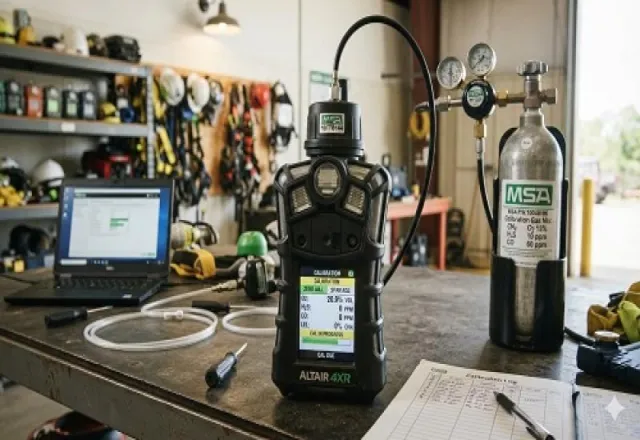
- Switch the instrument on in clean air and let it complete its self-test and warm-up.
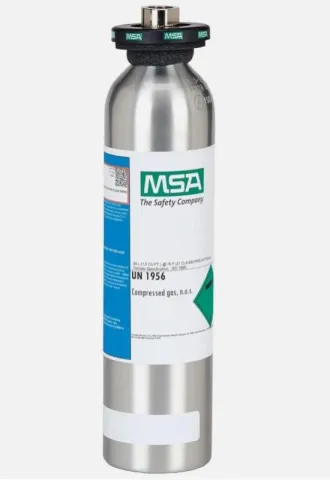
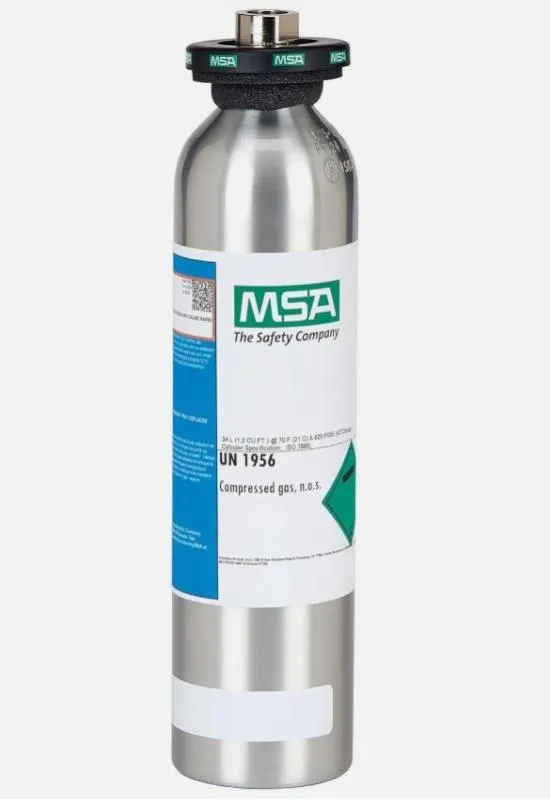
- Use the right gas: a certified cylinder, within its expiry date, with the concentrations the manufacturer specifies for that model.
- Use the correct regulator and adapter. Some instruments require a fixed-flow regulator and others a demand-flow regulator; the wrong flow gives incorrect readings.
- Check the alarms on every channel: audible, visual and vibration.
- Record the result: many instruments and automatic docking stations store the date, time and result of each test.
Automatic test and calibration stations simplify the process when there are many instruments: they apply the gas, check the response, calibrate if needed and keep the history. Their cost is quickly justified in plants with large fleets of detectors.
The calibration gas matters
- Certified and traceable: the gas is the calibration standard; if its concentration is not reliable, neither is the calibration.
- Expiry date: some reactive gases, such as hydrogen sulphide, have a shorter cylinder life than stable gases.
- LEL channel reference gas: catalytic sensors respond differently to each combustible gas. If the instrument is calibrated with methane but used to detect solvent vapours, the reading must be corrected with the factors published by the manufacturer, or the instrument calibrated with the appropriate reference gas.
- Cross-sensitivity: some electrochemical sensors respond to gases other than their target. Check the manufacturer’s tables before interpreting a reading in an atmosphere with several contaminants.
Common mistakes
- Relying on the start-up self-test as if it were a bump test.
- Zeroing the instrument in a contaminated area, which shifts every reading.
- Using expired cylinders or regulators that do not match the instrument.
- Cleaning the detector with silicone-based products, which can poison the catalytic sensor.
- Lending or renting out instruments without evidence of their last calibration.
- Continuing to use an instrument with a sensor that no longer passes calibration “because it still turns on”.
Buy, rent or send out for calibration?
If your staff enter confined spaces every day, it makes sense to own instruments, keep test gas and run a documented bump-test programme, backed by periodic calibrations from a technical service provider. If the work is occasional, such as a maintenance shutdown or a tank cleaning, renting detectors that arrive tested and calibrated avoids the cost of keeping instruments and gas in stock. Either way, ask for a calibration certificate showing the date, the gas used and the results for each channel.
How CreativeIT can help
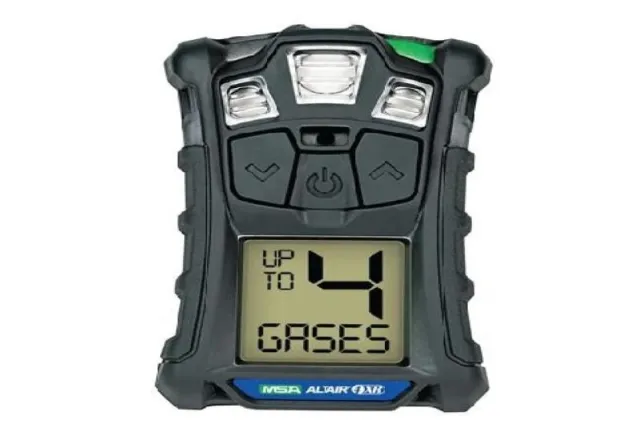
At CreativeIT Group we offer MSA ALTAIR 4X multigas detector calibration and MSA ALTAIR 4XR calibration, as well as the MSA ALTAIR 4X multigas detector and rental of gas detectors for LEL, H2S, CO and O2. Contact us at +52 (81) 4777 6921 or info@creativeit.mx with the model and number of instruments to schedule their calibration.