Measuring current looks like the simplest task in electrical maintenance: open the clamp, close it around the conductor and read the value. But the sensor you choose makes a big difference to the result. An iron-core clamp cannot see direct current, a Hall-effect clamp can drift several amperes if it is not zeroed, and a Rogowski probe will not saturate at thousands of amperes but cannot measure DC either. A poor choice means wrong readings on a drive, harmonics recorded incorrectly in a power quality study or, simply, a clamp that will not close around the busbars in the panel. This guide compares the most common technologies and explains when each one makes sense.
The three main technologies
Current transformer clamp (iron core)
It works like a transformer: the conductor is the primary and a coil on a magnetic core is the secondary. It is rugged, inexpensive and the sensor needs no power supply. Its main limitation is that it measures alternating current only, and the core can saturate with very high currents or with DC components present in the signal. Bandwidth is also limited, which affects the measurement of higher-order harmonics.
Hall-effect clamp
A Hall sensor in the core’s air gap measures the magnetic field directly, so it can measure both AC and DC. It is the choice for batteries, chargers, photovoltaic systems, drive DC buses and currents with a DC component. In exchange, it needs power, must be zeroed before every DC measurement and is sensitive to temperature and to residual magnetism in the core. At low currents, zero error can be a significant part of the reading.
Rogowski probe
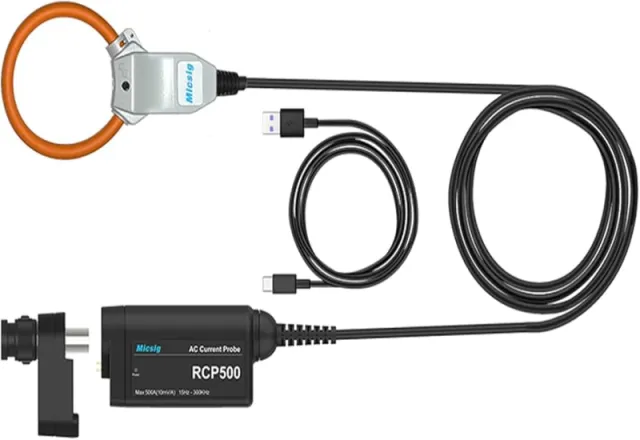
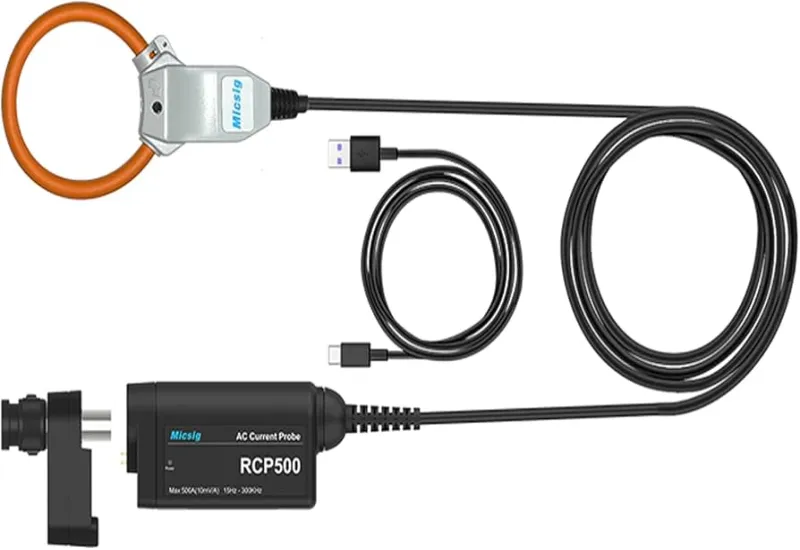
This is a flexible coil with no magnetic core that wraps around the conductor. Its output is proportional to the rate of change of current, so it needs an electronic integrator to deliver a signal proportional to the current itself. With no iron, it does not saturate, it is light and its response is linear over a very wide range. Its flexible shape lets it wrap around busbars, several parallel cables or large-diameter conductors in tight spaces. Its key limitation: it cannot measure DC.
Quick comparison
| Feature | Iron core (CT) | Hall effect | Rogowski |
|---|---|---|---|
| Measures DC | No | Yes | No |
| Saturation at high currents | Possible | Possible | No |
| Large conductors or busbars | Limited by jaw size | Limited by jaw size | Very well suited |
| Small currents | Good, depending on the model | Limited by zero error | Less suited |
| Sensor power | No | Yes | Yes (integrator) |
| Weight and size | Larger | Larger | Light and flexible |
The table describes general tendencies; actual specifications vary widely between models, so always check the datasheet of the sensor you will be using.
When to use each one
- General AC maintenance: a true RMS iron-core clamp covers most cases on motors, feeders and panels.
- DC circuits or currents with a DC component: batteries, chargers, solar panels, power electronics. You need a Hall-effect clamp or an equivalent AC/DC sensor.
- Very high currents, busbars or several cables per phase: the Rogowski probe is the practical option, especially for power quality studies at substations and main switchboards.
- Harmonics and transients: Rogowski probes usually have a wide bandwidth and are not distorted by saturation, which makes them suitable for recording currents with high harmonic content or inrush currents.
- Leakage currents and 4–20 mA signals: specialized high-resolution clamps are used. To measure leakage, clamp all the live conductors of the circuit together (phases and neutral); what you read is the current returning by another path.
Common measurement errors
With jaw-type clamps
- Jaws not fully closed or dirty: the extra air gap introduces error. Clean the mating faces and check that they close completely.
- Not zeroing the Hall clamp: in DC, zero offset adds directly to the reading. Zero it away from the conductor and in the orientation in which you will measure.
- Using an instrument without true RMS: on non-linear loads such as drives or switch-mode power supplies, an average-responding instrument can read very differently from the actual value.
With Rogowski probes
- Conductor position: accuracy is best with the conductor centred and away from the coil’s closing point. Manufacturers specify the position error; respect it for critical measurements.
- Nearby conductors: a good probe rejects external fields, but heavy currents in neighbouring conductors can affect the reading if the coil is deformed or not properly closed.
- Integrator range: selecting a very high range for small currents reduces resolution and increases relative noise.
- Phase shift in power measurements: on power quality analyzers, use the probes specified by the analyzer manufacturer or compensate their phase shift, since it affects the calculation of power and power factor.
Safety and measurement category
A clamp does not remove electrical risk: you are working close to energized parts and, at main switchboards, with high available fault energy. Check that the clamp or probe has the measurement category (CAT III or CAT IV) and voltage rating appropriate for the point in the installation where you will measure, according to IEC 61010-1 and the specific part for current sensors, IEC 61010-2-032. Inspect leads and coils before use, and wear the personal protective equipment determined by the risk assessment under NFPA 70E and NOM-029-STPS.
Buy or rent?
For day-to-day work, most maintenance departments need at least one true RMS AC clamp and, if there is DC in the plant, an AC/DC clamp. Large Rogowski probes and three-phase sets for analyzers are usually needed occasionally, for power quality studies or specific diagnostics; in those cases, renting them together with the analyzer is usually the most practical option.
How CreativeIT can help
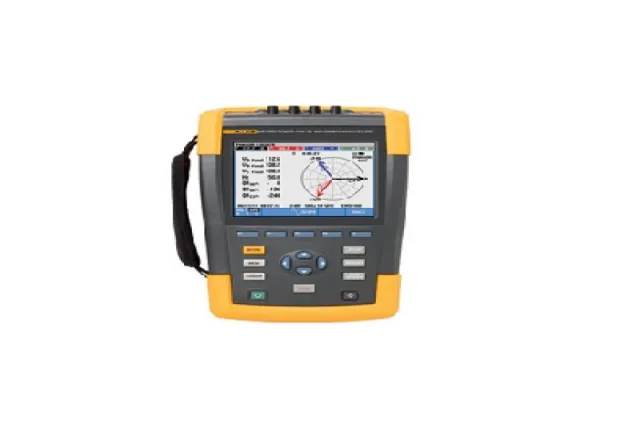
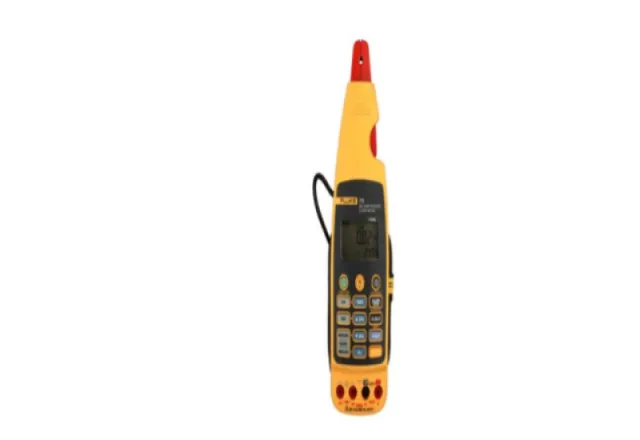
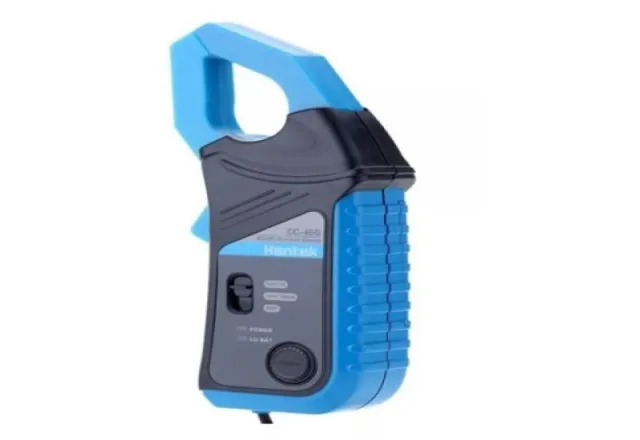
At CreativeIT Group in Monterrey we offer Rogowski probe rental, rental of the Fluke 773 milliamp clamp meter, sales of the Hantek CC-650 AC/DC clamp meter and power quality analyzer rental. Contact us at (81) 4777 6921 or info@creativeit.mx and tell us what current you need to measure.