Winding resistance testing is one of the simplest measurements you can perform on a transformer, and also one of the most revealing. With a DC current and a four-wire instrument you can detect loose connections, damaged tap changer contacts, broken strands in parallel conductors and shorted turns. The catch is that a reading taken badly, without temperature correction or before it has stabilized, can lead to the wrong conclusion. This guide explains how the test is done, what precautions it requires and how to interpret the results.
What the test detects
The resistance of a winding depends on the conductor material, its cross-section, its length and its temperature. If everything is in good condition, the three phases should read very close to each other and be consistent with the factory test report. An abnormal difference usually points to one of these problems:
- Loose or high-resistance connections at bushings, terminals or internal joints.
- Worn, coked or misaligned contacts in the tap changer, whether de-energized (DETC) or on-load (OLTC).
- Broken strands in windings made of several conductors in parallel.
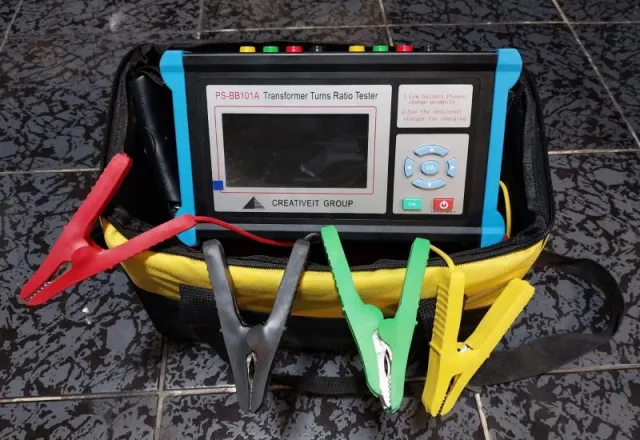
- Shorted turns, which are normally confirmed with other tests such as the turns ratio (TTR) test and excitation current.
That is why it is used for acceptance of new units, in periodic maintenance, after transport or a fault, and whenever dissolved gas analysis or thermography point to an internal hot spot.
How it is performed
Four-wire measurement
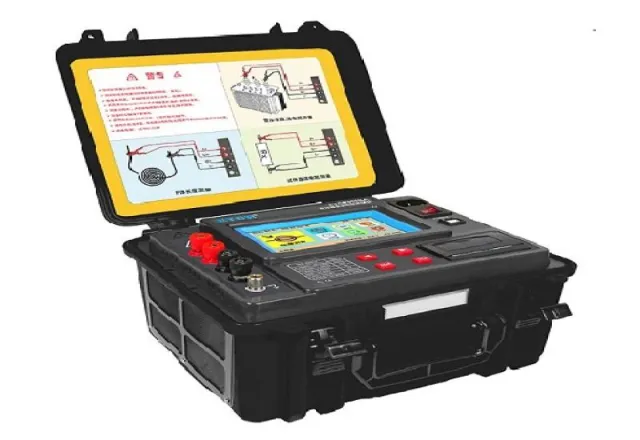
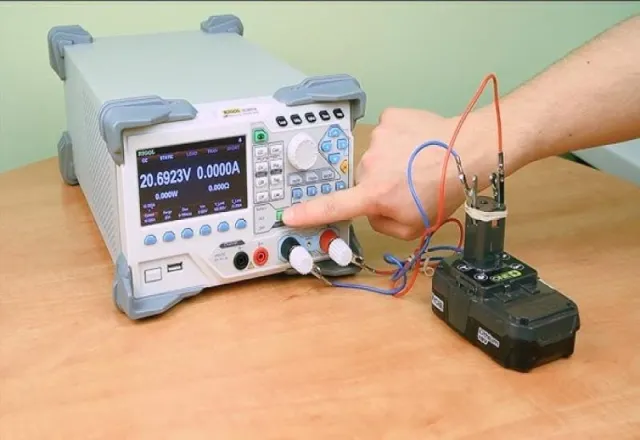
Values for a large power winding can be in the milliohm or even microohm range, so the Kelvin method is used: one pair of leads injects the current and another pair, connected as close to the bushing as possible, measures the voltage drop. This removes the resistance of the leads and clamps. Dedicated instruments, known as winding resistance meters or low-resistance ohmmeters, combine a stable DC current source with the voltage measurement.
Saturate the core and wait for stabilization
A winding is a large inductance. When current is applied it takes time to reach its final value, and the reading is not valid until the core saturates and the current stops changing. In large transformers this can take anywhere from seconds to several minutes. Modern instruments show when the reading is stable; do not record the value too early. The test current must be enough to saturate the core without heating the winding: a common recommendation is not to exceed about 10% of the winding’s rated current. Check the applicable guide and your instrument’s manual.
Connection by winding type
| Connection | What is measured | Note |
|---|---|---|
| Wye with accessible neutral | Each phase to neutral | Gives the resistance of each phase directly |
| Wye without neutral | Line to line | Each reading includes two phases in series |
| Delta | Line to line | One phase is measured in parallel with the other two in series; in a balanced delta, phase resistance is 1.5 times the measured value |
Most importantly, always measure the same way, on the same terminals, so results can be compared with previous tests.
Every tap position
Measure at every position of the tap changer. A deteriorated contact usually shows up as a jump at a single position. On on-load tap changers, dynamic measurement also records the current during the tap change and reveals interruptions or abnormal transition times.
Temperature correction
The resistance of copper and aluminum increases with temperature, so one reading can only be compared with another if both refer to the same temperature. The usual correction, used in IEEE C57.12.90, is:
Rs = Rm × (Ts + Tk) / (Tm + Tk)
Where Rm is the resistance measured at temperature Tm, Rs is the resistance at the reference temperature Ts (for example, the one in the factory report), and Tk is 234.5 for copper and 225 for aluminum. In oil-filled transformers, winding temperature is estimated from the liquid temperature after the unit has been de-energized for several hours and the temperature has stabilized. Recording the temperature incorrectly is one of the most common causes of misdiagnosis.
How to interpret the results
- Phase-to-phase comparison. The three phases of the same winding and tap should give very close values. Many criteria used in practice treat a difference of a few percent as suspicious, but the exact limit depends on the guide you apply and the transformer design.
- Comparison with factory data. Correct to the same temperature and compare with the manufacturer’s test report.
- Trend. A gradual increase in one phase, test after test, is usually more significant than a single value.
- Pattern across taps. Values should change smoothly from one position to the next. A jump at one position points to the tap changer; a jump at every position of one phase points to a connection or the winding itself.
When a result is abnormal, it is worth adding ductor contact resistance tests, power factor and oil analysis before deciding on an intervention.
Safety and precautions
- De-energize and ground. Follow your lockout/tagout procedure and the requirements of NOM-029-STPS and NFPA 70E.
- Stored energy. When the current is interrupted, the winding produces an inductive voltage that can be dangerous. Never disconnect the leads during the test; wait for the instrument to discharge the winding and confirm it.
- Demagnetize afterwards. DC current leaves remanent magnetism in the core, which can increase inrush current and distort tests such as excitation current or frequency response analysis. That is why this test is usually done last and followed by demagnetization.
- Short the other winding only if your procedure or instrument calls for it to speed up stabilization; follow the instrument manufacturer’s instructions.
How CreativeIT can help
At CreativeIT Group in Monterrey, we perform transformer testing, including winding resistance with temperature correction and a results report. If you prefer to run the test with your own staff, we also offer winding resistance test equipment rental. Contact us at (81) 4777 6921 or info@creativeit.mx to plan your next test.