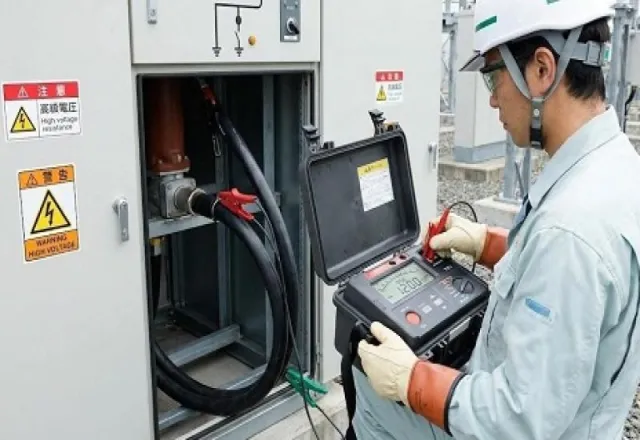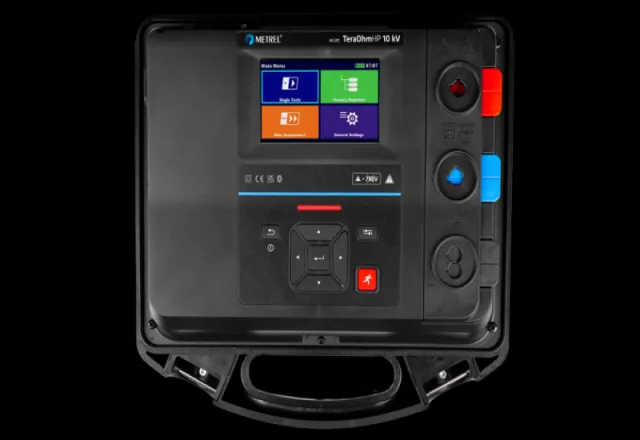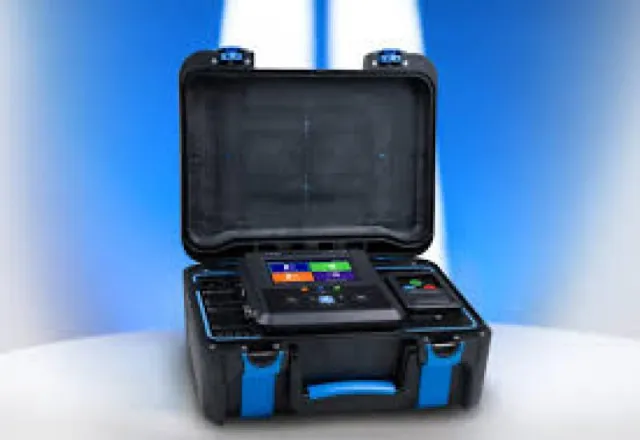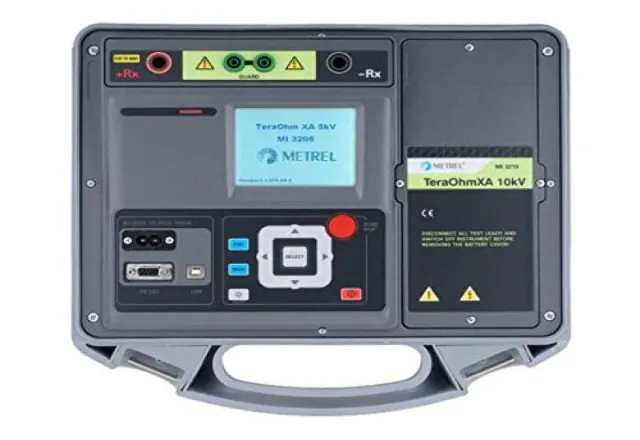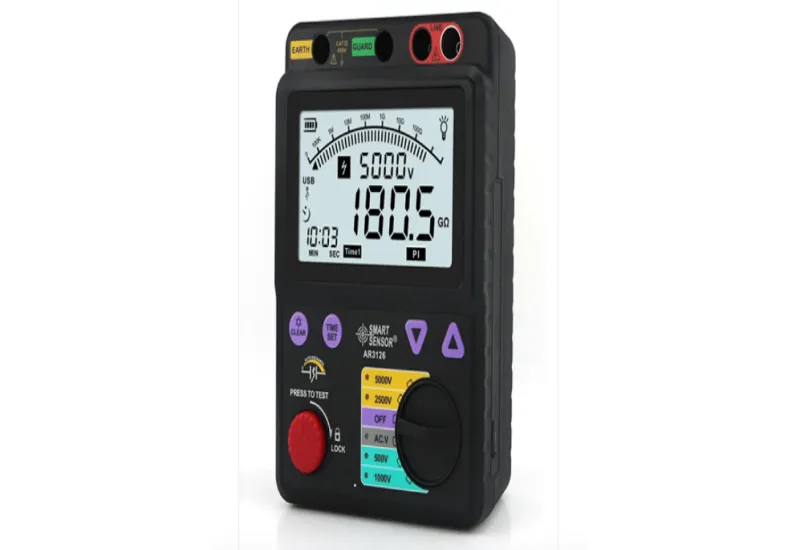
The insulation resistance tester, known as a megohmmeter or “megger”, is one of the basic instruments of electrical maintenance. It is used to assess the insulation of motors, cables, transformers, switchgear and generators, and to detect moisture, contamination and deterioration before they turn into a failure. But not every megohmmeter does the same job: a 1 kV unit that works well on low-voltage panels may fall short on a medium-voltage motor or a long cable. This guide explains which specifications to check to choose the right one.
Test voltage: the first criterion
The test voltage is chosen according to the rated voltage of the equipment under test. Low-voltage megohmmeters typically offer 50, 100, 250, 500 and 1,000 V DC. Medium-voltage units reach 2.5, 5, 10 or 15 kV.
For rotating machines, IEEE 43 gives guidance on DC test voltages according to the rated winding voltage:
| Rated winding voltage | DC test voltage |
|---|---|
| Below 1,000 V | 500 V |
| 1,000 to 2,500 V | 500 to 1,000 V |
| 2,501 to 5,000 V | 1,000 to 2,500 V |
| 5,001 to 12,000 V | 2,500 to 5,000 V |
| Above 12,000 V | 5,000 to 10,000 V |
For cables, transformers and switchgear there are equivalent tables in acceptance and maintenance testing specifications such as ANSI/NETA, and in the equipment manufacturer’s recommendations. If your plant has 4,160 V motors, 13.8 kV cables or medium-voltage transformers, you will need a 5 kV or 10 kV unit. If you only work on installations of 480 V or less, a 1 kV instrument is usually enough.
Be careful with electronic equipment: drives, control boards, surge suppressors and some sensors can be damaged by the test voltage. Disconnect them before testing.
Measurement range
The maximum resistance range is expressed in gigohms (GΩ) or teraohms (TΩ). Low-voltage testers usually measure up to a few GΩ or tens of GΩ; 5 kV and 10 kV units usually reach several TΩ. Healthy insulation on medium-voltage cables and transformers can give very high values, and a tester that saturates does not let you see the trend or calculate the polarization index properly. Also check the accuracy specified for each range: it usually gets worse at the ends of the range.
Short-circuit current and charging capability
A long cable or a large motor has considerable capacitance. Before measuring insulation resistance, the instrument has to charge that capacitance. A tester with a higher short-circuit current (on the order of a few mA in medium-voltage units) charges the test object faster and gives stable readings sooner. With a low-current tester, a test on a cable several hundred meters long can take a long time or fail to stabilize within the one-minute test.
Guard terminal
Medium-voltage megohmmeters usually have three terminals: positive, negative and guard. The guard terminal diverts surface leakage currents so they are not added to the measurement. It is essential when testing dirty bushings, cables with exposed terminations, or whenever you want to separate bulk insulation resistance from surface resistance. If your work includes medium-voltage transformers or cables, a guard terminal is a must.
Diagnostic tests
Beyond a spot reading, more complete testers run tests that give more information about the insulation:
- Polarization index (PI): the ratio of the 10-minute reading to the 1-minute reading. It is widely used on motors and generators and is described in IEEE 43.
- Dielectric absorption ratio (DAR): the ratio of readings at short times, commonly 60 and 30 seconds. It is quicker than PI, though less conclusive.
- Step voltage test (SV): measures at several voltage levels. A marked drop in resistance as voltage increases can indicate cracks, contamination or weak insulation.
- Dielectric discharge (DD): analyzes the discharge current after the test and helps detect damaged layers in multilayer insulation.
- Ramp test: raises the voltage gradually; some manufacturers recommend it for rotating machines.
If your maintenance program is predictive, it is worth having a tester that calculates these ratios automatically and stores the results.
Instrument safety
- Measurement category: check the IEC 61010 category (CAT III or CAT IV) for the location where you will connect the instrument.
- Live circuit detection: the instrument should warn you if voltage is present on the circuit and, preferably, block the test.
- Automatic discharge: at the end of the test, the tester should discharge the test object and display the residual voltage. On long cables and large windings, the stored charge is dangerous.
- Standards compliance: for low-voltage installations, IEC 61557-2 defines the requirements for insulation resistance testers.
Remember that the test is done with the equipment de-energized, after verifying the absence of voltage and following the lockout/tagout procedure required by NOM-029-STPS.
Practical features
- Memory and software: let you store results by asset and compare them with earlier tests. The trend over time says more than a single reading.
- Temperature correction: insulation resistance changes a great deal with temperature. IEEE 43 recommends correcting values to a reference temperature of 40 °C so tests can be compared. Always record the winding temperature and ambient humidity.
- Power: a rechargeable battery with good capacity for long tests such as PI or step voltage, and the option to run on mains power.
- Ruggedness: dust and water ingress protection, and test leads rated for the voltage.
Quick comparison by application
| Application | What to prioritize |
|---|---|
| Low-voltage panels, wiring and motors | 1 kV unit, several test voltages, CAT III or CAT IV |
| Medium-voltage motors and cables | 5 kV or 10 kV, high charging current, guard terminal, PI and DAR |
| Transformers and generators | TΩ range, guard, step voltage and DD tests, trending software |
| Occasional use or a one-off project | Consider renting a suitable unit |
Buy, rent or hire the service?
If you test frequently, owning a tester is a good investment. If you need a 10 kV unit for a plant shutdown or a commissioning job, renting may be more practical. And if you need a formal report with interpretation, hiring the service gives you access to both equipment and experience. In every case, the instrument must have a current calibration with traceability.
How we can help
At CreativeIT Group we offer Metrel insulation testers for sale and rental of 10 kV insulation resistance testers. If you prefer to outsource the test, we provide insulation resistance testing of cables and windings. Contact us for a recommendation based on your equipment.