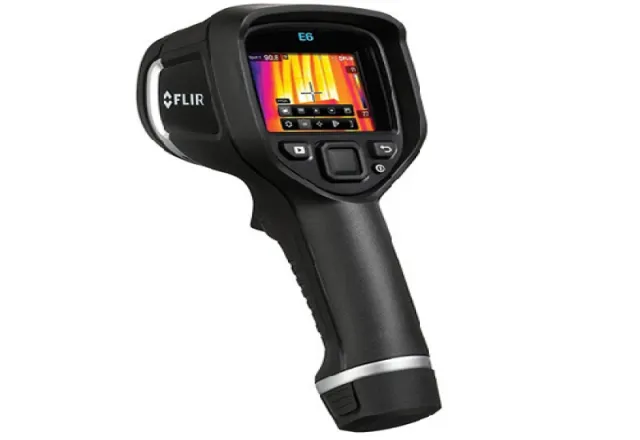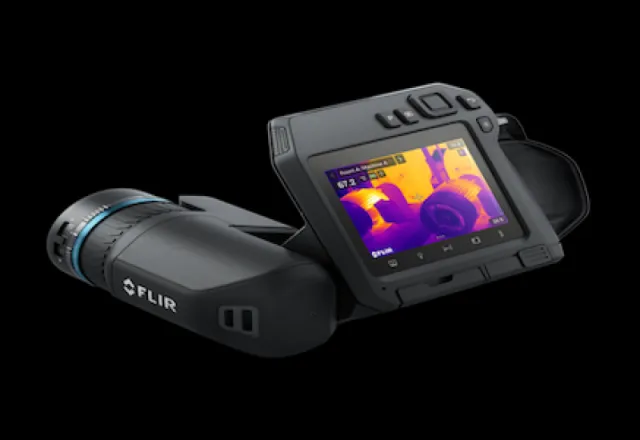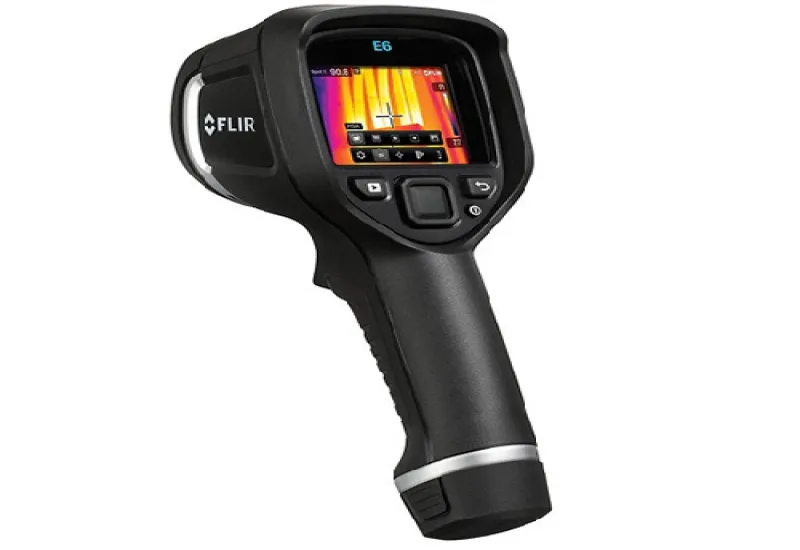
A thermal imaging camera is one of the most useful tools in electrical maintenance: it finds loose connections, overloaded phases and damaged components without touching the equipment or stopping production. But the choice is huge, from models that plug into a phone to professional cameras with interchangeable lenses, and the datasheets are full of acronyms. Buying the wrong camera means missing the fault that matters or paying for features that will never be used. This guide explains which specifications really count for electrical inspections and how to compare them.
Detector resolution: the most important specification
The detector is an array of microbolometers; each element is a pixel that measures temperature. Common resolutions are 160 × 120, 320 × 240 and 640 × 480 pixels. Higher resolution means more measurement points in the same scene, so you can measure smaller objects or measure from farther away.
Always check the detector’s native resolution. Some manufacturers advertise higher resolutions obtained through image processing (super-resolution or interpolation). Those images look sharper, but they don’t add real temperature information in the same proportion. The same goes for digital zoom: it enlarges pixels, it doesn’t create new ones.
IFOV: how small a target you can measure
The instantaneous field of view (IFOV), expressed in milliradians (mrad), tells you the size of the area a single pixel covers at a given distance. It is approximately: pixel size on the target (mm) = IFOV (mrad) × distance (m).
Example: with an IFOV of 1.4 mrad at 3 m, each pixel covers about 4.2 mm. For a reliable temperature reading, the target must cover several pixels, not just one; a common rule of thumb is at least 3 × 3 pixels, although some manufacturers state a different value (sometimes called measurement IFOV). In that example, the target should be about 13 mm or larger.
This matters a lot in electrical work: a circuit breaker terminal or a busbar connection can be small, and in substations or on overhead lines the safe approach distance forces you to measure from far away. A low-resolution camera, or one with a wide-angle lens, can average the hot connection with its cooler surroundings and report a lower temperature than the real one.
Lenses and field of view
The field of view (FOV) describes how much the image covers. A standard lens of around 25° works well for panels at short range. A telephoto lens narrows the field of view and improves IFOV, useful for substations, yard-mounted transformers or equipment behind a barrier. A wide-angle lens helps in tight spaces in front of large switchboards. If your inspections cover equipment at very different distances, consider a model with interchangeable lenses.
Focus also affects measurement: an out-of-focus image underestimates the temperature of small hot spots. Fixed-focus cameras are convenient, but they may not focus well at short range; manual or automatic focus gives better results in professional work.
Thermal sensitivity (NETD)
NETD indicates the smallest temperature difference the camera can distinguish from noise, in millikelvin (mK). Lower is better; specifications of 50 mK or less are common in maintenance cameras. Good sensitivity produces cleaner images and makes it easier to detect subtle differences, for example in lightly loaded connections. For electrical inspections NETD is important, but it usually weighs less than resolution and IFOV.
Accuracy and temperature range
Industrial cameras typically specify accuracy on the order of ±2 °C or ±2% of reading, whichever is greater, under laboratory conditions. In the field, real accuracy depends more on technique than on the camera:
- Emissivity: shiny metal surfaces such as polished copper or aluminum have low emissivity and reflect the heat around them. Their readings can be badly wrong. Whenever possible, measure on high-emissivity surfaces (insulation, paint, tape of known emissivity).
- Reflected temperature: it has to be set in the camera, especially when measuring surfaces of medium or low emissivity.
- Distance and angle: measure as perpendicular to the surface as you can and within the camera’s IFOV capability.
As for range, a range up to around 120 °C to 150 °C is usually enough for panels and motors, but it helps if the camera has a high range reaching several hundred degrees so the image doesn’t saturate during a severe fault.
Remember that long-wave cameras, which most maintenance cameras are, work roughly between 7.5 µm and 14 µm and cannot see through ordinary glass or acrylic. To inspect enclosed equipment without opening doors, purpose-designed infrared windows are used.
Features that help day to day
- Visible image and fusion: a built-in visual camera makes it easier to identify in the report which equipment and which phase had the hot spot.
- Radiometric images: they store the temperature data of every pixel, so emissivity, palette and measurement points can be adjusted on the computer after the inspection.
- Reporting software: it produces reports with the thermal image, visual image, temperatures and comments, and lets you compare inspections from different years.
- Voice or text annotations and connectivity: they speed up documentation on routes with many assets.
- Ergonomics and battery: a display readable in daylight, weight, swappable batteries and drop resistance count for a lot on long rounds.
Quick comparison by application
| Application | What to prioritize |
|---|---|
| Quick checks on low-voltage panels | Entry or mid-level resolution, suitable short-range focus, ease of use |
| Predictive maintenance program with reports | Mid or high resolution, radiometric images, reporting and trending software |
| Substations, yards and overhead lines | High resolution, telephoto lens, good IFOV and wide temperature range |
| Electronics and circuit boards | Macro or close-up lens, good NETD, precise focus |
Don’t forget standards and training
NFPA 70B, which since its 2023 edition has been a standard rather than only a recommended practice, includes infrared thermography in electrical equipment maintenance. The camera is only one part: correct interpretation depends on the circuit load at the time of inspection, emissivity, phase-to-phase comparison and the thermographer’s experience. Consider certified training for the staff who will carry out inspections, and remember that opening energized panels requires the protective equipment and procedures of NOM-029-STPS and NFPA 70E.
Don’t forget periodic verification of the camera either. Like any measuring instrument, its accuracy can drift over time, and a quality program normally requires traceable calibration.
Buy a camera or hire the service?
If your plant has many assets and trained staff, owning a camera allows frequent inspections. If inspections are occasional, or you need formal reports for an insurer or an audit, hiring the service can be more practical, with the advantage of higher-resolution equipment and an experienced thermographer.
How we can help
At CreativeIT Group we offer professional thermal imaging cameras for sale and help you choose the right model for your facilities. If you’d rather hire the service, we carry out thermographic inspections of electrical panels with a documented report. See our equipment sales too, and contact us for a recommendation for your application.