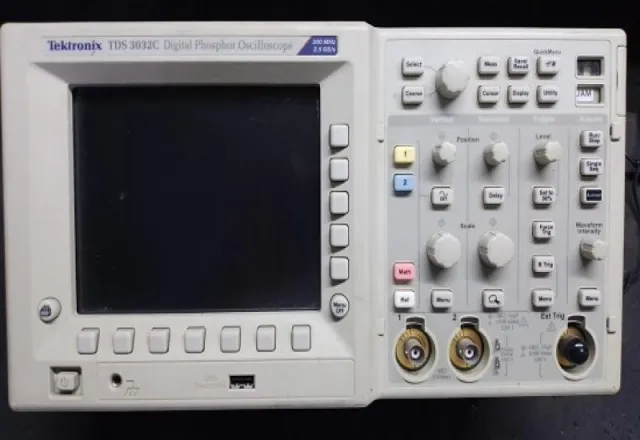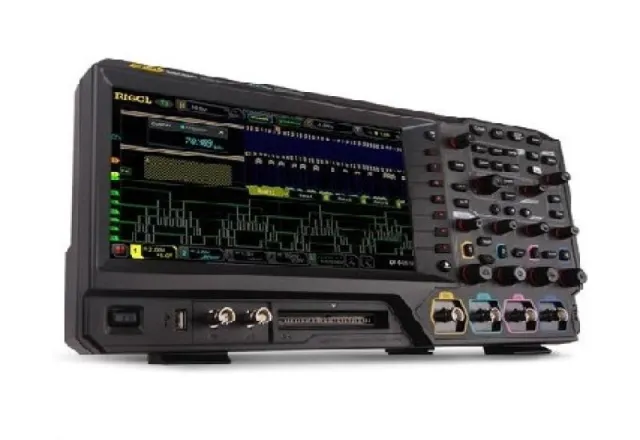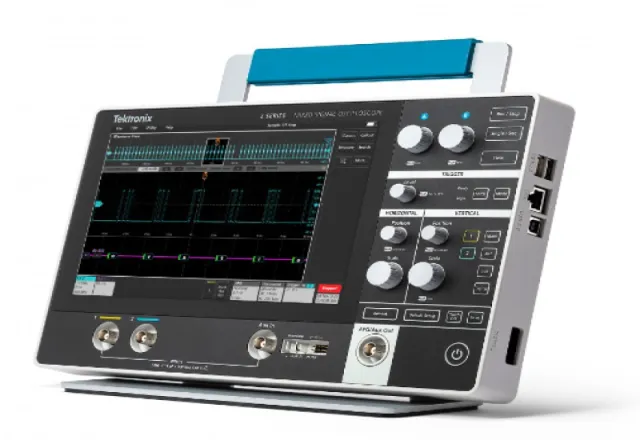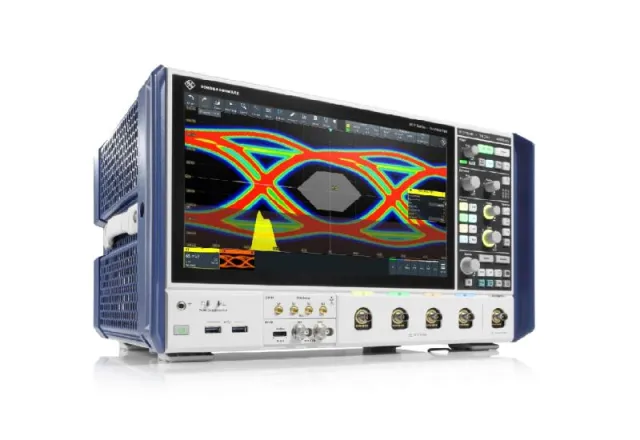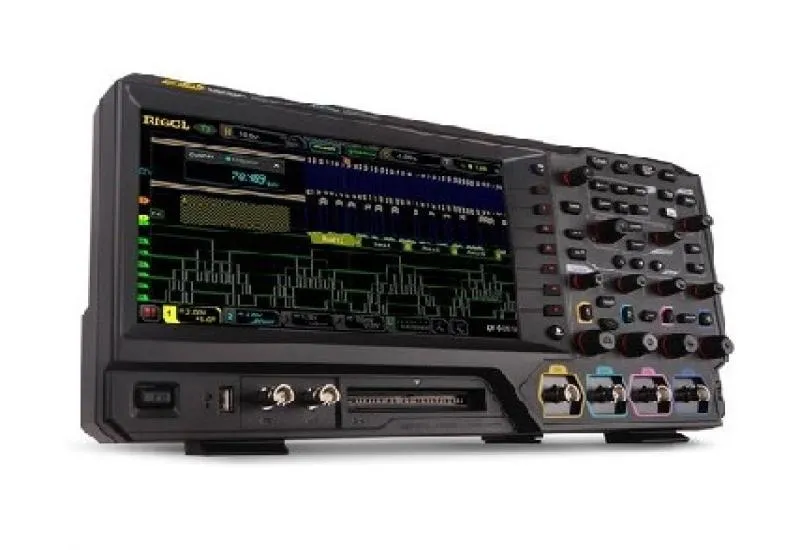
The oscilloscope is the most used instrument on the bench, and also the one most often chosen badly. It is common to find a plant with a scope that has far more bandwidth than needed but no isolated channels to measure a drive, or a budget unit that does not show the noise spike behind an intermittent CNC board fault. Datasheets are full of numbers, and not all of them carry the same weight. This guide explains what each specification means, how to work out what you actually need and which mistakes to avoid before buying or renting an oscilloscope.
Start with the signal, not the catalog
Before looking at models, describe what you will measure: low-frequency control signals, communication buses (I²C, SPI, CAN, RS-485), IGBT switching in a drive, noise on a switch-mode supply or RF signals? Write down the highest frequency or fastest rise time, the amplitude, whether the signal is ground-referenced or floating, how many signals you need to see at once and how long you must capture. With that list, the specifications stop being abstract.
Bandwidth
Bandwidth is the frequency at which a sine wave is displayed attenuated by 3 dB, that is, at about 70.7% of its true amplitude. That is why a 100 MHz oscilloscope does not measure a 100 MHz sine wave well: it already shows it with an error of almost 30%. A widely used rule of thumb is to choose a bandwidth of at least 3 to 5 times the highest frequency of interest.
For digital signals, rise time matters more than clock frequency, because edges contain much higher harmonics. For an oscilloscope with a Gaussian-type response, its own rise time is approximately 0.35 divided by the bandwidth (on many modern scopes with a flatter response the factor is between 0.4 and 0.45). If you want to measure a 5 ns edge with little error, the oscilloscope’s rise time must be several times shorter.
Remember that system bandwidth includes the probe: a 500 MHz oscilloscope with a 100 MHz probe is, in practice, a system of less than 100 MHz.
Sample rate
It is expressed in samples per second (S/s or GS/s). According to the Nyquist theorem it must be more than twice the highest component of the signal, but on a real oscilloscope considerably more is recommended: manufacturers typically use sample rates of 2.5 to 5 times the bandwidth, supported by sin(x)/x interpolation. Check one important detail: the maximum sample rate is often shared between channels. A “5 GS/s” instrument may only reach that figure with one or two channels active.
Memory depth
Memory determines how many samples each acquisition stores. The relationship is simple:
Captured time = memory points ÷ sample rate
With 10 million points at 1 GS/s you capture 10 ms. If you need to see a complete motor start or a long communication sequence without losing detail, memory is as important as bandwidth. With little memory, the oscilloscope automatically lowers the sample rate at slow time bases, and it may miss narrow pulses or show false waveforms due to aliasing.
Vertical resolution: 8, 10 or 12 bits
For years, oscilloscopes used 8-bit converters, meaning 256 levels across the full screen. Today many models offer 10 or 12 bits, with 1,024 or 4,096 levels. More resolution lets you see small noise on a large signal, such as power supply ripple or the voltage drop across a conducting MOSFET. However, converter bits are not everything: the instrument’s own noise defines the effective resolution (ENOB). Compare both figures.
Channels, isolation and safety
On most bench oscilloscopes, the reference of every channel is tied to the instrument’s ground. Connecting the probe’s ground clip to a point that is not at ground, such as a drive’s DC bus, creates a short circuit through the probe, with risk to the person and the equipment. There are three safe ways to measure power electronics:
- High-voltage differential probes, which measure the difference between two floating points.
- Oscilloscopes with isolated channels, common in portable field models.
- Two-channel differential measurement (channel A minus channel B), useful only for low-voltage signals and limited in common-mode rejection.
Never “float” an oscilloscope by disconnecting its protective ground: it is a dangerous practice. Also check the measurement category (CAT II, CAT III) of the instrument and probes if you will work in electrical panels.
Triggering, update rate and analysis
- Trigger modes: beyond edge triggering, pulse width, runt, setup-and-hold or pattern triggers are key to catching intermittent faults.
- Waveform update rate: the more waveforms per second the instrument processes, the higher the chance of seeing a rare event.
- Serial bus decoding: saves hours when diagnosing communication on boards and PLCs.
- FFT, math and power functions: useful for harmonics, ripple and switching losses.
- Digital channels (MSO): add 8 or 16 logic inputs to view analog and digital signals together.
Quick guide by application
| Application | What to prioritize |
|---|---|
| Plant and field maintenance | Portable unit, isolated channels, suitable measurement category, battery |
| Drives and power electronics | Differential probes or isolated channels, deep memory, power functions |
| Board and CNC repair | 4 channels, advanced triggers, bus decoding, digital channels |
| Switch-mode supplies and ripple | 10- or 12-bit resolution, low self-noise, bandwidth limit |
| High-speed digital design and signal integrity | High bandwidth, short rise time, active probes |
Common selection mistakes
- Buying on bandwidth and forgetting memory or channel count.
- Using the wrong probe, uncompensated or with a long ground lead that adds ringing.
- Ignoring that the sample rate is divided when more channels are enabled.
- Not considering isolation when power electronics will be measured.
- Forgetting calibration: if the oscilloscope is used in a quality process, its time base and vertical gain must be calibrated with traceability.
Rent, buy or repair
If the oscilloscope is part of your daily work, buying is the usual choice. For a one-off project, a validation or a need for more bandwidth than your current instrument offers, renting avoids an investment that will see little use. And if your oscilloscope shows faults, such as noisy channels, a damaged display or self-test errors, a technical evaluation can tell you whether repair makes sense.
How CreativeIT can help
At CreativeIT Group we offer general-purpose oscilloscopes, signal integrity oscilloscopes and Tektronix digital phosphor oscilloscope rental, as well as our full line of oscilloscopes and accessories. We help you choose the right instrument for your application. Contact us at (81) 4777 6921 or info@creativeit.mx.