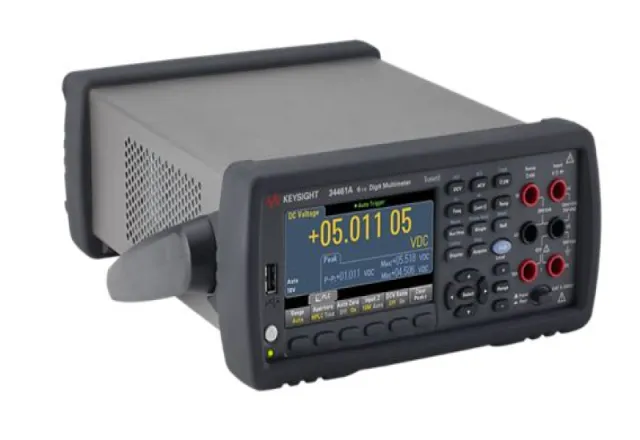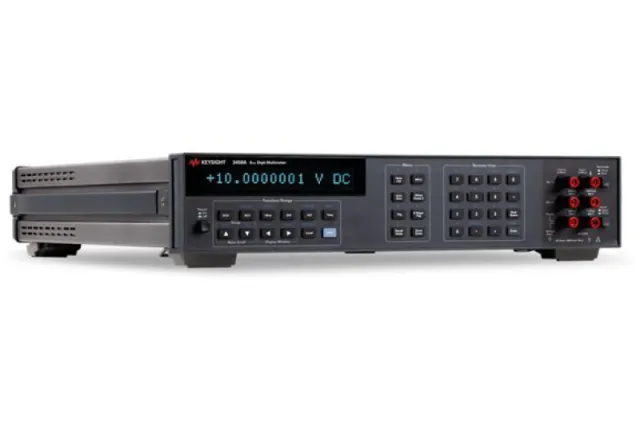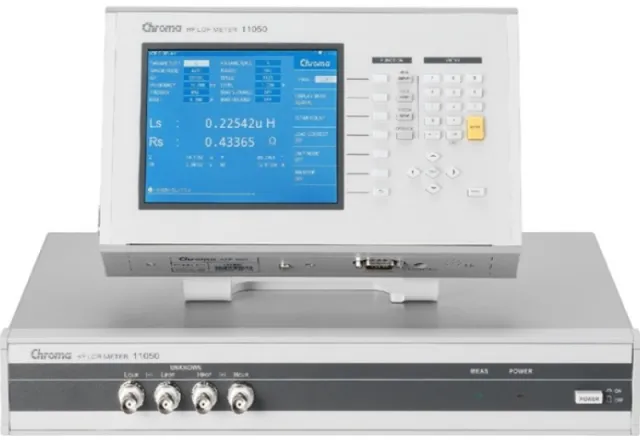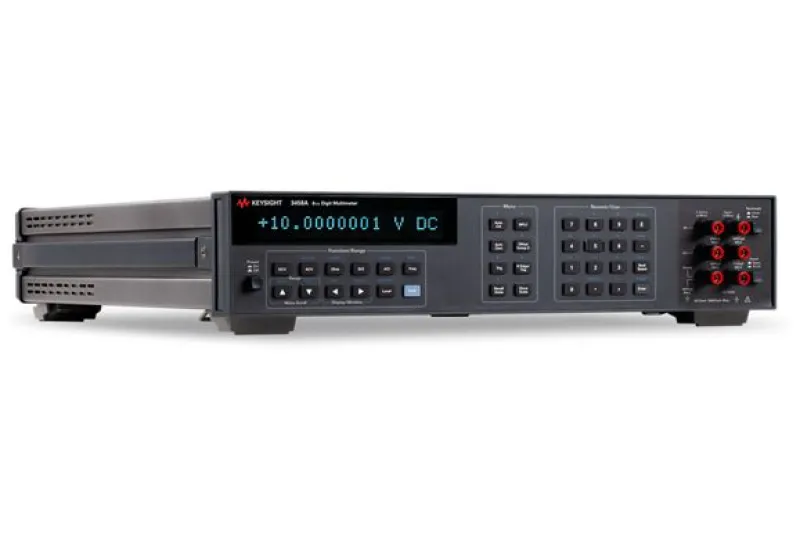
A 6½-digit bench multimeter can show a value such as 5.000123 V, and it is tempting to believe all those digits are correct. They aren’t necessarily. Resolution tells you the smallest change the instrument can display; accuracy tells you how close that reading is to the true value. Confusing the two leads to buying an instrument that doesn’t meet the required tolerance, or paying for one you didn’t need. This guide explains how to read bench multimeter specifications, how to calculate the real error of a measurement and how to decide whether to buy or rent.
What “6½ digits” means
The figure describes display resolution: six full digits, 0 through 9, plus a leading digit that only reaches a limited value. That’s why it is called a half digit, although the actual maximum count varies between models and is worth checking on the data sheet. As a general guide:
| Class | Typical use |
|---|---|
| 3½ to 4½ digits | Field work, maintenance and general troubleshooting |
| 5½ digits | Repair benches and production testing |
| 6½ digits | Laboratory work, design validation, automated testing |
| 7½ and 8½ digits | Metrology and calibration of other instruments |
More digits let you see small changes, such as slow drift in a voltage reference. That is useful even when absolute accuracy is poorer than the resolution: when comparing two readings taken a short time apart, stability matters more than the absolute value.
How to read accuracy on the data sheet
Bench multimeter accuracy is usually expressed as ±(% of reading + % of range). Handheld multimeters usually express it as ±(% of reading + counts). The second term is fixed, so it weighs more heavily when the measurement uses only a small part of the range.
Here is an example with hypothetical values. You measure 5 V on the 10 V range, with a one-year specification of ±(0.0035% of reading + 0.0005% of range):
- Reading term: 0.0035% of 5 V = 175 µV.
- Range term: 0.0005% of 10 V = 50 µV.
- Maximum specified error: ±225 µV, so a true 5 V input could read anywhere from 4.999775 V to 5.000225 V.
A handheld multimeter rated ±(0.05% + 3 counts), with 0.1 mV resolution on that range, would give 2.5 mV + 0.3 mV = ±2.8 mV for the same measurement, about twelve times more. This also shows the limit of resolution: in the bench example the display resolves microvolts, but the specified error is hundreds of microvolts.
Conditions that change the specification
- Time since calibration: many manufacturers publish values for 24 hours, 90 days and one year. Use the one that matches your actual calibration interval, not the most favorable one.
- Temperature: the specification usually holds within a window around the calibration temperature. Outside it a temperature coefficient is added, which matters in workshops without air conditioning.
- Warm-up: specifications normally require a warm-up period, stated by the manufacturer.
- Integration time: some specifications are only met at a certain NPLC setting, explained below.
- Function and frequency: AC accuracy is considerably worse than DC, and it degrades at high frequencies or with signals that are very small relative to the range.
Measurement errors the data sheet doesn’t solve
Loading
Typical DC input impedance is 10 MΩ. Measuring a circuit with 100 kΩ of source resistance produces an error close to 1%, far larger than any instrument specification. Many models offer a very high impedance input on the low ranges, which is useful in these cases.
Line noise and NPLC
NPLC is integration time measured in power line cycles. In Mexico, at 60 Hz, 1 PLC equals 16.67 ms. Integrating over a whole number of cycles rejects much of the 60 Hz noise. High values give steadier but slower readings, and low values allow more readings per second with more noise. If the instrument was imported, also check that it is set for 60 Hz.
Low resistance and thermoelectric voltages
For low resistances, use four-wire measurement, which eliminates lead resistance. At microvolt levels, junctions of dissimilar metals at different temperatures generate small thermoelectric voltages. Use suitable leads and connections, let the setup stabilize and, if the instrument allows it, turn on offset compensation.
Current and burden voltage
When measuring current, the multimeter goes in series and its internal resistance produces a voltage drop. In low-voltage circuits, that drop can change how the device under test behaves.
True RMS
For distorted signals, such as the output of a drive or a switch-mode supply, you need a true RMS instrument. Also check its crest factor and bandwidth, because both limit accuracy on non-sinusoidal waveforms.
How to tell if the instrument is good enough
Start with the tolerance of what you need to measure, not the number of digits. A widespread metrology practice is to aim for a 4:1 ratio between the product tolerance and the measurement uncertainty. If you need to verify a supply with a ±1 mV tolerance, your total measurement error should be about ±250 µV or less. With that figure, work out the specification for your actual range, calibration interval and temperature. If your quality system has its own decision rules, for example under ISO/IEC 17025, those are the rules that apply.
Other buying criteria:
- Speed and connectivity: interfaces such as LAN, USB or GPIB and SCPI commands, if the instrument will be part of automated testing.
- Data logging and graphing: useful for spotting drift and intermittent faults.
- Scanner cards: for measuring many points with a single instrument.
- Calibration: include its cost and frequency in the budget.
A safety warning
A bench multimeter is designed for the laboratory. Its measurement category, defined in the IEC 61010 family of standards, is usually lower than that of an industrial handheld multimeter, and in many cases it is not suitable for a distribution panel. Always check the category and voltage marked on the instrument and its leads before connecting to an installation.
Frequently asked questions
Does a 6½-digit multimeter replace a calibrator?
No. A multimeter measures, and a calibrator generates known values. It can serve as a comparison reference if it is calibrated and its uncertainty is good enough for the tolerance being verified.
Should I buy or rent?
For a one-off validation, an audit or a project lasting a few weeks, renting avoids the investment and the upkeep of calibration. If use is continuous or part of a test line, buying usually makes more sense.
How CreativeIT can help
CreativeIT Group, in Monterrey, works with digital multimeters for laboratory and production use. We offer bench multimeters for sale and Keysight 6.5-digit multimeter rental for short-term projects; you can find more options in our multimeters section. We also repair test instruments. Contact us at +52 (81) 4777 6921 or info@creativeit.mx and tell us what you need to measure.