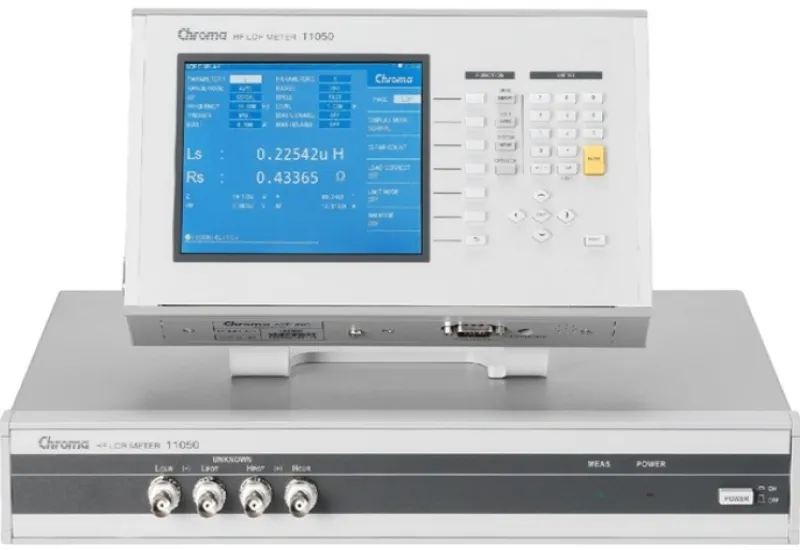
We have a wide range of LCR meters from 50 Hz to 3 GHz for checking all types of electronic components. We have a large number of accessories for LCR meters with 4 BNC inputs. Instruments with plotting capability for checking impedance, capacitance, inductance, resistance, phase, etc.
An LCR meter can be used to determine impedance, the complex resistance created by alternating currents. The LCR meter measures current, voltage and phase angle and calculates the corresponding LCR values, which can be represented in various ways (e.g., Z, R and X, in a series circuit diagram Ls and Rs or a parallel circuit diagram Lp and Rp, etc.). There are handheld LCR meters that are generally easy to use, benchtop versions and laboratory versions. LCR meters are available in various ranges, from 1 kHz to 100 MHz and higher.
In addition to the determined range, the frequency range must also be considered, and frequency significantly affects the price of the instrument. In general, you should measure samples at the frequencies at which they will operate. In addition, LCR meters often come with other useful features including compare and list sweep functions. In compare mode, you can enter threshold values and the test samples will be automatically graded as “PASS” or “FAIL.” The list sweep function allows a DUT to be tested automatically at different frequencies, similar to an impedance analyzer. An LCR meter is ideal for direct, accurate measurements of inductors, capacitors and resistors using different test frequencies. The test range can be selected manually or automatically. The LCR meter can be operated fully automatically, for example via RS-232, USB, LAN or Handler. Control software can be used to log the results.