Many problems that look like circuit faults, such as ringing, overshoot, noise or slow edges, are actually introduced by the oscilloscope probe. The probe is part of the measurement system: it has its own bandwidth, it loads the circuit electrically and it determines which voltages can be measured safely. Choosing the wrong probe, or using the wrong probe well, can cost hours of troubleshooting, a damaged instrument or an accident. This guide explains the types of probes, how to choose one for each measurement, and the most common mistakes on the plant floor and in the lab.
Why the probe matters as much as the oscilloscope
A high-bandwidth oscilloscope connected through an unsuitable probe measures like a much slower scope. Three effects explain most errors:
- System bandwidth: the scope plus probe together limit the frequency and rise time you can see.
- Circuit loading: the resistance and, above all, the capacitance of the probe tip draw current from the circuit and change the signal you are trying to measure.
- Ground connection: the probe’s ground lead forms an inductive loop that resonates with the input capacitance and produces ringing that does not exist in the circuit.
A widely used rule of thumb relates bandwidth (BW) to rise time: tr ≈ 0.35 / BW. A 100 MHz system, for example, has a rise time of about 3.5 ns and cannot faithfully show a faster edge. For accurate measurements, the system bandwidth should be several times (three to five times is often quoted) the highest frequency component of interest.
Probe types and what each one is for
10:1 passive probes
These ship with almost every oscilloscope. They offer high input resistance (typically 10 MΩ with the scope set to 1 MΩ), are rugged, inexpensive and need no power. Their weak point is tip capacitance, typically on the order of 10 pF depending on the model. That capacitance has a reactance of 1/(2πfC): at 100 MHz, 10 pF is about 160 Ω, a heavy load on a high-impedance circuit. They are ideal for general-purpose electronics, control signals and low- to mid-frequency measurements.
1:1 passive probes
Useful for very small signals because they do not attenuate, but their bandwidth is usually low (a few tens of MHz) and their input capacitance much higher. Use them only when the amplitude demands it.
Active (FET) probes
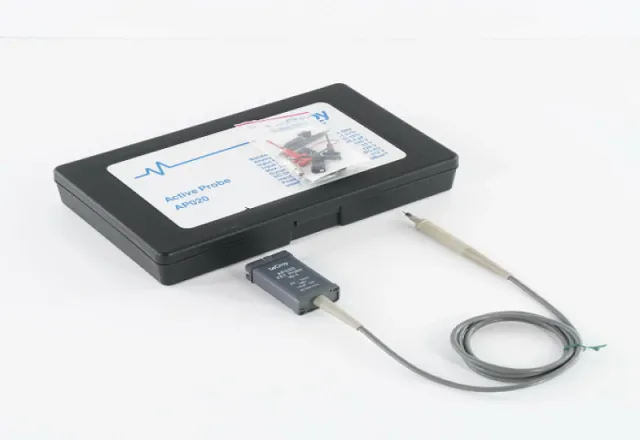
These include an amplifier at the tip and achieve very low input capacitance, often below 1 pF, with bandwidths of several GHz. They are the choice for fast digital buses, clocks and RF circuits. In exchange, their dynamic range and maximum voltage are limited, they need power from the scope and they are sensitive to electrostatic discharge: handle them with a wrist strap.
Differential probes
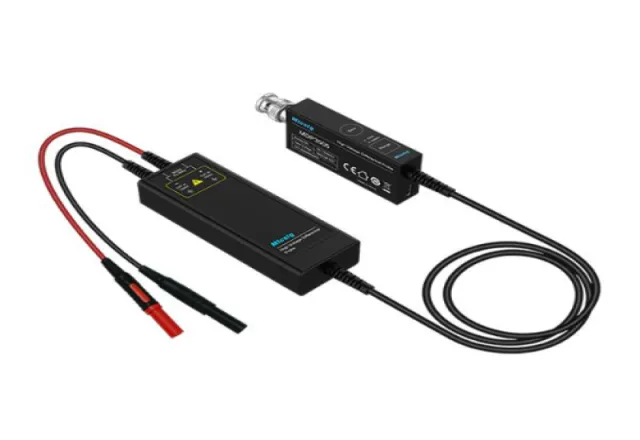
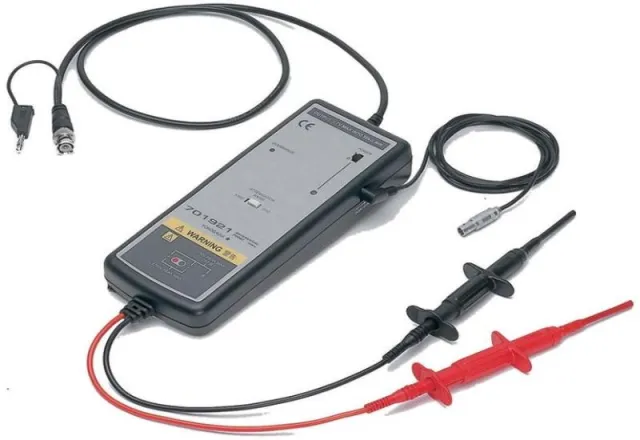
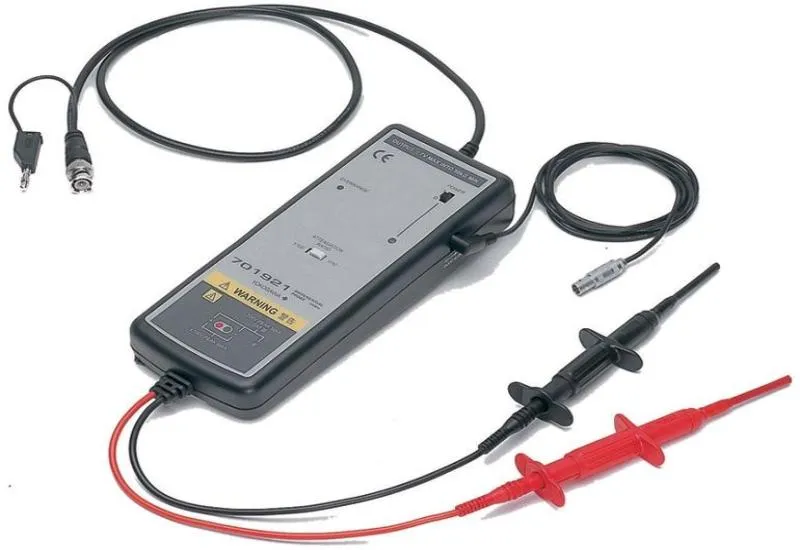
These measure the voltage difference between two points without referencing ground. They are essential in power electronics (drives, inverters, switch-mode supplies) and on differential buses such as CAN or USB. Their key parameter is common-mode rejection ratio (CMRR), which falls as frequency rises; for fast-switching converters, check the manufacturer’s CMRR curve rather than just the 60 Hz figure. There are low-voltage versions for signals and high-voltage versions for power measurements.
High-voltage probes
100:1 or 1000:1 passive probes allow ground-referenced measurements in the kilovolt range. They are not a substitute for a differential probe when neither point is at ground.
Current probes
Hall-effect probes measure AC and DC and must be degaussed and zeroed before measuring. Rogowski coils measure AC only, but they are flexible, lightweight and handle very high currents. In both cases, respect the maximum current, the bandwidth and the working voltage of the conductor.
Safety: measurement categories and the “floating scope” mistake
Probes are designed to IEC 61010-031, which sets their safety requirements and their rating by measurement category (CAT II, CAT III, CAT IV) and voltage. The safe capability of the setup is set by its lowest-rated element: scope, probe or accessory. A 300 V CAT II probe should not be used in a distribution panel, which normally falls under CAT III.
On a bench oscilloscope, the reference (the BNC shell and the probe’s ground clip) is bonded to protective earth. Clipping that ground to a point that is not at earth creates a short circuit through the instrument. The most serious mistake is “floating” the scope by defeating the power cord ground or using an adapter to do so: the chassis rises to circuit voltage and exposes the operator to shock. The right solution is a differential probe, a scope with isolated inputs or a handheld scope designed for it.
Good measurement practice
- Compensate passive probes every time you move them to a different channel, using the scope’s square-wave calibration output and adjusting until the corners are flat, with no overshoot or rounding.
- Shorten the ground: for fast signals, replace the long ground clip with a ground spring or a board-mounted tip adapter.
- Set the attenuation factor on the scope (many modern probes do this automatically); otherwise amplitude readings will be wrong.
- Use the correct input impedance: passive probes work into 1 MΩ; some active and low-impedance probes require 50 Ω.
- Deskew voltage and current probes when measuring power; a few nanoseconds of skew distorts the calculation on fast converters.
- Inspect the cable and tip: kinked or crushed cables, worn tips and loose BNC connectors cause intermittent readings.
How to choose: summary
| Measurement | Recommended probe |
|---|---|
| General electronics, control signals, low frequency | 10:1 passive |
| Millivolt-level, low-frequency signals | 1:1 passive |
| Fast digital buses, clocks, RF | Low-capacitance active |
| Drives, inverters, switch-mode supplies, MOSFET or IGBT gates | High-voltage differential |
| Differential buses (CAN, RS-485, USB) | Low-voltage differential |
| Current in motors, supplies and loads | Hall-effect or Rogowski current probe |
Frequently asked questions
Can I use another brand’s probe on my oscilloscope?
BNC passive probes are usually compatible if their compensation range matches the scope’s input capacitance. Active probes and those with a proprietary interface generally work only with the brand and family they were designed for.
Do probes need calibration?
Yes. Attenuation, bandwidth and, on active and current probes, gain and offset can drift with use. If your quality system requires traceability, include probes in the calibration program alongside the oscilloscope.
Should I buy or rent specialty probes?
For a one-off project, such as validating a drive or debugging a fast bus, renting a differential or active probe is usually more cost-effective than buying.
How CreativeIT can help
CreativeIT Group, a test and measurement laboratory in Monterrey serving all of Mexico, helps you choose the right probe for your measurement. We offer oscilloscope probes and oscilloscope probes for sale, as well as high-voltage differential probe rental and active probe rental for short-term projects. Contact us at +52 (81) 4777 6921 or info@creativeit.mx; our engineers reply the same day.