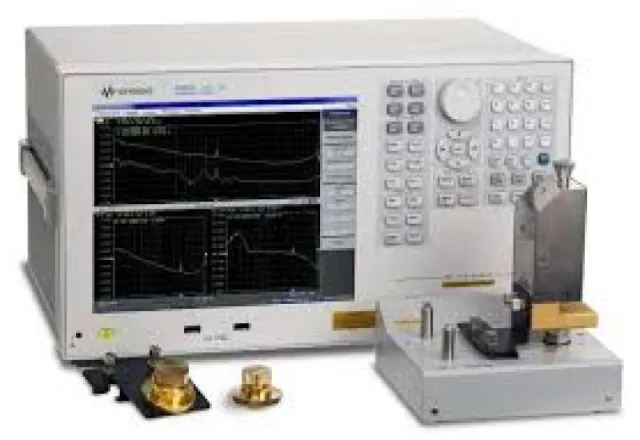
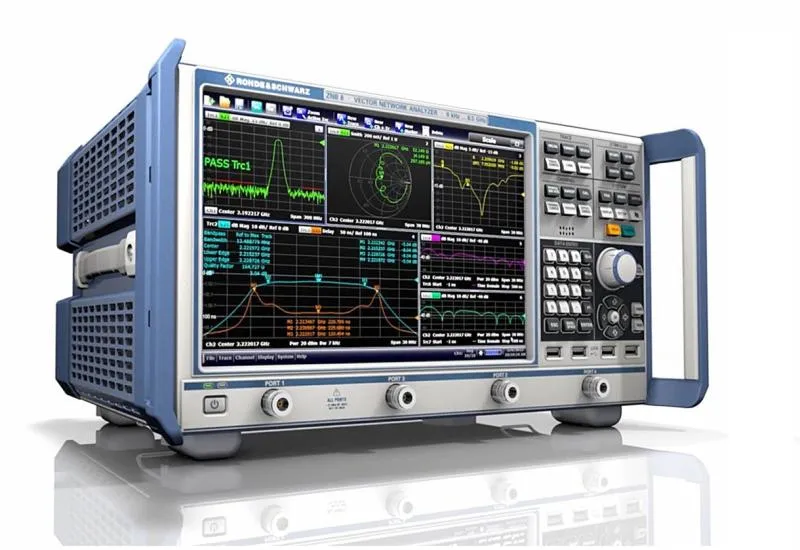
At Creativeit Group we offer an exclusive rental, sales and characterization service for radio frequency components. Our network analyzers (VNA) are versatile and flexible and adapt to your needs, letting you get the most suitable analyzer.
All of them are equipped with the most advanced technology. Take advantage of renting or buying a network analyzer (VNA).
A network analyzer, also known as a vector network analyzer (VNA), is a measuring instrument used in communications and in electrical and electronic engineering. Its main function is to measure and characterize the transmission and reflection properties of radio frequency (RF) and microwave circuits and devices.
The Vector Network Analyzer or VNA is used mainly to analyze components and systems at RF and microwave frequencies, such as filters, amplifiers, antennas, transmission lines, coaxial cables, diplexers, directional couplers, etc. It helps engineers understand how these elements behave in terms of signal amplitude and phase as a function of frequency.
Some of the most common features and capabilities of a network analyzer include:
1. S-parameter measurements: Network analyzers measure scattering parameters, or S-parameters (S11, S21, S12, S22), which describe the relationship between the input and output signals of a device or circuit, as well as signal reflections at the input and output ports.
2. Frequency range: VNAs are available in different models with different operating frequency ranges. Some can cover frequencies from MHz to GHz, while others can span even higher frequencies in the microwave range.
3. Magnitude and phase: Network analyzers provide information about the magnitude and phase of signals as a function of frequency. This is crucial for understanding how the device or circuit affects the signal passing through it or reflected from it.
4. Wideband and narrowband: Some VNAs are wideband, meaning they can sweep a wide frequency range at once, while others are narrowband and are used for more precise measurements at a specific frequency.
5. Calibration: Network analyzers must be calibrated before making accurate measurements. Calibration ensures that the instrument accounts for the effects of connections and test cables, providing more accurate measurements.
6. Additional functions Some VNA models may have additional functions, such as the ability to perform time domain reflectometry (TDR) measurements to detect and locate discontinuities in transmission lines and cables.
The network analyzer is an essential tool in the design, development and maintenance of RF and microwave systems. It allows engineers and technicians to evaluate the performance and quality of components and devices, which is fundamental in applications such as wireless communications, high-frequency electronics, microwave research and many other areas related to RF signals.
How a network analyzer works
The network analyzer is an essential tool in the design, development and maintenance of RF and microwave systems. It allows engineers and technicians to evaluate the performance and quality of components and devices, which is fundamental in applications such as wireless communications, high-frequency electronics, microwave research and many other areas related to RF signals.
The basic operation of a network analyzer, or vector network analyzer (VNA), involves generating test signals and measuring the responses of a circuit or device under test in terms of magnitude and phase at different frequencies.
The general steps in the operation of a network analyzer are described below:
- Test signal generation: The network analyzer generates test signals, usually sinusoidal, at different frequencies within the instrument’s operating range. These signals are sent to the device or circuit under test through one of the VNA’s ports.
- Measurement of reflected and transmitted signals: The network analyzer receives the reflected and transmitted signals from the device or circuit under test through its inputs. The reflected signals are those that have been reflected or returned by the device, while the transmitted signals are those that have passed through the device and exit through the other VNA port.
- Conversion to S-parameters: The VNA converts the reflected and transmitted signals into S-parameters, which describe the relationship between the input and output signals of the device under test. S-parameters form a complex matrix that describes the magnitude and phase of the signals as a function of frequency.
- Display of results: The S-parameter values are shown on the network analyzer’s screen. The results are generally displayed as graphs that plot magnitude and phase versus frequency. These graphs are known as Bode plots or Smith charts, among others.
- Calibration: Before making accurate measurements, the network analyzer must be calibrated. Calibration is performed using known calibration standards to remove the effects of connections and test cables, ensuring accurate and reliable measurements.
- Analysis and diagnosis: Engineers and technicians can analyze the results shown in the graphs to understand the behavior of the device or circuit under test. They can identify important characteristics such as resonant frequencies, cutoff points and attenuation levels, among others.
The network analyzer is an essential tool for characterizing and analyzing components and devices in the radio frequency and microwave frequency domain. Its ability to measure S-parameters provides valuable information about the behavior of circuits and devices at different frequencies, which is fundamental for the design, development and maintenance of high-frequency communication and electronic systems.
What a network analyzer is used for
The network analyzer, or vector network analyzer (VNA), has many applications and is an essential tool in communications and in electrical and electronic engineering.
Some of the main uses of the network analyzer are detailed below:
Component characterization: The VNA is used to characterize electronic components such as filters, amplifiers, couplers, diplexers, antennas, transmission lines and other radio frequency and microwave devices. It lets you evaluate their behavior in terms of magnitude, phase, gain, attenuation and reflection coefficient, among other parameters.
Circuit design and optimization: The network analyzer is a fundamental tool in the design and optimization of RF and microwave circuits and systems. It lets you measure and analyze how circuits behave at different frequencies, which is crucial for achieving the desired performance and compatibility with communication standards.
Communication network analysis: In communication network applications, the VNA is used to measure the response of networks as a function of frequency. It helps identify transmission problems, signal loss, attenuation and other irregularities that can affect communication quality.
Troubleshooting: The network analyzer is used to locate and diagnose problems and defects in RF and microwave circuits and systems. It helps identify poor connections, discontinuities, signal loss and other problems that can affect performance.
Antenna measurements: In antenna applications, the VNA is used to characterize the antenna response as a function of frequency, which is fundamental for designing and optimizing transmitting and receiving systems.
Communication standards verification: The VNA is used to verify compliance with the communication standards established by regulatory bodies and industry organizations. This ensures that equipment and devices meet the requirements established for use in specific applications.
Research and development: The network analyzer is an essential tool in the research and development of RF and microwave technologies. It allows engineers and scientists to investigate new techniques, components and systems to improve and advance high-frequency communication and electronics technology.
Overall, the network analyzer is a versatile and powerful tool for characterizing and analyzing RF and microwave signals. Its ability to accurately measure the transmission and reflection properties of circuits and devices makes it an indispensable tool for engineers, technicians and scientists working in communications and high-frequency electronics.