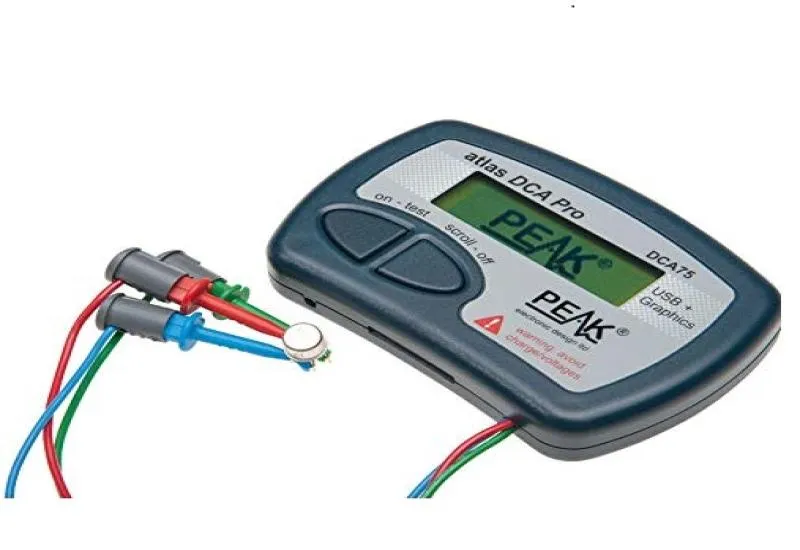
We have curve tracers available for sale or rental.
What is a Curve Tracer?
A curve tracer is a device that displays on a screen the relationship between the voltage applied to a semiconductor device and the current flowing through it.
It is called a curve tracer because it traces a graph (curve) of the voltage-current characteristic and displays it on the screen. In semiconductor devices, the relationship between applied voltage and the current flowing is nonlinear and not proportional, as it is with resistors.
Therefore, measuring the voltage-versus-current characteristics of semiconductors and electronic devices requires procedures such as changing the voltage, measuring the current value and plotting the results on a sheet of paper. With a curve tracer, by contrast, the voltage-current characteristic can be displayed directly on a screen.
Uses of Curve Tracers
Curve tracers are used in situations such as measuring the characteristics of semiconductor devices during development, inspecting devices in manufacturing departments, and verifying the operation of circuits that use semiconductors. The main measurement targets are semiconductor devices such as diodes, bipolar transistors and FETs.
In semiconductors, the voltage applied to the device under test is varied gradually and the current flowing at that moment is measured. The display section of the curve tracer then shows the voltage value on the X axis and the current value on the Y axis, thereby representing the relationship between voltage and current as a graph.
For applications in which high voltages are applied or high currents flow, optional power supplies are available for each of these applications, and the equipment has been prepared to support a wide range of devices.
Principle of the Curve Tracer
1. Diode Measurement
If the device under test is a diode, connect a device drive power supply between the anode and the cathode, set the maximum and minimum applied voltage values Vmax and Vmin, and the power supply will automatically sweep the voltage between them at a frequency of 50 Hz to 60 Hz. At this time the value of the current flowing through the diode is also measured.
The CRT horizontal sweep circuit uses the voltage of the power supply driving the semiconductor device as its input signal, while the vertical sweep circuit uses the current flowing through the diode as its input signal, so that the current characteristic (V-I characteristic) versus the applied voltage is drawn on the CRT.
2. Transistor Measurement
For bipolar transistor/FET measurements, a current/voltage source using a step generator is connected to the base/gate electrodes. The device power supply is connected between emitter/source and collector/drain, and the maximum and minimum applied voltage values Vmax and Vmin are set.
For Bipolar Transistors
If the base current is varied step by step with a step generator and the emitter-collector voltage and the collector current at that moment are displayed on the CRT, the static characteristic curve of the transistor is drawn.
In the Case of FETs
When the gate voltage is varied step by step with a step generator, a static characteristic curve of a FET is drawn, showing the relationship between the source-drain voltage and the drain current.
Curve tracers were built on the assumption that a CRT is used for the display. However, because CRTs are now almost no longer manufactured, the conventional type of curve tracer has disappeared.
Instead, a PC is used to import the voltage-current characteristic data and draw the characteristic curves on the screen.
Curve Tracer Configuration
Curve tracers consist of a power supply to drive the device, a step generator to control the transistor base current and the FET gate voltage, a CRT, and its horizontal and vertical sweep circuits.
Other Information about Curve Tracers
Semiconductor Parameter Analyzer
Curve tracers were very effective measuring instruments for learning the basic characteristics of semiconductors, and they were basic measuring instruments used in every process from research and development to product inspection, especially by device manufacturers. They were also used by users in acceptance testing of semiconductor devices, and several Japanese manufacturers used to produce them, but they have now been withdrawn from the market, with the exception of a few manufacturers.
On the other hand, curve tracers developed for evaluating solar panels are now on sale. In addition, semiconductor parameter analyzers have replaced curve tracers.
These are equipped with multiple voltage and current sources and measure semiconductor characteristics by controlling the voltage and current from a controller (PC).