Conducted emissions are the mechanism by which electromagnetic energy generated in an electronic device couples onto its AC power line. This phenomenon is especially critical in industrial environments in northeastern Mexico—such as Monterrey, Guadalupe, and Apodaca—where the high density of electronic equipment, variable frequency drives, and automated systems increases the likelihood of interference.
The danger of these emissions is that they can propagate through the power network to which the device is connected and then radiate more efficiently than the equipment itself. As a result, other devices within the same facility, or even in nearby facilities, can be affected by this electromagnetic interference. In sectors such as automotive, electronics, and advanced manufacturing in Nuevo León, this can translate into communication failures, sensor errors, or line stoppages.
In this article we take a closer look at the measurement methods used to control them.
Conducted emissions are regulated internationally by bodies such as the Federal Communications Commission (FCC), which sets limits typically in the range of 450 kHz to 30 MHz, and by standards such as CISPR 22 (now superseded by CISPR 32), which limits emissions from 150 kHz to 30 MHz.
In Mexico, these regulatory frameworks are complemented by regulations issued by the Secretaría de Economía (Ministry of Economy) and the Instituto Federal de Telecomunicaciones (IFT, the Federal Telecommunications Institute), as well as standards such as:
- NOM-001-SCFI (safety of electronic equipment)
- NOM-EM-016-SCFI (electromagnetic compatibility, applicable in certain contexts)
- Indirect references to international standards such as CISPR and IEC in certification processes
In industrial practice in northeastern Mexico, especially for export to the United States and Europe, manufacturers must simultaneously comply with FCC, CISPR 32, and IEC standards, which makes reliable measurement methodologies indispensable.
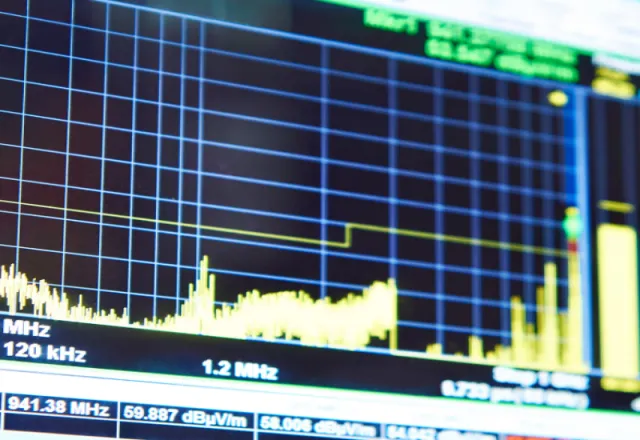
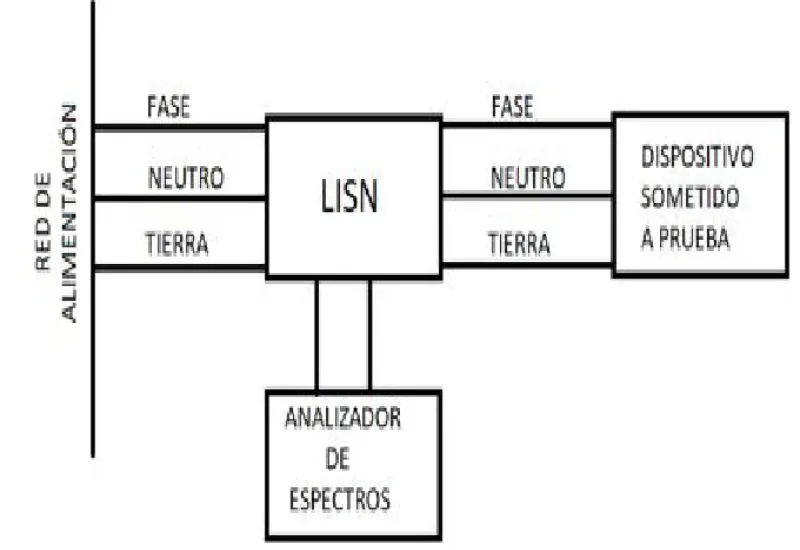
For compliance or pre-compliance testing under the standards mentioned, a LISN (Line Impedance Stabilization Network) must be inserted between the AC power supply of the device under test (DUT) and the commercial outlet. As shown in the conceptual test diagram, a spectrum analyzer is also connected to the LISN, which allows measurement of the conducted emissions generated by the product under test within the regulated range.
The purpose of the conducted emissions test is to measure the noise currents leaving the AC power supply of the product under test, verifying that they remain below the regulated limits. Because the currents present in the device depend on the impedance of the supply network—which can vary significantly between industrial facilities in Monterrey or industrial parks in the region—it is not enough to measure the noise directly without controlling the environment. Instead, the product under test is connected to a LISN, which stabilizes the impedance seen by the equipment under controlled conditions. This yields repeatable measurements that are comparable across different laboratories or test sites.
The second purpose of the LISN is to block external noise coming from the power grid. Since only the emissions generated by the DUT are of interest, it is essential to prevent mains noise from influencing the measurement. The LISN is designed not to affect the operation of the product under test at the line frequency (60 Hz in Mexico), allowing the equipment to run normally while its high-frequency emissions are evaluated.
Differential-mode and common-mode currents
Conducted emissions can be classified mainly into two types: differential mode and common mode. Understanding this difference is essential in industrial applications in northeastern Mexico, where power converters, switch-mode power supplies, and electric motors are prevalent. Differential mode refers to noise currents that flow between line and neutral. These currents are directly tied to the internal operation of the equipment, such as switching in switch-mode power supplies or speed drives. Their impact is critical in precision equipment and measurement systems.
On the other hand, common mode refers to currents that flow in the same direction on both line and neutral with respect to ground. This type of noise is usually associated with capacitive coupling to ground and is particularly relevant in installations with large metal structures, industrial cabinets, and extensive grounding systems, such as those found in manufacturing plants in Nuevo León. Correctly identifying these modes makes it possible to design more effective mitigation strategies, such as the use of EMI filters, ferrites, and proper grounding techniques.