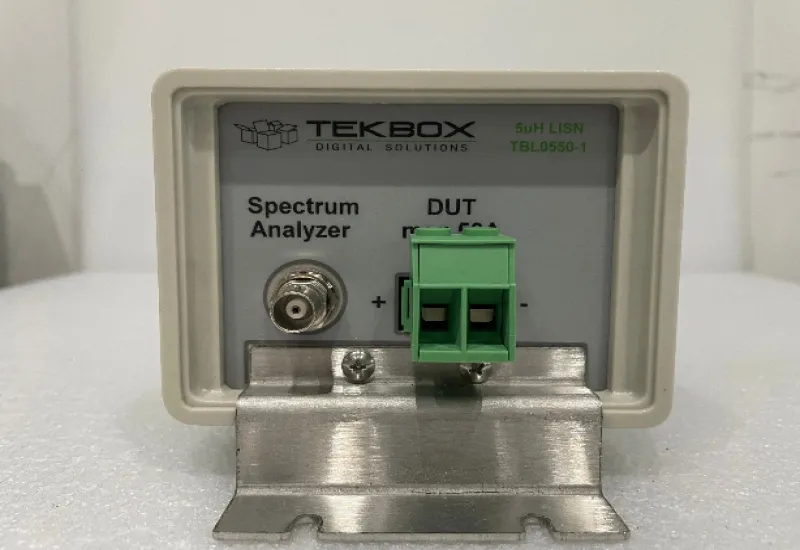
In the industrial ecosystem of northeastern Mexico—particularly Monterrey, Apodaca, and Saltillo—the automotive industry demands increasingly strict levels of electromagnetic compatibility (EMC). The integration of electronic modules, ECUs, ADAS systems, and electrified powertrains has increased the need to control conducted emissions in direct current (DC) systems.
In this context, specialized equipment such as the TBL0550-1 5µH LISN becomes essential for ensuring regulatory compliance and the reliability of automotive electronic systems.
What is the TBL0550-1 5µH LISN and why is it key in automotive?
The TBL0550-1 is a Line Impedance Stabilization Network (LISN) designed specifically for measuring conducted noise on DC-powered equipment.
Unlike typical LISNs for the AC mains, this 5 µH model simulates real vehicle conditions:
-
It replicates the inductance of an automotive wiring harness of approximately 5 meters, a common length in vehicles.
-
It allows realistic conducted emissions measurements on ECUs, electronic modules, and vehicle subsystems.
-
It operates over wide frequency ranges that cover the requirements of modern automotive testing.
This is especially relevant at plants in northeastern Mexico that develop or integrate systems for global OEMs requiring EMC compliance from the early stages (pre-compliance).
Standards it covers for Mexico and export
The TBL0550-1 is designed to meet multiple international standards widely used in the automotive industry:
-
CISPR 25 / EN 55025 → Vehicle emissions
-
ISO 11452-4 → Immunity (BCI)
-
ISO 7637-2 → Automotive electrical transients
-
MIL-STD-461F → Military and aerospace applications
-
DO-160 / ED-14G → Aeronautical applications (with certain limitations)
-
IEC / CISPR 16-1-2 → Measurement instrumentation
In Mexico, these tests are key to meeting export requirements for the United States and Europe, as well as aligning with the quality guidelines required by OEMs located in Nuevo León and Coahuila.
Relevant technical specifications
The TBL0550-1 offers features designed for demanding environments:
| Parameter | Description |
|---|---|
| Frequency range | 100 kHz to 150 MHz |
| Maximum current | 50 A continuous / 70 A for 3 minutes |
| Operating voltage | 0 – 60 V DC |
| Internal resistance | Low, to minimize impact on the DUT |
| RF port | 50 Ω for connection to a spectrum analyzer |
| Internal capacitor | 1 µF configurable (removable for specific tests) |
| Terminals | High-current Phoenix Contact type |
| Calibration certification | Traceable to NIST standards |
These features allow work with real automotive systems such as ECUs, DC-DC converters, BMS, and lighting or infotainment systems.
Operating principle in EMC testing
The LISN performs multiple functions within the test setup:
-
Acts as a low-pass filter between the DC source and the equipment under test (EUT)
-
Stabilizes the impedance seen by the EUT
-
Couples conducted noise to a 50 Ω RF port
-
Blocks interference coming from the power supply
-
Prevents EUT noise from contaminating the supply network
This ensures repeatable, comparable measurements, which is critical in automotive validations.
Applications in automotive testing
Conducted emissions measurement – Voltage method
When the equipment under test is connected to the vehicle chassis with a return shorter than 20 cm, a single LISN can be used. In this case, noise is monitored on the positive supply line.
This method is common in validating compact electronic modules inside the vehicle.
Current probe measurement

When noise must be analyzed on complete harnesses, including signal and control lines, current probes are used. These allow emissions to be evaluated over a wider frequency range than the LISN.
It is a common practice at OEMs that want to fully characterize the EMC behavior of the system.
Current injection (BCI – Bulk Current Injection)
In immunity tests per ISO, a configuration similar to the probe measurement is used, but in this case an interference signal is injected using a generator and amplifier.
These tests require two LISNs in order to establish a controlled supply impedance.
Electrical transient tests
In tests per ISO, the LISN can be used as part of the test system. In this case, the internal 1 µF capacitor must be disconnected to allow correct application of the transient pulses.
This type of test is essential for validating the resistance of electronic modules to events such as engine start or battery disconnection.
Value for the automotive industry in Monterrey
Using the TBL0550-1 LISN in rental and testing services offers clear advantages:
-
Lower risk of failure in OEM validations
-
Faster EMC pre-certification processes
-
Realistic evaluation of systems under vehicle-equivalent conditions
-
Compliance with international standards from the early stages
This is especially valuable for Tier 1 and Tier 2 suppliers established in northeastern Mexico.
Available services
We offer:
-
TBL0550-1 5µH LISN rental in Monterrey
-
Automotive conducted emissions testing services
-
Test setup support per CISPR 25 and ISO
-
Integration with spectrum analyzers and EMI receivers