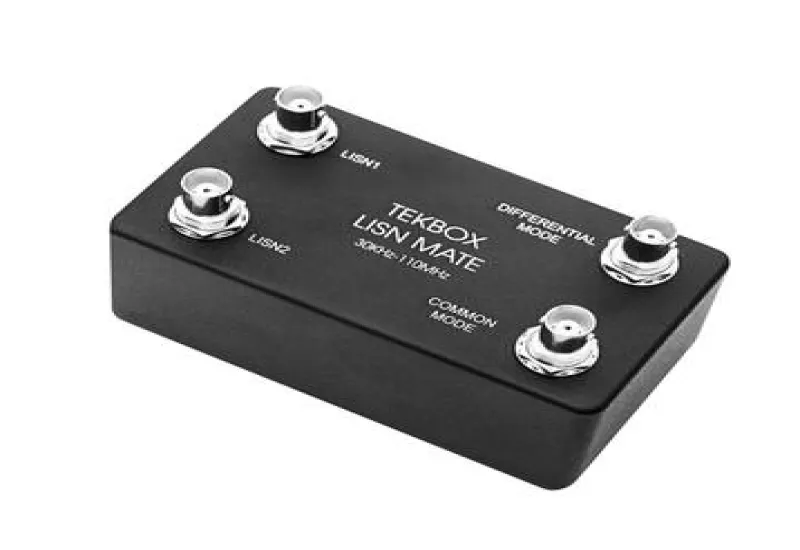
In electromagnetic compatibility (EMC) testing, identifying the origin of conducted emissions is a fundamental task for achieving standards-compliant designs. One of the most common difficulties is that the noise measured at a LISN (Line Impedance Stabilization Network) is the sum of common-mode and differential-mode components, which complicates diagnosing the true source of the problem.
The LISN Mate (separation network) is a device designed specifically to overcome this limitation, allowing both components of the conducted noise to be separated and analyzed independently.
Noise separation: key to EMC diagnostics
In electronic systems, noise can propagate in two main ways:
- Differential mode: noise that flows between conductors (positive and negative line)
- Common mode: noise that couples to ground or external structures
Distinguishing between these two modes is critical because each has different generation mechanisms and mitigation solutions. Without this separation, the analysis can lead to inefficient or incorrect solutions.
How the LISN Mate works
The LISN Mate, such as the TBLM1 model, is used together with two LISNs installed on the supply lines:
- One LISN on the positive line
- One LISN on the negative line
The device connects to the outputs of both LISNs and internally decomposes the total noise into its components:
- Dedicated output for common mode
- Dedicated output for differential mode
Each component is presented on a separate BNC connector, allowing direct analysis with instruments such as spectrum analyzers or EMI receivers.
Benefits in conducted emissions testing
Using a separation network brings significant advantages during the diagnostic process:
- Clear identification of the dominant noise type
- Less time spent debugging EMC failures
- Proper selection of solutions (filters, ferrites, layout redesign)
- Greater efficiency in the regulatory compliance process
This is especially useful during development, pre-certification, or field troubleshooting.
Integration into EMC test benches
The LISN Mate integrates easily into standard conducted emissions measurement setups. Using it does not alter the base measurement process but adds extra visibility into the system’s behavior.
It is compatible with:
- Standard LISNs on supply lines
- Spectrum analyzers
- EMI receivers
- RF acquisition systems
This makes it a versatile tool for laboratories and engineering environments.
Technical specifications – LISN Mate (TBLM1)
| Parameter | Specification |
|---|---|
| Frequency range | 30 kHz – 110 MHz |
| Maximum RF level (BNC) | 27 dBm |
| Maximum DC current (BNC) | 30 mA |
| Main function | Common-mode and differential-mode separation |
| Connectivity | Independent BNC outputs |
Typical applications
The LISN Mate is especially useful where detailed analysis of conducted emissions is required:
- Power supply development
- Automotive electronics
- Industrial equipment
- Consumer electronic devices
- EMC test laboratories
Its separation capability gives a better understanding of the noise source so more effective solutions can be applied.
Benefits of renting
Renting the LISN Mate adds advanced EMC analysis capabilities without buying specialized equipment, which is ideal for development, diagnostic, or pre-certification projects.
Its main advantages include:
- Accurate identification of noise sources
- Optimized engineering time
- Higher success rate in EMC tests
- Simple integration into existing benches
- Lower costs during development stages
This approach allows deeper analysis of conducted emissions, supporting regulatory compliance and the design of products that are more robust from an electromagnetic standpoint.