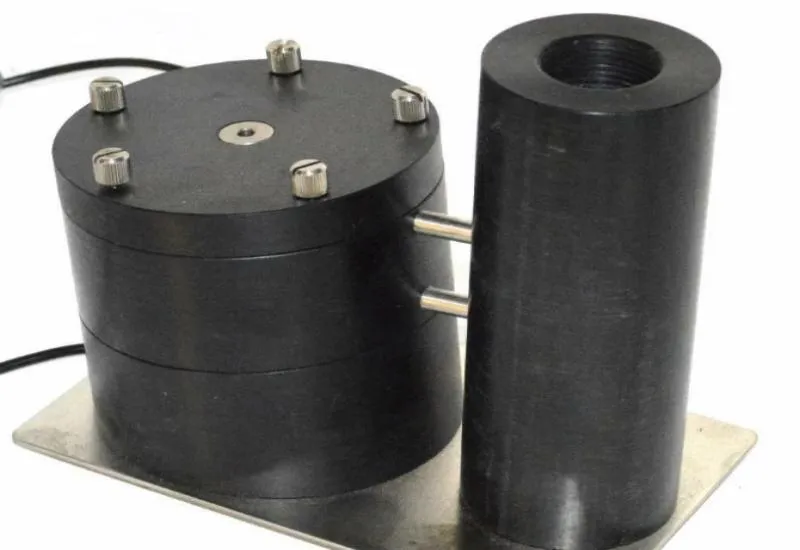
Liquid Volume Resistivity Test Cells for Accurate Resistivity Measurement in Liquids
In the vast world of industrial fluids, from the most sophisticated lubricants to the fuels that move the world, there is a quiet but fundamental electrical property: volume resistivity. Controlling this parameter is synonymous with ensuring safety, efficiency and quality. The LVRTC (Liquid Volume Resistivity Test Cells) from ETS Electro-Tech Systems stand as the reference tool for revealing this data with unmatched precision and repeatability, turning an abstract concept into a tangible, actionable value.
This test system is a fundamental tool for analyzing fluids used in the electronics, chemical, pharmaceutical and advanced materials industries, where the electrical properties of the liquid can directly influence the safety, reliability and performance of the process.
The Strategic Value of Knowing the Resistivity of Your Fluids
Incorporating LVRTC cells into quality control protocols offers a benefit that goes beyond simply obtaining a number. For a manufacturer, knowing exactly the resistivity of a batch of dielectric oil is the assurance that the product will perform as expected in a high-voltage transformer, preventing catastrophic failures and costly unplanned shutdowns. In the fuel industry, this measurement is a direct indicator of the fluid’s ability to dissipate electrostatic charge, a phenomenon that, if left uncontrolled, can generate sparks capable of triggering fires or explosions during transfer. The instrument thus becomes a guardian of operational integrity and an ally in risk management.
How the LVRTC system works
The LVRTC test cells operate on an electrostatic measurement principle in which the liquid is introduced into a measurement cell designed with calibrated electrodes and controlled geometry. A voltage source applies an electric potential between the electrodes and the resulting current passing through the fluid is measured.
From this relationship between applied voltage and measured current, the system can calculate the volume resistivity of the liquid with high accuracy. The cell design ensures that the electric field within the liquid remains uniform, minimizing errors arising from geometry or variations in the contact surface.
This method makes it possible to evaluate liquids with different levels of conductivity, from highly resistive fluids to solutions with greater conductive capacity.
How the instrument interacts with the laboratory environment
The LVRTC system is designed to operate in controlled laboratory environments and in industrial test facilities where metrological precision is required. Interaction with the environment includes factors such as temperature, relative humidity and the purity of the liquid being analyzed, variables that can influence the measured resistivity.
The cell can be integrated with electrometers or high-impedance measurement systems that record extremely low currents. This type of integration is essential when working with highly resistive liquids, where currents may be in the picoampere range.
The mechanical design of the instrument also facilitates cleaning and preparation between tests, avoiding cross-contamination between samples. This is particularly important in environments where multiple chemical formulations or specialty fluids are analyzed.
Technical Specifications and Application Versatility
The LVRTC series cells are designed to deliver uncompromising performance. They are characterized by a certified cell constant, which ensures measurement traceability. They are built to withstand a wide range of fluids and temperatures, and their design allows thorough cleaning between samples, eliminating the risk of cross-contamination. Their versatility makes them suitable for a variety of critical applications.
They are the standard in the electrical sector for quality control of dielectric oils used in transformers, circuit breakers and capacitors. In the oil and hydrocarbon industry, their use is indispensable for evaluating the conductivity of fuels such as gasoline, diesel and fuel oil, as well as additives and specialty lubricants. Beyond these fields, they find application in new materials research, in controlling cutting fluids and coolants in the metalworking industry, and in any process where a liquid needs to maintain insulating properties or control its ability to generate and dissipate static electricity, thus ensuring the quality of the final product and the safety of the facilities.
Main uses of the LVRTC system
Liquid volume resistivity measurement cells are widely used in electrical characterization laboratories and in quality control areas. In the electronics industry they are used to evaluate cleaning liquids, solvents used in semiconductor manufacturing and dielectric fluids used in cooling systems.
In the chemical and petrochemical sector they are used to analyze fuels, oils and industrial solvents in order to evaluate their electrostatic behavior during storage or transfer. They are also valuable tools in academic research and materials development, where the electrical conductivity of the liquid can determine the viability of new formulations.
Emerging Applications in New Technologies
Beyond traditional industries, the need to measure the resistivity of liquids is finding new frontiers. In the development of flow batteries for large-scale energy storage, the resistivity of liquid electrolytes is a critical parameter that directly influences system efficiency. In the field of lubricants for electric vehicles, which must be compatible with the high-voltage electrical components of the motors, controlling their resistivity is vital to avoid short circuits and discharges. Likewise, in the pharmaceutical and semiconductor industries, where ultrapure water is a fundamental input, LVRTC cells offer the sensitivity needed to verify its quality, showing that their usefulness goes beyond conventional limits and adapts to the technological challenges of the present and the future.
Volume resistivity measurement process
During a typical test, the liquid of interest is carefully introduced into the measurement cell. A controlled voltage source generates a potential difference between the internal electrodes, causing electrical charges to move through the liquid.
The measurement system records the current flowing between the electrodes and, from this information, the volume resistivity is calculated taking into account the exact geometry of the cell. This procedure makes it possible to accurately determine the opposition the liquid presents to the flow of electric current.
In highly insulating liquids, the recorded current can be extremely low. For this reason, the system is usually used together with measuring instruments capable of detecting currents in very small ranges, which ensures reliable results even in materials with high resistivity.
Standards
ASTM D1169 – Specific resistance (resistivity) of electrical insulating liquids
This standard developed by ASTM International establishes the test method for determining the electrical resistivity of insulating liquids under controlled conditions. LVRTC cells make it possible to take accurate measurements of the current flow through a defined volume of liquid, which makes it easier to obtain resistivity values that can be used to evaluate the quality and electrical behavior of dielectric oils, solvents and other industrial fluids.
ASTM D4308 – Electrical conductivity of liquid hydrocarbons
This standard defines procedures for measuring the electrical conductivity of fuels and petroleum-derived liquids. The information obtained from resistivity measurements with LVRTC cells can help evaluate the electrostatic behavior of these liquids, which is important for preventing charge accumulation during storage, pumping or transport.
IEC 60247 – Electrical properties of insulating liquids
This International Electrotechnical Commission standard describes procedures for determining electrical properties in dielectric liquids, such as conductivity and resistivity. LVRTC cells can be used in laboratory tests to analyze the electrical behavior of insulating oils used in transformers and other electrical equipment.
Need Advice or a Quote?
Contact us today on WhatsApp at 8117860768 for pricing, availability and usage recommendations. At Creativeit Group, our specialized technical team can help you integrate it into your resistive measurement processes.