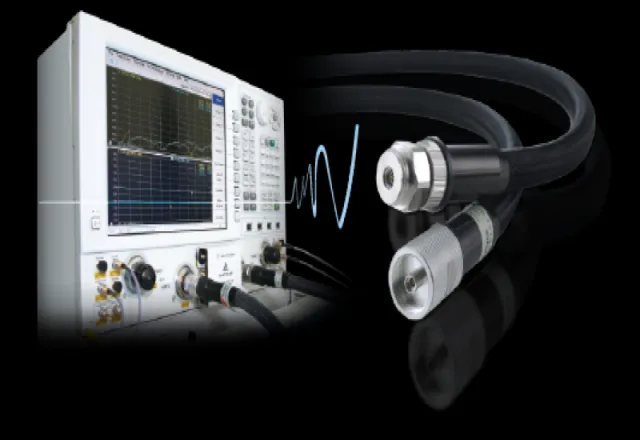
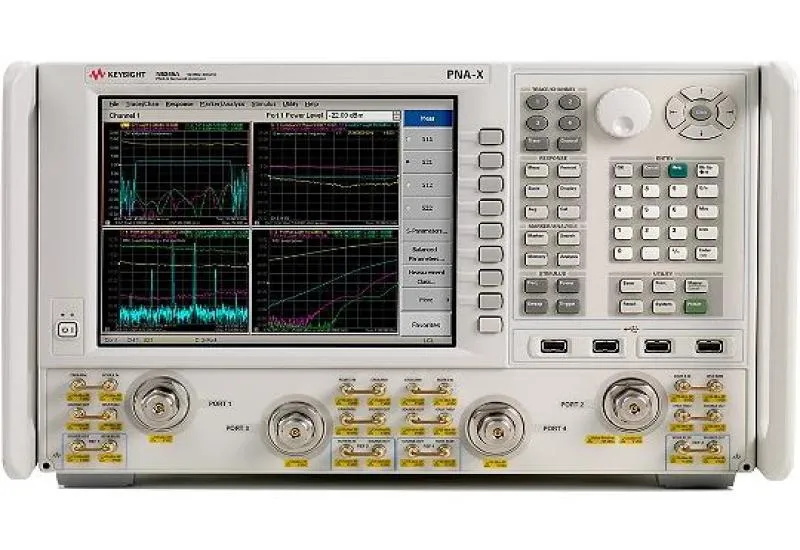
Instrument: Vector Network Analyzer (VNA)
Application: Electrical characterization of RF/microwave devices and systems
General Objective:
Measure scattering parameters (S-parameters), impedance, reflection, transmission and frequency response of electrical components to validate their performance in high-frequency and microwave systems.
Tests That Can Be Performed with a VNA
|
Test |
Main Parameter |
Industrial Applications |
|
Antenna measurement |
S11 (VSWR, Return Loss) |
Antenna tuning, resonance analysis, telecommunications design and testing |
|
Filter and multiplexer analysis |
S11, S21, S22 |
Validation of cutoff frequency and out-of-band attenuation |
|
Cable and transmission line testing |
S11, S21, TDR |
Verification of losses and mismatches, fault location |
|
Passive component testing |
Complete S-parameters |
Measurement of couplers, dividers, adapters, connectors |
|
Amplifier/transistor measurement |
S21, K-factor, P1dB |
Evaluation of gain, stability and frequency response |
|
Differential device testing |
Differential-mode S-parameters |
USB, HDMI, Ethernet, balanced signals |
|
Dielectric characterization (with accessories) |
εr, σ, Df |
Permittivity and dissipation in solids, liquids and composite materials |
Measurable Technical Parameters
- S11 (input reflection)
- S21 (forward transmission)
- S12 (reverse transmission)
- S22 (output reflection)
- Complex impedance and admittance (Z, Y)
- Reflection coefficient (Γ)
- Group delay and phase
- Frequency response and time domain (TDR)
Industry Uses
- Aerospace and Defense: Validation of radars, filters, waveguides and aircraft antennas.
- Telecommunications: Development and installation of RF, 4G/5G, Wi-Fi and satellite systems.
- R&D Laboratories: Design and simulation of new active and passive devices.
- Automotive: Radar sensors, high-speed connectors, EMC validation.
- Electronics Manufacturing: Quality control of connectors, adapters and RF PCBs.
- Advanced Materials: Dielectric analysis of polymers, ceramics and liquids.
Common VNA Accessories
- Dielectric material test fixtures (e.g., Keysight 16451B, 16453A)
- RF test bridges (bridge test sets)
- Precision calibration kits (SOLT, TRL)
- Coaxial and millimeter-wave adapters
- Time-domain test kits
Regulations and Standards
- IEC 61753, 62037 – Passive fiber optic and RF devices
- IEEE 287, 370 – High-speed interconnect modeling
- MIL-STD-202, 883 – Environmental and performance tests for electronic components
Advantages of VNA Testing
- Vector accuracy in phase and magnitude
- Fast, multi-frequency measurement
- Compatibility with simulators (SPICE, ADS, HFSS)
- Time- and frequency-domain modeling capabilities
- Critical instrumentation in production, maintenance and design lines
1. Antenna Measurement (S11)
- Determine whether the antenna is properly tuned to its operating frequency.
- Measure return loss, VSWR and effective bandwidth.
- Verify radiation efficiency.
Industrial uses: Telecommunications, satellites, defense, automotive (radar, RFID, 5G).
2. Characterization of Filters, Diplexers and Multiplexers
- S21 measurement to see the passband.
- S11 and S22 analysis for out-of-band return loss.
- Validation of cutoff frequencies, flatness and slope.
Industrial uses: Base stations, RF equipment, medical electronics, instrumentation.
3. Testing of Coaxial Cables and Transmission Lines
- Measurement of attenuation (S21) and mismatches (S11).
- Detection of discontinuities with TDR.
- Verification of dielectric losses and coupling effects.
Industrial uses: Telecommunication tower installation, satellite TV, maintenance testing.
4. Evaluation of Passive Components (Couplers, Dividers, Adapters)
- Measurement of isolation, balance and phase inversion.
- Verification of operation across the entire frequency range of interest.
Industrial uses: RF design, development laboratories, quality control.
5. Measurement of Active Devices (Amplifiers, Transistors)
- Gain (S21), stability (K-factor) and noise figure (when combined with additional analyzers).
- Analysis of frequency response, compression point, etc.
Industrial uses: Satellite communications, electronic defense, radar systems.
6. Dielectric Characterization of Materials (with accessories such as 16451B, 16453A, etc.)
- Measurement of permittivity, conductivity and dissipation factor.
- Testing of solids, liquids and composite materials.
Industrial uses: Aerospace, automotive, power electronics, advanced materials.
7. Measurement of Differential and Balanced Devices
- Differential and common-mode parameters with balanced adapters.
- Testing of data lines, high-speed connectors, etc.
Industrial uses: Telecommunications, USB/HDMI, industrial data networks.
8. Propagation and Dispersion Analysis in Waveguides and RF Integrated Circuits
- Accurate measurement of insertion loss, delays, edge effects and resonances.
- Modeling of complex structures such as metamaterials or dielectric waveguides.
Industrial uses: Photonics, R&D in optical telecommunications, quantum technologies.