At our company Creativeit Group we offer permittivity testing services for dielectric materials
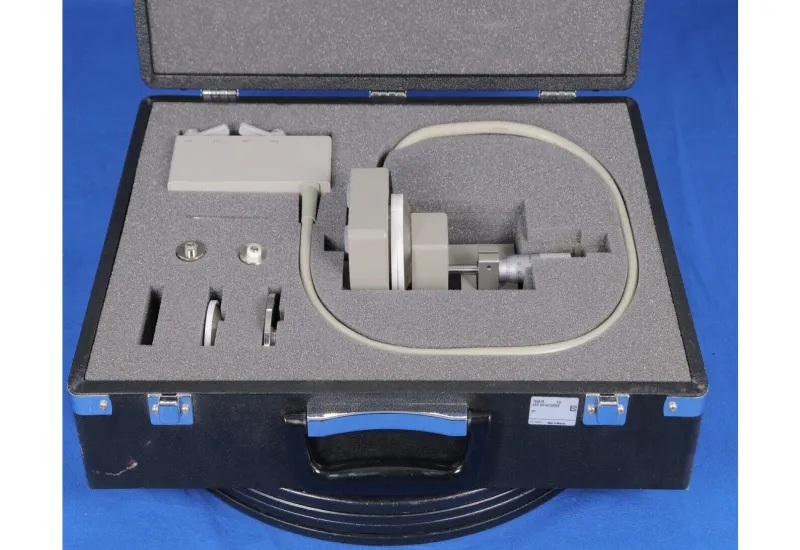
The 16451B measurement adapter is suitable for determining the dielectric constant of film material and meets the requirements of ASTM D150 (ASTM International / American Society for Testing and Materials). The measurement adapter consists of two parallel plates between which the dielectric material is clamped. The resulting capacitor can be connected to Keysight (formerly Agilent Electronic Measurement) LCR meters or impedance analyzers to determine dielectric parameters or capacitance.
Electrical permittivity (also called dielectric constant for homogeneous dielectrics) is a physical parameter of materials that describes how much they are affected by an electric field. Information about the electric field is contained in the vectors E and D, where E is the field intensity and D is the electric displacement or electric flux density. It is the latter that accounts for the influence of the field on a material (analogous to the magnetic field vector B, which is called “magnetic flux density” or “magnetic induction” in a material).
Permittivity is determined by a material’s tendency to polarize when an electric field is applied, thereby partially canceling the internal field of the material. It is directly related to electric susceptibility. For example, in a capacitor, a high permittivity allows the same amount of electric charge to be stored with a smaller electric field and, therefore, at a lower potential, leading to a higher capacitance.
Electrical Permittivity. Permittivity is determined by a material’s tendency to polarize when an electric field is applied, thereby partially canceling the internal field of the material. It is directly related to electric susceptibility. For example, in a capacitor, a high permittivity allows the same amount of electric charge to be stored with a smaller electric field and, therefore, at a lower potential, leading to a higher capacitance. It is a scalar physical quantity. Its unit in the International System is F/m.
In electromagnetism, an electric displacement field D is defined, which represents how an electric field E will influence the arrangement of electric charges in the medium, for example, charge redistribution and reorientation of electric dipoles. The relationship between the two fields (for linear media) with permittivity is D= ε * E where ε is a scalar if the medium is [isotropic] or a 3 by 3 matrix in other cases. Permittivity, taken as a function of frequency, can take real or complex values. It is generally not a constant, since it can vary with position in the medium, the frequency of the applied field, humidity, or temperature, among other parameters. In a nonlinear medium, permittivity can depend on the magnitude of the electric field. The unit of measurement in the International System is the farad per meter (F/m). The displacement field D is measured in coulombs per square meter (C/m 2), while the electric field E is measured in volts per meter (V/m).
D and E represent the same phenomenon, the interaction between charged objects. D is related to the charge densities associated with this interaction. E is related to the forces and potential differences involved. The permittivity of vacuum ε0 is the scale factor that relates the values of D and E in that medium. ε0 is equal to 8.8541878176…×10 -12 F/m. The units of ε0 in the International System of Units are farad per meter (F/m). In the International System of Units, force is measured in newtons (N), charge in coulombs (C), distance in meters (m), and energy in joules (J). As in all equations that describe physical phenomena, using a consistent system of units is essential.
Vacuum permittivity
The permittivity of vacuum ε0 is the ratio of the fields D / E in that medium. It also appears in Coulomb’s law as part of the Coulomb force constant, which expresses the attraction between two unit charges in vacuum. 1/4 πε0, where ε0=8.8541878176* 10-12F/m, where c is the speed of light and µ0 is the magnetic permeability of vacuum.
Absolute and relative permittivity
The permittivity of a material is normally given relative to that of vacuum, and is called relative permittivity (also called dielectric constant in some cases). Absolute permittivity is calculated by multiplying the relative permittivity by that of vacuum