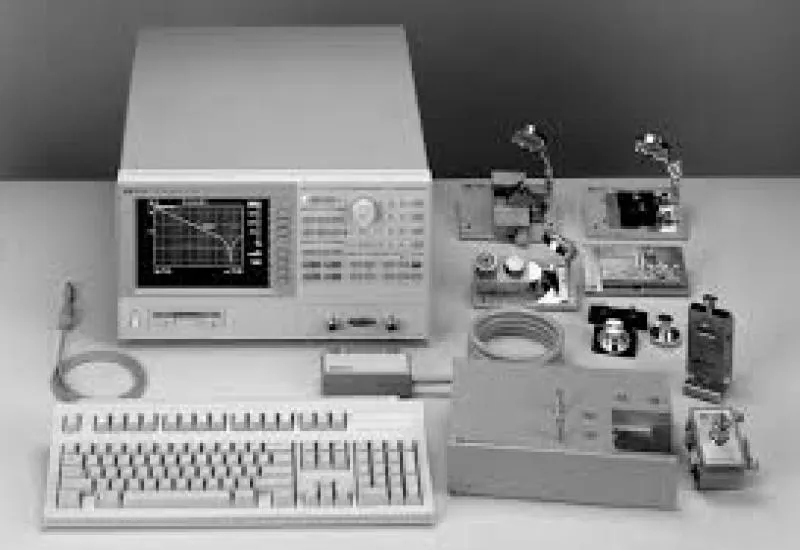
IMPEDANCE AND MATERIAL ANALYZER
The ASTM D150 standard covers the determination of relative permittivity, dissipation factor, loss index, power factor, phase angle and loss angle of specimens of solid electrical insulating materials when the standards used are bulk impedances. The frequency range addressed extends from 1 Hz to several hundred megahertz.
Permittivity: insulating materials are generally used in two different ways: to support and insulate the components of an electrical network from each other and from ground, and to act as the dielectric of a capacitor. For the first use, it is generally desirable for the capacitance of the support to be as small as possible, consistent with acceptable mechanical, chemical and heat-resistance properties. A low permittivity value is therefore desirable. For the latter use, it is desirable to have a high permittivity value so that the capacitor can be as physically small as possible. Intermediate values are sometimes used to grade the voltages at the edge or end of a conductor to minimize AC corona.
AC loss should generally be small in both cases (as electrical insulation and as capacitor dielectric) to reduce heating of the material and minimize its effect on the rest of the network. In high-frequency applications, a low loss index value is particularly desirable, since dielectric loss increases directly with frequency for a given loss index value. In certain dielectric configurations, such as those used in termination bushings and test cables, greater loss due to higher conductivity is sometimes added to control the voltage gradient. It is potentially useful to also consider the dissipation factor, power factor, phase angle or loss angle when comparing materials with approximately the same permittivity, or when using any material under conditions in which its permittivity remains essentially constant.
Correlation is useful when sufficient correlation data are available, and dissipation factor or power factor can indicate material properties such as dielectric degradation, moisture content, degree of cure, and deterioration from any cause. However, deterioration due to thermal aging may not affect the dissipation factor unless the material is subsequently exposed to moisture. While the initial value of the dissipation factor is important, the change in dissipation factor with aging is usually much more significant.
These test methods provide general information on various electrodes, apparatus and measurement techniques. They can be applied directly to the material to be tested, for a reader interested in topics related to a particular material.
This standard does not purport to address all of the safety concerns, if any, associated with its use. It is the responsibility of the user of this standard to establish appropriate safety and health practices and to determine the applicability of regulatory limitations prior to use.
Our organization also provides testing services within the scope of the ASTM D150 standard test methods for AC loss characteristics and permittivity (dielectric constant) of solid electrical insulation, as part of our laboratory testing services.
AGILENT 4291B
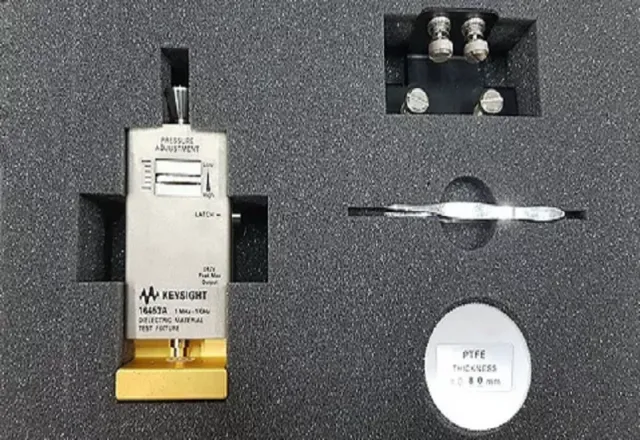
We offer rental of Agilent HP 4291B impedance/material analyzer equipment and fixtures such as: 16190A 16191A 16192A 16193A 16194A 15453A 16454A.
The instrument can measure surface-mount components and dielectric and magnetic materials with high accuracy, using the current-voltage method, which allows very precise measurements over a wide impedance range. Basic accuracy is +/- 0.8% from 1 MHz to 1.8 GHz with 1 mHz resolution. IBASIC is built into the instrument for easy control of external equipment such as temperature chambers.
Measures permittivity and permeability of materials. Cole-Cole plots and relaxation time analysis.
Impedance parameters: |Z|, |Y|, U, R, X, G, B, Cp, Cs, Lp, Ls, Rp, Rs, D, Q
Service for analyzing passive components such as capacitors and RF inductors with RF sweeps. PCB trace width analysis and characterization of circuit board materials for RF.
In the field of electronic component development and verification, we encounter various instruments that help us measure physical variables such as impedance (Z), inductance (L), capacitance (C) and resistance (R). Some devices that measure these parameters are known as LCR meters (derived from the physical variables they measure), and other instruments that measure the same parameters are known as impedance analyzers. It might seem that the two do the same thing; however, this is where the question arises
What is the difference between an LCR meter and an impedance analyzer?
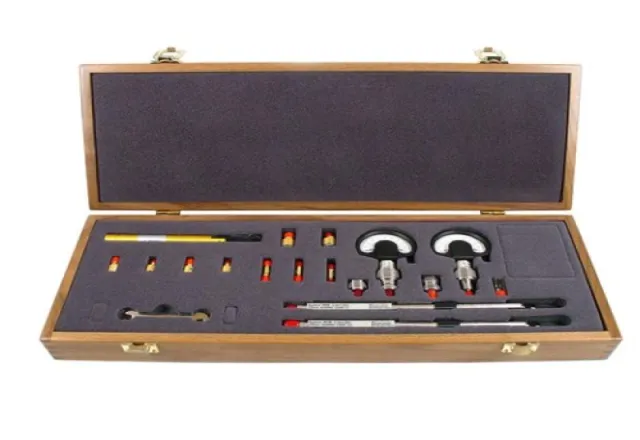
First, in addition to measuring the variables mentioned above, the LCR meter provides a simple and accurate way to measure impedance in a specific environment or at a single frequency point. However, for components where inductance (L), capacitance (C) or resistance (R) are measured directly, this instrument is often inadequate for fully estimating component performance. In these cases, impedance analyzers are used to measure and plot the complex impedance of the device under test over a range of frequencies. Obviously, because it does this job, a typical impedance analyzer costs significantly more than an LCR meter. In addition, an impedance analyzer has a more precise way of being calibrated before measurements are made, using a calibration kit.
With that in mind, when can we use an LCR meter? An LCR meter is basically used when you need to measure physical components that operate at a particular frequency, for example, the components of a data acquisition card or a computer motherboard.
However, there are applications in which the performance of components must be tested or measured at certain frequencies or over a frequency sweep. In these cases the impedance analyzer must be used.
From these fundamental measurements, impedance parameters can be derived by applying a user-defined equivalent circuit model to the fundamental values. These parameters include capacitance, inductance and resistance (hence the name LCR meter). Other parameters can also be derived, including Q factor, dissipation and conductance.
An impedance analyzer includes this functionality and also offers the ability to sweep frequency and graphically display the acquired impedance parameters. This is in contrast to LCR meters, which acquire at a fixed frequency. That said, some LCR meters can acquire at many different fixed frequencies, so the impedance parameters can be interpolated from the data in an additional step.
We also have the Agilent HP 4263B LCR meter and a wide range of fixtures for axial, radial and SMD components.