A high-voltage output function generator amplifier is a combined instrument that can generate signals with specific waveforms (such as sine, square, triangle, and others) and amplify them to high voltage levels. This type of equipment is used mainly in applications that require a high-amplitude signal for testing, simulation, or research.
Features of a high-voltage output function generator amplifier:
1. Function generator
Produces standard waveforms such as sine, square, triangle, pulse, and arbitrary waveforms.
The generated signals have adjustable frequency, amplitude, and waveform, making it possible to create a variety of waveforms that are useful for different applications.
2. High-voltage amplification
The amplifier can increase the voltage level of the signal produced by the function generator.
This allows low-voltage signals (such as those from a standard function generator) to be amplified to much higher levels, which is crucial for some tests and experiments.
3. High-voltage applications
These generator amplifiers can deliver signals at much higher voltages than ordinary function generators, which makes them ideal for certain tests that require high-power signals.
What is a high-voltage output function generator amplifier used for?
- Electronic component testing
It is used to generate high-voltage signals for testing electronic circuits, such as amplifiers, transistors, resistors, and other components.
For example, a high-voltage function generator amplifier may be needed to test how a component responds under different voltage conditions.
- High-amplitude signal simulation
In telecommunications, signal engineering, or research applications, this equipment can generate high-amplitude signals to simulate real operating conditions or fault conditions in communication systems and electronic circuits.
- Research and development
In research laboratories, especially in areas such as power electronics, high frequency, and communication systems, this equipment is used to generate high-voltage test signals to study how devices respond to those voltages.
It can be used to simulate extreme conditions, such as voltage spikes or overload situations in systems.
- Signal generation for high-power device testing
This equipment is essential when testing devices that operate at high voltage, such as power supplies, transformers, or high-voltage power systems.
The generated signals can also be used to measure the response of protection systems (such as circuit breakers, fuses, and relays) to these elevated signals.
- Materials and insulation studies
In materials analysis, such as electrical insulators, the equipment can be used to apply high-voltage signals and study how the materials respond, verifying the robustness of their insulation and their ability to withstand high voltages without failing.
- High-frequency circuit testing
In high-frequency applications, such as radio frequency (RF) circuits, these generator amplifiers can be used to create the high-voltage signals needed to test the response of devices such as antennas, RF filters, transmit and receive modules, and more.
- High-power equipment verification
High-voltage function generators are used to verify the response and behavior of equipment such as power converters, inverters, high-power supplies, and battery chargers that require testing under extreme voltage conditions.
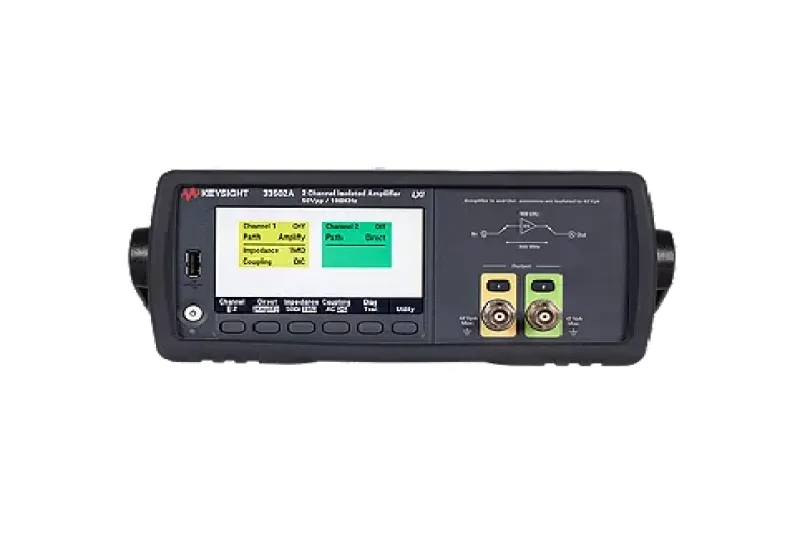
We have the Keysight 33502A two-channel, high-voltage output function generator amplifier. It has an isolated analog front end with an output voltage range of up to 50 Vpp (±25 V). It is also a very low-distortion amplifier, with < 0.01% at 10 kHz and 40 Vpp. The 33502A works as a complement to function generators to deliver higher-voltage, low-distortion outputs.
Full-power bandwidth: 100 kHz at 50 Vpp
Small-signal bandwidth: > 300 kHz
Slew rate: 20 V/μs min.
THD+N: < 0.01% at 10 kHz, 40 Vpp
Output current: 200 mA max.
Isolation: floats ± 42 Vpk to ground