Importance of dielectric strength testing in low-voltage assemblies
In the assembly of low-voltage switchgear and controlgear—those with a rated voltage not exceeding 1000 V AC or 1500 V DC—verifying dielectric integrity is an essential requirement for operational safety and standards compliance. Under the IEC 61439 framework, these tests are part of the design verifications and routine verifications intended to ensure that the insulation between live parts and the chassis, as well as between independent circuits, is sufficient to prevent electric shock, arcing, and catastrophic failures.
The dielectric strength (hipot) test subjects the system to a voltage level above its nominal operating voltage, evaluating both the insulation’s ability to withstand transient electrical stress and the absence of undue leakage paths. This type of test identifies assembly defects, surface contamination, insufficient clearances, or material degradation before the equipment is energized under real conditions.
In electrical panels, motor control centers, and industrial distribution systems, these tests also contribute indirectly to validating withstand capability under short-circuit conditions, since robust insulation reduces the likelihood of internal faults that could escalate into more severe events. In this context, test equipment with high current capability and precise voltage control is indispensable to replicate the conditions required by international standards and to ensure reliable, repeatable results.
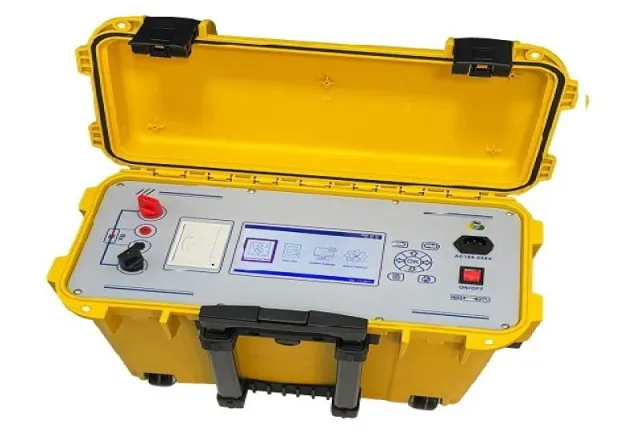
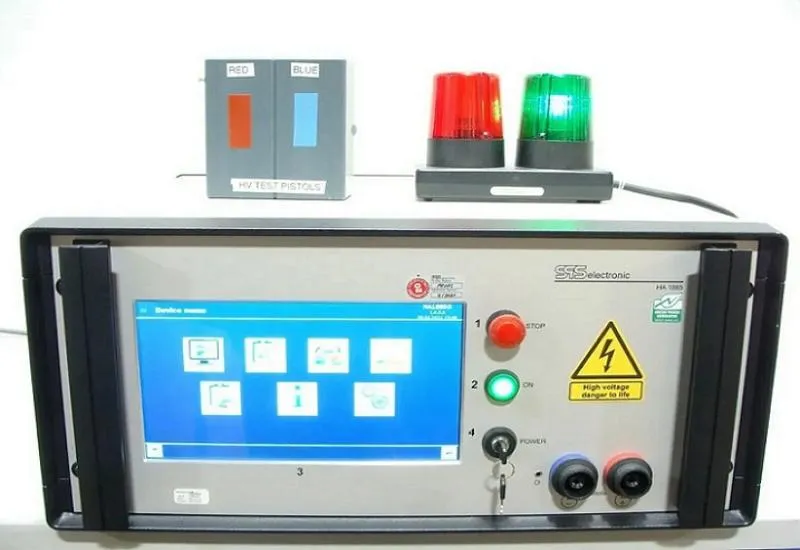
HA 1885G technical specifications
| Parameter | Specification |
|---|---|
| Voltage range | 100 to 5,500 V |
| Current range | 0 to 100 mA |
| Short-circuit current | > 200 mA |
| Arc detection (optional) | Area 0 – 100 % |
| Test modes | Screen step / text step |
| Evaluation type | Subjective or informative |
| Safety | Safety mains field per IEC EN 50191 |
| Limits | Fully programmable |
| Error indication | Optical and acoustic |
| Clock / calendar | Internal |
| Ramp function | Programmable (per IEC 61439) |
| Generator | Fully electronic, digital technology |
| Memory | Up to 64 GB |
| Additional functions | Programmable inputs and outputs |
| Dimensions / weight | 222 x 483 x 487 mm / approx. 24 kg |
| Power supply | 90 to 250 V, 50/60 Hz |
| Interfaces | USB, RS-232, Ethernet/LAN, CAN |
| Digital interface | 24 VDC, 8 inputs + 8 outputs |
| Analog interfaces | 10 VDC, 2 inputs + 1 output |
| Operation | 10.1” color TFT touchscreen |
A relevant differentiator of the HA 1885G is its current supply capability above 200 mA under short-circuit conditions, which exceeds the typical requirements of many dielectric tests on low-voltage equipment. This is especially significant for assemblies per IEC 61439-2, where dielectric strength tests can demand current levels of up to 100 mA. The additional margin not only allows the normative criteria to be met with ease, but also ensures stable application of the test voltage even in systems with high distributed capacitance or complex geometries, avoiding voltage drops and improving the reliability of results.
Applications
The HA 1885G is mainly intended for manufacturing, integration, and verification environments for electrical systems in which insulation reliability is a critical requirement. In northeastern Mexico, where sectors such as automotive, advanced manufacturing, energy, home appliances, and electrical backup systems converge, this type of testing is an integral part of quality assurance processes.
In the assembly of electrical panels under IEC 61439, the unit runs routine dielectric tests between busbars, power circuits, and metal structures, ensuring that insulation clearances and the materials used meet design requirements. These tests are typically performed both at the final stages of production and in precompliance schemes, where prototypes are validated before being submitted for formal certification.
In uninterruptible power supply (UPS) systems, regulated mainly by IEC 62040, using a hipot tester presents technical particularities due to the presence of EMI filters, Y-type capacitors, and transient suppression devices. In these cases, the unit can perform both AC tests—required for certification—and DC tests for diagnostics or internal validation, reducing the effect of capacitive currents that could produce erroneous results. Correct configuration of voltage ramps and current limits is essential to avoid damaging sensitive components and to obtain measurements representative of the actual insulation.
The unit is also applicable to verification of switch-mode power supplies under IEC 62368-1, electric motors per IEC 60034, transformers under IEC 61558, and industrial cabling and harnesses per IEEE 400. In all these cases, the HA 1885G can apply controlled voltages with enough power to evaluate insulation in systems with high capacitance or complex geometries.
Precompliance testing is particularly relevant in the region, where export-oriented manufacturers need to validate their designs before formal certification processes in markets such as the United States, Europe, or Asia. Running dielectric tests at early stages reduces design iterations, avoids rejections at accredited laboratories, and ensures compliance with international electrical safety requirements.
Contact for rental and service
To rent the HA 1885G, or for technical advice on its application in dielectric strength testing, integration into test benches, or configuration in accordance with standards, please get in touch by sending a WhatsApp message to the number shown on the page. Through this channel we provide additional information on availability, service terms, and detailed technical specifications tailored to your project’s needs.