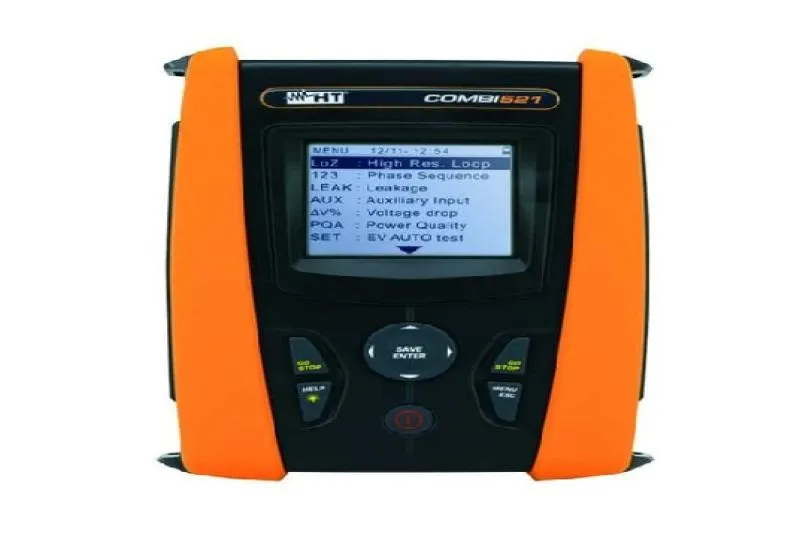
COMBI521 multifunction instrument rental for electrical installation verification (UNE 20460 and IEC/EN61557-1) and Electric Vehicle EVSE charging stations in Monterrey
In the verification of modern electrical installations, in both residential and industrial settings, it is essential to have equipment that integrates multiple measurement functions in a single system. The COMBI521 is a multifunction instrument designed to meet regulatory and operational requirements in electrical testing, integrating analysis, verification, and field diagnostic capabilities.
Its applications range from safety checks per standards such as the Reglamento Electrotécnico de Baja Tensión (R.E.B.T., the Spanish low-voltage electrotechnical regulation) and UNE 20460, to single-phase network analysis and validation of electric vehicle charging stations (EVSE).
Comprehensive verification of electrical installations
The COMBI521 performs a wide range of tests fundamental to ensuring the correct operation and safety of an installation:
-
Measurement of earth loop resistance without tripping the RCD
-
Evaluation of line impedance (phase-phase, phase-neutral, phase-earth)
-
Testing of residual current devices (RCD) in multiple types: A/F, AC, B/B+, DD, and CCID
-
Measurement of insulation resistance up to 1000 V, including advanced indices such as DAR and PI
-
Verification of protective conductor continuity
-
Calculation of prospective short-circuit current
These functions validate both the safety and the electrical integrity of the installation on a single platform.
Electrical analysis and monitoring
In addition to compliance tests, the instrument includes single-phase network analysis capabilities:
-
Measurement of voltage, current, and power (active, reactive, and apparent)
-
Evaluation of power factor and harmonics
-
Detection of leakage currents
-
Verification of phase sequence
It also accepts external probes for recording environmental parameters such as temperature, relative humidity, and illuminance, enabling more complete field diagnostics.
EVSE charging station validation
The COMBI521 includes specific functions for verifying electric vehicle charging stations. Using the optional EV-TEST100 adapter, guided test sequences can be run that simplify validation of these systems in line with current requirements.
Automation and data management
One of the instrument’s standout features is its AUTO function, which runs a complete test sequence automatically after you set only the rated current of the RCD. The instrument performs:
-
Loop resistance test
-
RCD verification
-
Insulation measurement
At the end, it presents results with a clear compliance indication (OK / NO OK), saving time and reducing operator errors.
In addition, the instrument features:
-
Large-capacity internal memory for storing measurements
-
WiFi connectivity, allowing integration with the HTAnalysis app
-
Data transfer to PC for report generation
Main specifications and capabilities
| Parameter | Description |
|---|---|
| Applicable standards | R.E.B.T., UNE 20460 |
| RCD tests | Types A/F, AC, B/B+, DD, CCID up to 1A |
| Insulation resistance | Up to 1000 V with DAR and PI |
| Loop impedance | Line, phase-phase, phase-neutral, phase-earth |
| Continuity | Measurement at 200 mA |
| Electrical parameters | V, A, W, VAR, VA, PF |
| Leakage current | Integrated measurement |
| Automatic sequence | AUTO function with OK/NO OK result |
| EVSE | Tests with optional EV-TEST100 adapter |
| Connectivity | Built-in WiFi (HTAnalysis APP) |
| Memory | Internal results storage |
| Environmental parameters | Measurement with external probes |
Benefits of renting
Renting the COMBI521 gives you a highly versatile instrument without a permanent investment, making it easy to use in specific projects, regulatory inspections, or scheduled maintenance.
Its main advantages include:
-
Access to multiple functions in a single instrument
-
Shorter test times through automated testing
-
Regulatory compliance in electrical verifications
-
Adaptability to residential, industrial, and EVSE applications
-
Optimized resources in field work
This approach allows complete diagnostics with a single instrument, improving operating efficiency and ensuring compliance with current electrical standards.