Solids · Liquids · Gases | Regulatory compliance and total transparency
Engineering, international standards and real technical evidence
We are a laboratory specializing in certifications, technical audits and advanced electrical analysis of materials, with the capability to evaluate solid, liquid and gaseous materials under a standards-based, metrological and fully transparent approach.
Our services are designed for organizations that require repeatable, defensible results aligned with international ANSI, ASTM, ESD and IEEE standards.
Specialized certifications and technical audits
We carry out technical certifications and independent audits to validate materials, processes and measurement systems, evaluating both regulatory compliance and the correct application of test methods.
Audits include:
-
Verification of the test method against the applicable standard
-
Evaluation of repeatability, stability and measurement drift
-
Review of instrumentation, probes and electrodes
-
Validation of calibrations and intermediate checks in our laboratory
-
Issuance of well-supported technical opinions
This approach allows our customers to support external audits, corporate reviews and certification processes with solid evidence.
Electrical analysis of materials by physical state
Solid materials
Engineering plastics, polymers, composites, laminates, ceramics, coatings, and insulating, dissipative and conductive materials.
Commonly applied standards:
-
ASTM D257 – Electrical resistance and resistivity
-
ANSI/ESD STM 11.11 – Volume resistivity
-
ANSI/ESD STM 11.12 – Surface resistivity
Liquid materials
Dielectric oils, insulating fluids, technical liquids and special formulations.
Reference standards:
-
ASTM D924 – Dissipation factor and dielectric constant
-
ASTM D150 – Permittivity (dielectric constant) and losses
-
IEC / equivalent methods for insulating liquids (depending on application)
Gaseous materials
Controlled air, technical atmospheres and industrial gases used as an insulating medium.
Evaluations based on:
-
Dielectric characterization methods in an electric field
-
IEEE models and specialized technical literature
-
Comparative and experimental validation procedures
Electrical permittivity (ε) testing
Electrical permittivity describes the response of a material to an applied electric field and is critical for insulation design, advanced electronics and functional materials.
Our tests make it possible to:
-
Determine the actual dielectric constant
-
Analyze behavior as a function of frequency
-
Evaluate material stability
-
Compare formulations, batches and aging
Applicable standards:
-
ASTM D150 – Permittivity and dissipation factor
-
IEEE-derived methods for advanced dielectric analysis
Electrical permeability testing and electromagnetic behavior
We perform specialized analysis of electromagnetic response and permeability, aimed at materials that interact with electric and magnetic fields in critical applications.
These tests make it possible to:
-
Evaluate field–material interaction
-
Validate functional electrical performance
-
Reduce the risk of interference or failure
ESD control: certification and audit
We offer evaluation and certification of materials for electrostatic discharge (ESD) control, aligned with recognized international standards:
-
ANSI/ESD STM 11.11 – Volume resistivity
-
ANSI/ESD STM 11.12 – Surface resistivity
-
ANSI/ESD S20.20 – ESD control program
-
EIA-541 – ESD packaging materials
-
ASTM D257 – Electrical resistance and resistivity
These tests are essential for EPA (ESD protected areas), electronics manufacturing, ESD packaging and critical surfaces.
Technical staff and institutional backing
All tests, audits and certifications are performed by specialized personnel with active membership in international technical organizations such as:
-
IEEE
-
IEEE Dielectrics and Electrical Insulation Society (DEIS)
This backing ensures:
-
Correct application of standards
-
Advanced interpretation of results
-
Technical judgment that goes beyond instrument readings
Instrumentation, verifiers and calibrators
The laboratory has distinct, redundant equipment for each type of test, as well as:
-
Internal verifiers for measurement systems
-
Calibrators for probes, electrodes and meters
-
Intermediate validation procedures
-
Multiple setups for confirming results
This allows us to deliver high accuracy, repeatability and metrological reliability, even in complex studies.
Technical reports with total (100%) transparency
We are unique in the market for our approach of absolute technical transparency.
Our reports include:
– Complete numerical results
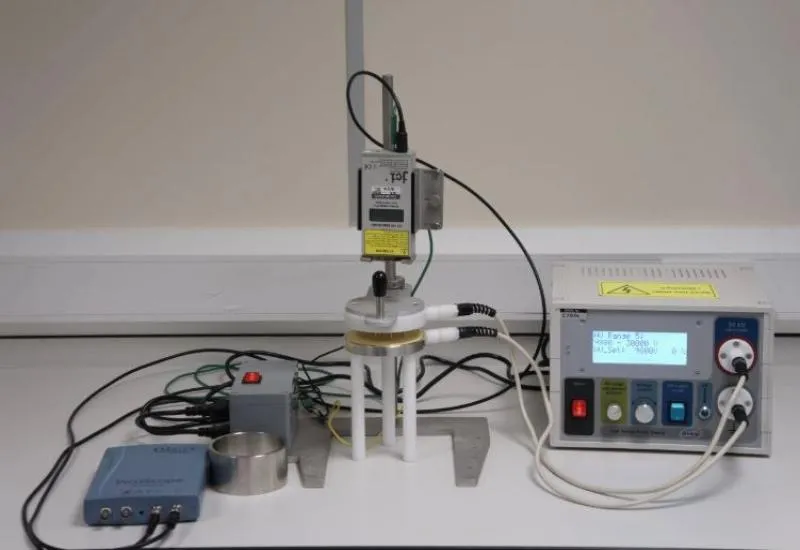
– Real, current photographs of the material during measurement
– Visual evidence of the instrumentation and setup
– Documented environmental conditions
– Clear technical interpretation with reference to standards
– Optional: video of the test process
We don’t just deliver numbers: we deliver verifiable technical evidence.
Why is this laboratory different?
Standards-based certifications and audits
Electrical testing of solids, liquids and gases
Permittivity and permeability testing
ESD control and certification
IEEE and DEIS member personnel
Verified and calibrated instrumentation
Reports with photographic and video evidence
100% technical transparency