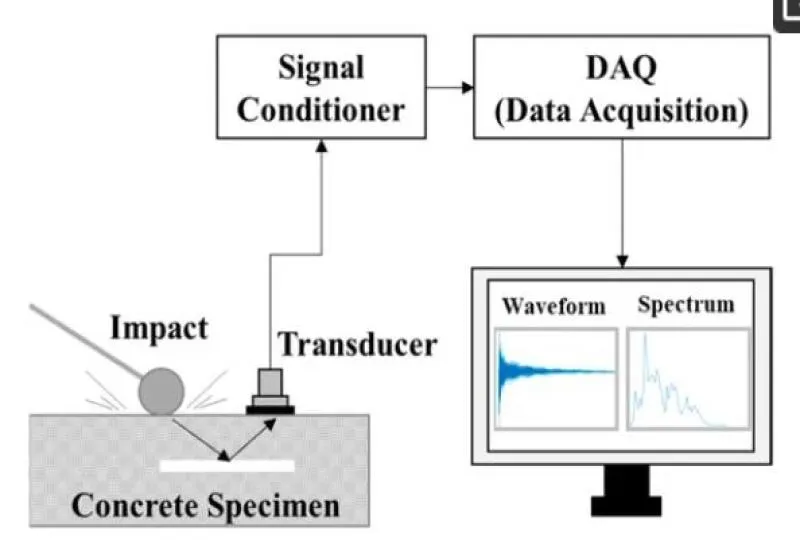
In accordance with ASTM D5882, ASTM C597 and ISO 1920‑7. We perform vibration and pulse-echo analysis and testing. Non-destructive evaluation of the quality of concrete floors, footings, bases, foundations and concrete columns using the impulse response method and the impact-echo method. The decision to remove and replace defective concrete can be costly. It is important that defects be identified and located as clearly as possible so that only the concrete that warrants replacement is removed. A method increasingly used to achieve that purpose is non-destructive pulse-echo testing.
Definition of pulse-echo testing
Pulse-echo integrity testing (also called low-strain dynamic testing, sonic echo testing or low-strain integrity testing) can be carried out on any type of concrete foundation pile (for example, bored piles, auger piles, vibro-mixed in-situ concrete columns, drilled diaphragm walls, etc.)
The test is suitable not only for ensuring the quality of new deep foundations, but also for inspecting the serviceability and length of existing piles beneath pile caps or other structures.
Measurement method
An impact wave is induced in the pile by striking it with a light, hand-held hammer. The echo from the pile toe, and therefore the pile length, can be determined by measuring the movements at the top of the pile. The wave velocity c, a measure of concrete quality, follows from the pile length L and the travel time T.
Changes in pile properties, such as a reduction in diameter or in material properties, voids in the concrete, soil inclusions and cracks, produce wave reflections. The depth of the defect follows from the measured travel time of the wave, and the severity of the defect from the intensity of the reflected signal.
Pulse-echo tests on concrete reveal the presence and location of discontinuities in the concrete, such as cracks, voids, honeycombing, sawdust, metal plates and lack of consolidation around reinforcing bars.
Because no concrete structure is completely free of imperfections, it is vital to distinguish between relatively minor defects and those that may threaten the structural integrity of a member. Pulse-echo testing can determine the extent and location of internal discontinuities so that a realistic analysis of internal defects can be made.
Pulse-echo testing can reveal several things about the soundness of concrete. These include compressive strength, degree and uniformity of consolidation, location and orientation of cracks or cold joints, presence of unconsolidated material around reinforcing bars, inadequate bonding of epoxy injection repairs, thickness of slabs on grade, presence of concrete that froze at an early age, and sizes of voids beneath slabs on ground.