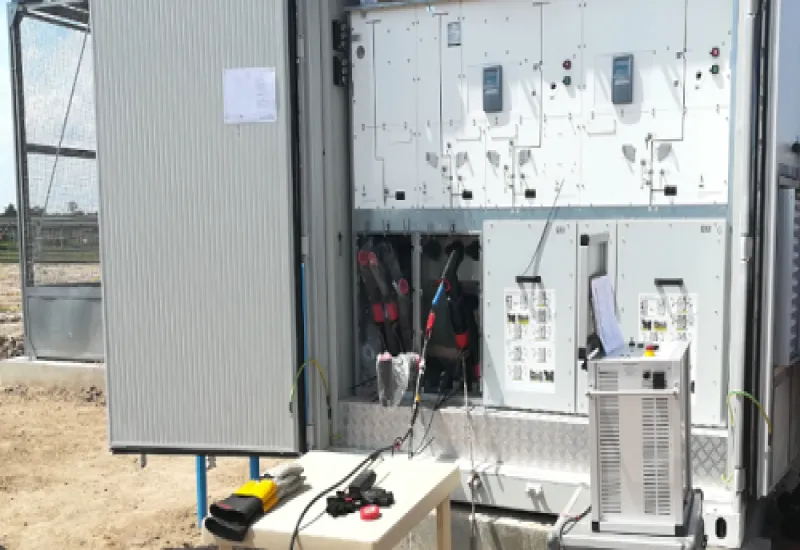
In accordance with the current standards IEEE 400, IEEE 400.2, and IEC 60502-2, low-frequency insulation testing is an effective and indispensable diagnostic because it facilitates the evaluation and inspection of electrical cables. At Creativeit Group we offer VLF testing services for medium and high voltage.
VLF (Very Low Frequency) tests consist of applying a very low frequency voltage (normally between 0.1 Hz and 0.01 Hz) to a medium- or high-voltage cable, or to other electrical equipment, to verify the condition of its insulation. These tests are used mainly to make sure the system is in good condition and has no hidden faults that could cause an electrical failure.
What does the VLF test involve?
1. Low-frequency signal generation
- A VLF generator is used that produces an alternating signal, but at frequencies much lower than the power frequency (50/60 Hz).
- This signal is applied to the equipment or cable under test.
2. Applying voltage to the system
- A voltage higher than the system’s normal operating voltage is applied, but at a very low frequency, which allows a safer and more efficient test.
- Because the frequency is low, the cable’s capacitive current is also low, which makes it possible to test long cables without the need for huge equipment.
3. Monitoring the system response
During the test, the following are measured:
- Leakage current (an indicator of insulation defects).
- Insulation resistance.
- Sometimes partial discharge is also measured, if the equipment allows it.
4. Insulation evaluation
The main objective is to verify whether the insulation of the cable or equipment is in good condition or shows signs of deterioration. If the insulation is damaged, the following can be detected:
- Current leakage.
- Partial discharges.
- Voltage collapses during the test.
5. Analysis and diagnosis
Based on the results:
- If the values are within the acceptable range → The system passes the test.
- If anomalies are detected → Repair or replacement of the tested component is recommended.