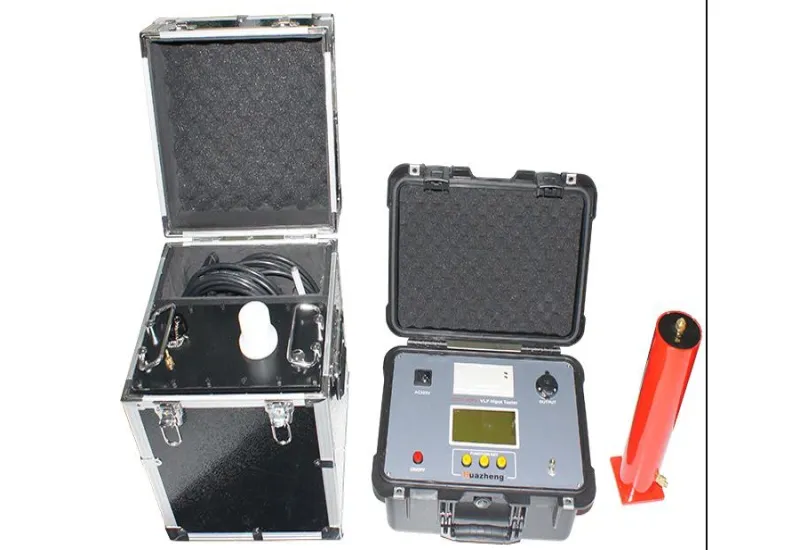
We have several VLF and conventional hipots for sale or rent for testing XLPE cables and other insulation, in all available voltages from 30 kV to 140 kV. Equipment for sale or for performing the relevant tests. According to the Mexican NOM-001-SEDE-2012 (Mexican electrical installations standard), electrical installations must be tested before being placed in service and after any modification, to verify proper workmanship.
The term “HIPOT” refers to high-potential tests, also known as dielectric strength tests or dielectric withstand tests. These tests are commonly used in the electrical industry to verify the dielectric integrity of electrical equipment and cables.
In the context of VLF (Very Low Frequency) testing, the VLF HIPOT test is performed by applying a very low frequency voltage to a cable or electrical equipment to evaluate its dielectric strength. Very low frequency is generally in the range of 0.1 to 0.01 Hz. These tests are useful for detecting possible faults in the dielectric insulation of electrical components, especially in long cables.
In summary, the VLF HIPOT test is used to ensure that electrical equipment and cables can withstand specific voltages at very low frequencies, which helps prevent failures and ensure electrical safety in a variety of applications.
The very low frequency (VLF) voltage test is a non-destructive test method used to assess the integrity of the insulation of high-voltage cables. The VLF test is performed by applying a very low frequency voltage (generally between 0.1 and 0.01 Hz) to the cable and measuring the current flowing through the insulation. If the current is too high, it may indicate that the insulation is damaged.
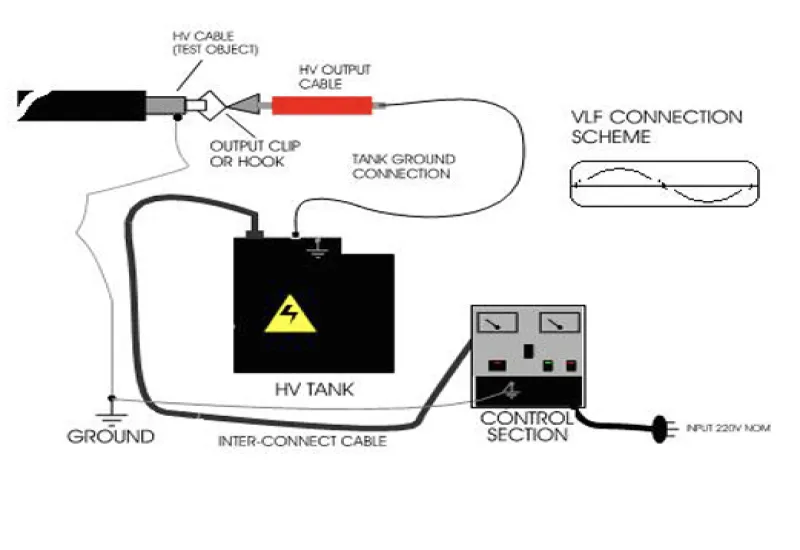
We sell very low frequency high-voltage test equipment. This equipment is used to test the dielectric strength of electrical materials and components, such as cables, transformers, and motors. VLF tests are performed by applying a very low frequency voltage to the material or component under test and measuring the current flowing through it. If the current is too high, it means the material or component has low dielectric strength and may fail under normal operating conditions.
Hipot test equipment for VLF testing is usually very expensive and requires a high level of expertise to use. Therefore, the sale of this equipment is usually restricted to companies and organizations engaged in the manufacture or repair of electrical equipment.
The VLF test is a very sensitive test and can detect even small defects in the insulation. However, it is also a very costly and time-consuming test. Therefore, the VLF test is usually used only when there is a suspicion that the cable insulation is damaged.
The VLF test is often used to test high-voltage cables used in critical applications, such as power plants and substations. It is also used to test high-voltage cables installed in high-risk areas, such as areas prone to earthquakes or floods.
What is VLF? VLF stands for Very Low Frequency. A VLF Hipot is a high-voltage AC output instrument. HVI VLF products supply sinusoidal AC voltage and current, but at 0.1 Hz – 0.01 Hz compared with the 50 – 60 Hz output of conventional AC test sets. It is still AC voltage with sinusoidal polarity every half cycle. The VLF instrument is used to perform a simple withstand test that gives us a pass / fail result. HVI VLF instruments can be used as a voltage source to perform Partial Discharge and Tan Delta diagnostic tests on cables disconnected from the grid. Why VLF? VLF test equipment makes it possible to field-test highly capacitive loads such as cables and motors / generators. The lower the frequency of an AC source, the lower the current and power required to apply a voltage to a capacitive load such as a cable. At 0.1 Hz, 500 times less power is required to test a cable than at 50 Hz. HVI-VLF instruments let users field-test long cables and large generators with a portable, economical test set. A 45 kg VLF instrument can do the job of a 50 Hz resonant-frequency test set. Cables must be tested with AC voltage. HVI’s VLF products come with a practical, economical, and easy-to-use presentation. When and where VLF is used – Cables and Rotating Machines. The main use of the VLF Hipot is testing insulated medium- and high-voltage power cables. A long cable can have a capacitance of many microfarads. For the AC withstand or dielectric strength test, this cable requires the use of VLF technology. The AC withstand test is the best way to verify the integrity of a cable. If a cable cannot withstand two or three times the normal working voltage, it indicates that it is not healthy and may fail in service. Use VLF to detect defective cables; if one fails during the test, you will prevent its failure under load. Locate the fault, make the repair or replace it, leaving a sound cable in service. It is especially suitable for verifying lines after a new installation or repair. It is better than using a 5 kV DC megohmmeter or a DC Hipot for load testing, neither of which supplies meaningful information about the cable’s ability to withstand AC voltage under normal load. The standards that define VLF cable testing are: IEEE 400, IEEE 400.2, VDE 0276, CENELEC HD 620 / 621, and IEC 60060-3. VLF is also very useful for testing large rotating machines, since it provides a portable and economical method of field-testing windings, and it is governed by the IEEE 433 standard. VLF Cable Diagnostic Testing: Partial Discharge and Tan Delta. The VLF Hipot is in itself an overvoltage test instrument. Although it can also be used as a voltage source for diagnostic tests on cables disconnected from the grid with partial discharge and Tan Delta. HVI meets the industry’s cable testing needs better than any other manufacturer. Contact HVI for additional information on any other cable testing methods and products available.