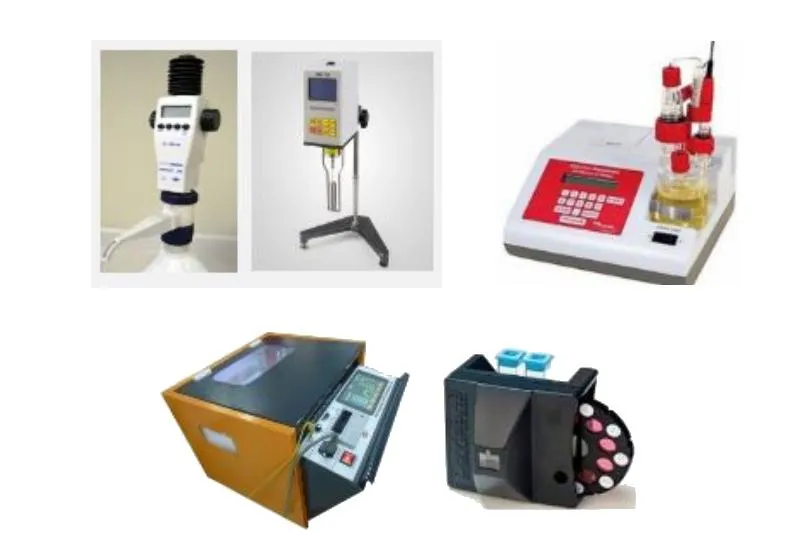
We apply NMX‑J‑123‑ANCE‑2019, ASTM D877, ASTM D1816 and IEC 60156:2025
Field testing of dielectric breakdown voltage, moisture and viscosity of oil!
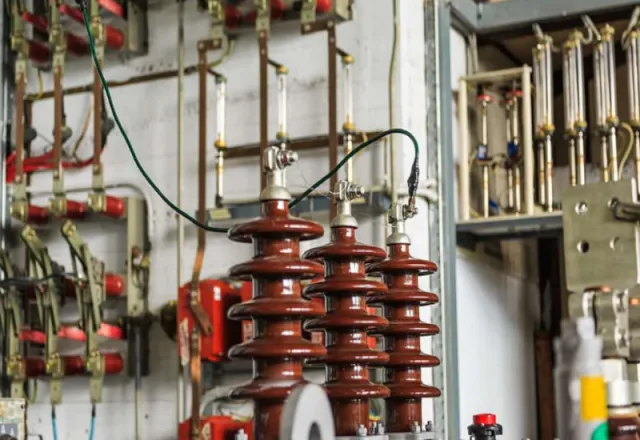
Transformer oil analysis in Monterrey. Oil color, viscosity, acidity, interfacial tension, and moisture tests using a coulometric titrator. We use the latest-generation, 100% automatic equipment on the market to minimize human error.
We offer the equipment in our laboratory for rental at competitive prices: breakdown voltage testers, viscosity, interfacial tension, acidity, power factor, and resistivity equipment, with a technician included. We are located in Monterrey, Nuevo León. We use only glass syringes to draw and handle the oil to avoid any contamination, adhering to internationally recognized ASTM, NEC, API and NFPA standards. We are members of the IEEE (Institute of Electrical and Electronics Engineers) and of the IEEE Dielectrics and Electrical Insulation Society (DEIS) #94801861. This gives us access to current standards, professional forums, webinars and a variety of research material.
What is the difference between us and the competition?
1. We record videos of the procedures.
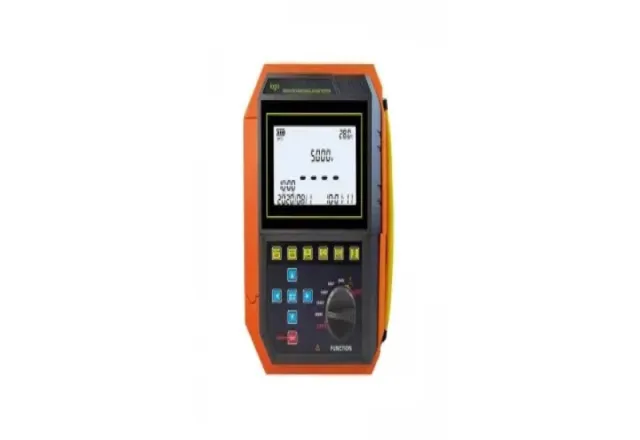
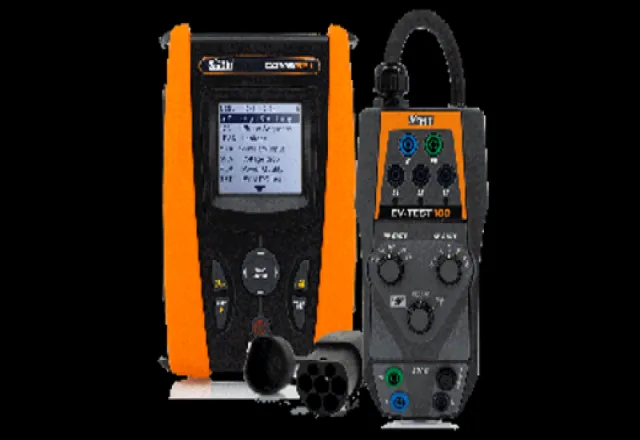
2. Latest-generation, touchscreen and computerized equipment.
3. Internal reports printed from the equipment’s own printer, with date and measurements.
4. Tests performed 100% as the standards indicate; we carry printed copies of them.
5. Field testing, or testing in front of the customer in our portable laboratory.
6. IEEE electrical and dielectric (DEIS) society members for more than 10 years.
7. We offer rental of ALL our equipment at lower cost.
8. Fast response: we perform the analysis the same day you contact us.
9. Spare equipment for comparison purposes or immediate replacement.
10. Fully automatic equipment to minimize human error.
We perform all oil analyses in a transparent and highly professional manner. Field testing of dielectric breakdown, color, viscosity and moisture content per ASTM D1524, D1533, D1816, D445 and D877 on substation transformer oils in Monterrey. Tests up to 80 kV and test cells with stirrer. We are 100% transparent and honest in our work because we consider our methods highly professional. We are the only ones in the industry where you can record videos of the work we perform or witness the tests live.
You can record videos of the work we perform. Testing in the field, right at the transformer, eliminates contamination during transport: there will be no condensation, agitation, sudden temperature changes or foreign agents. Tests performed in closed-door laboratories are done at 25 degrees, and transformers do not operate at that temperature. The properties of the oil and its contents change with temperature. The most effective way to do this is in the FIELD.
Dielectric breakdown is checked by applying high voltages and observing the minimum voltage that causes an electric arc between two metal electrodes, whose shape varies according to the standard used. It indicates the ability of an oil to withstand electrical stress without failure. A low dielectric breakdown voltage indicates contamination with water, carbon or foreign contaminants.
HOW WE PERFORM THE BREAKDOWN TEST
We repeat the tests 6 times, as the standard requires, to obtain the average, and then we calculate the standard deviation to see whether it is within the standard. If not, the tests are repeated until an optimal standard deviation is obtained, so as to produce the most accurate results in accordance with the current standards. We use a 100% automatic machine to avoid errors. We carry copies of the current standards to show the customer in case of any question. To watch our videos on YouTube, click the YouTube icon above.
The oil must have a low moisture content so that it can be used as an insulator and coolant in transformers.
We have the Oberco Hellige color comparator, which uses prisms with discs that serve as the reference for color values according to the ASTM D1500 standard.
Dielectric strength. The voltage is measured by applying a rising voltage per second, and the voltage at which the oil reaches dielectric breakdown is observed. This test is very useful in the field, since it indicates the presence of contaminants such as water; however, a good dielectric strength value does not guarantee the absence of acids and sediments.
Dielectric oil is a substance that performs multiple functions in electrical transformers: it improves insulation between transformer components, equalizes the internal temperature, and provides cooling. However, it degrades inside the transformer during normal operation. The degradation depends on many factors, such as the type of transformer, location, load and operating temperature.
What is dielectric oil:
The atoms in insulating substances have tightly bound electrons, which resist free radicals very well. However, insulators cannot withstand unlimited amounts of voltage. With a sufficiently high applied voltage, any insulation will eventually succumb to the electrical stress and a flow of electrons will occur. However, unlike conductors, where current is linearly proportional to the applied voltage, current through an insulator is highly nonlinear: for voltages below a specific threshold, virtually no electrons will flow, but if the voltage exceeds that threshold, an avalanche of current will result. Breakdown of the material structure has occurred once current is conducted through an insulation.
After breakdown, the substance may or may not act as an insulator, since its molecular arrangement was altered by the breach. There is a rupture of the medium. Comparison of dielectric strength between materials – Material – Dielectric strength – Vacuum – 20 – Air – 20 to 75 – Porcelain – 40 to 200 – Paraffin wax – 200 to 300 – Transformer oil – 400 – Bakelite – 300 to 550 – Rubber – 450 to 700 – Shellac – 900 – Paper – 1250 – Teflon – 1500 – Glass – 2000 to 3000 – Mica – 5000 – The materials listed are specially prepared for electrical use.
The thickness of an insulating substance plays a role in determining its breakdown voltage, also known as dielectric strength. Specific dielectric strength is sometimes listed in volts per mil, or kilovolts per inch, but in practice the relationship between breakdown voltage and thickness has been found not to be exactly linear. An insulator 3 times thicker has a dielectric strength slightly less than 3 times greater. For rough estimation, however, volts-per-thickness ratings are fine. Source: Lessons in Electric Circuits.