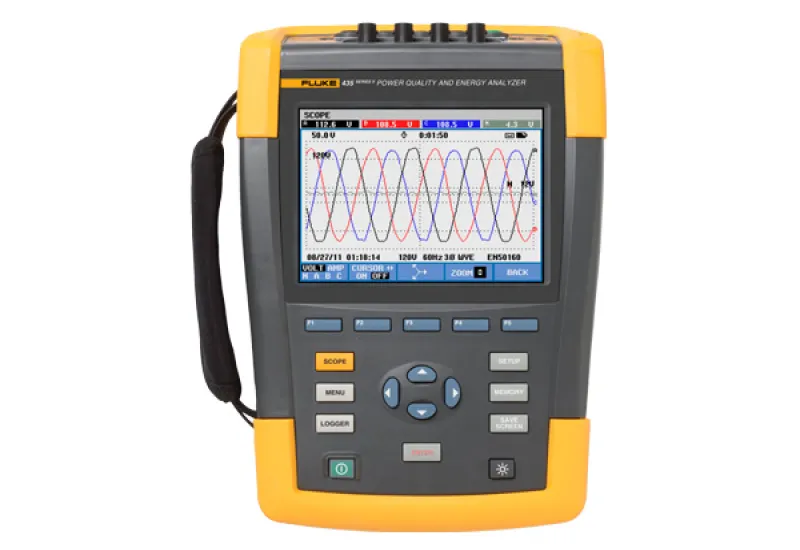
Power Quality Analysis with the Fluke 435 II for the Mexican Grid Code
Applicable standards: EN50160, IEC 61000-4-30 Class A, Mexico Grid Code (Código de Red), NEC (National Electrical Code).
Rental of electrical power analysis equipment such as the Fluke 435-II power quality analyzers, which comply with EN50160 and Class A requirements, available in Monterrey, Mexico. Ideal for meeting the Código de Red (Mexican Grid Code). Our equipment exceeds the required expectations. Tests are complemented with thermographic analysis and verification of the electrical integrity of your installations in accordance with the NEC.
The three-phase power quality (PQ) analyzer offers advanced functions such as power loss calculation, Unified Power Measurement (UPM), event waveform capture, flicker measurement, transients, mains signaling, harmonics analysis (THD), unbalance, inrush currents, power inverter efficiency, and more.
This model includes the new i430flex-TF flexible current probes. It enables predictive maintenance, long-term analysis, load studies, and first-level troubleshooting.
Equipment certified Class A according to IEC 61000-4-30.
Being Class A, this equipment is able to meet the main challenge posed by the Código de Red, which is to improve power quality in the national electrical system by requiring users to focus on the electrical variables that most affect power quality.
These electrical variables are:
- Voltage
- Frequency
- Power Factor
- Power Quality
- Current Harmonics
- Flicker
- Current Unbalance
Our power quality videos on YouTube:
https://www.youtube.com/watch?v=2rVtMQKeY0M
Description of the Fluke 435 II
- PowerWave data capture: quickly captures RMS data and displays half-cycles and waveforms to characterize the dynamics of electrical systems (generator start-ups, UPS switching, etc.).
- Energy Loss Calculator: Classic measurements of active and reactive power, unbalance and harmonics are quantified to reveal the monetary cost of energy losses.
- Real-time troubleshooting: Analyze trends with cursors and zoom tools.
- The industry’s highest safety rating: CAT IV 600 V and CAT III 1,000 V rating for use at the service entrance.
- Measures all three phases and neutral: Includes four flexible current probes and an improved slim design to fit into the tightest spaces.
- Automatic trending: All measurements are always recorded automatically, with no setup required.
- System Monitor: Ten power quality parameters on a single screen, in accordance with the EN50160 power quality standard.
- Graph display and report generation: With the included analysis software.
- Power inverter efficiency: Simultaneously measures AC output power and DC input power for power electronic systems using the optional DC clamp.
- Battery life: Seven hours of operating time per charge on a lithium-ion battery pack.
- PowerWave data capture
- Power inverter efficiency
- Unified Power Measurement (UPM)
- AutoTrend: check the trend quickly
- SystemMonitor: easily check the power supply against the EN50160 standard
What’s included:
- Power adapter, model BC430.
- International plug adapter set.
- BP290 (standard-capacity lithium-ion battery) 28 Wh (7 hours or more).
- Test lead set with alligator clips, model TL430.
- Color-coded clamps and regional stickers, model WC100.
- Model i430flex-TF, 61 cm (24 in.) long, 4 current clamps.
- 8 GB SD card.
- PowerLog on CD (includes instruction manuals in PDF format).
- USB A-B mini cable.
The power quality analyzer rental can include a technician proficient in the use of the equipment. This represents an enormous savings in time and cost for a customer who needs to analyze or measure quickly and safely. The purchasing process and the training process for using the equipment are thus eliminated instantly. It can also help you see how the equipment performs in the field before making a later purchase. We can carry out a complete analysis and advise you or find solutions to your problems.
Our rental prices for the Fluke 435 II power quality analyzer are the best on the market, GUARANTEED. Our equipment is the latest generation because we update it constantly. We are located in Monterrey, Nuevo León, but we travel throughout Mexico.
We offer instrumentation and analysis equipment at low prices, and we offer training and certification courses.
We produce professional reports and perform radio communication interference analysis for WiFi links and cellular antennas, Internet, radio communications, thermography, and more. We have a communications laboratory covering up to 26 GHz.
Rentals can be for a minimum of 4 hours. We are in Monterrey, Nuevo León, and service can be provided in any state of Mexico. Save time and money by renting from us; we include a technician proficient in the use of this equipment.
Power inverters are fed with DC current and convert it into AC current, or vice versa. Solar power generation systems normally include an inverter that is fed with DC current from solar cells and converts it into usable AC power. Inverters can lose performance over time, so periodic checks are necessary. By comparing input power with output power, the efficiency of the system can be determined. The 435 and 437 II models can measure the efficiency of these inverters by simultaneously measuring the input and output power of a system to determine how much energy has been lost in the conversion process.
Unified Power Measurement (UPM)
In the past, only experts could calculate the amount of electrical energy being wasted due to power quality problems; utility companies could calculate the cost, but the measurement process required was beyond the reach of the average technician. With the new, patented Unified Power Measurement (UPM) function of the 430 Series II models, you have a handheld tool capable of determining how much electrical energy is being wasted and calculating exactly the additional consumption costs. Fluke’s patented Unified Power Measurement (UPM) system provides the most complete view of available electrical power by measuring:
Classic electrical power parameters (Steinmetz 1897) and electrical power in accordance with the IEEE 1459-2000 standard.
Detailed loss analysis.
Unbalance analysis.
These UPM calculations are used to quantify the financial cost of the energy loss caused by power quality problems. The calculations are performed in the Energy Loss Calculator, using installation-specific information, and determine how much money a company loses due to wasted electrical energy.
AutoTrend: check the trend quickly.
The exceptional AutoTrend function provides fast insight into changes over time. Every displayed reading is recorded continuously and automatically, without having to set threshold levels or intervals and without having to start the process manually. You can quickly view trends in voltage, current, frequency, power, harmonics or flicker on all three phases and neutral. You can also analyze trends using the cursors and the zoom function, even while logging continues in the background.
SystemMonitor: easily check the power supply against the EN50160 standard.
At the push of a button, the exclusive SystemMonitor function provides an overview of the quality of the electrical system and its compliance with the limits of the EN50160 standard or with user-defined limits. The overview is shown on a single screen, with color bars that clearly indicate which parameters fall outside the limits.
The IEC 61000-4-30 CLASS A standard removes the guesswork when selecting a power quality instrument. This standard defines the measurement procedures for each power quality parameter in order to obtain reliable, repeatable and comparable results. It also specifies the accuracy, the bandwidth and the minimum set of parameters. What is more, manufacturers now have a reference point for designing to Class A standards, leveling the playing field for technicians when choosing instruments and thereby improving the accuracy and reliability of measurements as well as work efficiency.
The measurement and control of power quality is still under development, and it is a field in which the use of meters is relatively new. Although basic electrical measurements such as voltage and current were defined long ago, a large number of parameters had not been standardized before, forcing manufacturers to develop their own measurement methods. Today there are hundreds of manufacturers worldwide with proprietary measurement procedures. With so many different instruments, engineers must spend time trying to understand the functionality of the instruments and their measurement algorithms instead of learning about the quality of the power supply itself.
IEC 61000-4-30 Class A standardizes the measurement of:
• Power frequency.
• Magnitude of the supply voltage.
• Flicker, harmonics and interharmonics.
• Dips and swells.
• Interruptions.
• Supply voltage unbalance.
• Mains signaling voltage.
• Rapid voltage changes.
The measurement uncertainty is set at 0.1% of the declared input voltage. Low-cost measurement systems with uncertainties above 1% can incorrectly detect a -9% variation when the threshold is set at -10%. With a Class A certified instrument, events can be classified with confidence using internationally accepted uncertainties. This is especially important when verifying compliance with standards or when comparing results between different instruments or parties.
Dips and interruptions must be measured over a full signal cycle and updated every half cycle. This allows instruments to combine the high resolution of half-cycle sampling with the accuracy of a full-cycle RMS calculation.
Aggregation intervals: A power quality instrument compresses the acquired data into specific periods called aggregation intervals. A Class A instrument must provide data at the following aggregation intervals:
10/12 cycles (200 ms) at 50-60 Hz; the interval time varies with the mains frequency.
150/180 cycles (3 s) at 50-60 Hz; the interval time varies with the mains frequency.
Harmonics must be measured at 200 ms intervals in conformance with the new IEC 61000-4-7/2002 standard. The previous standard allowed 320 ms intervals, which could not be synchronized with the 200 ms aggregation intervals of other Class A measurements.
Using 200 ms intervals allows harmonics calculations to be synchronized with other values such as RMS, THD and voltage unbalance.
The algorithm used to calculate harmonics (FFT) is specified exactly so that Class A instruments arrive at similar harmonic magnitudes. The FFT methodology allows for infinite algorithms that can result in a wide range of different harmonic magnitudes. If it is standardized to 5 Hz bins and the harmonics and interharmonics are summed according to the specific standards, measurements made with Class A instruments will be consistent and comparable.
External time synchronization is required to achieve accurate time stamps, allowing exact correlation of data between different instruments. The accuracy is specified with a tolerance of ± 20 ms for 50 Hz instruments and ± 16.7 ms for 60 Hz instruments. Synchronization of the 10-minute interval with the clock. Synchronization of the 2-hour interval with the clock.