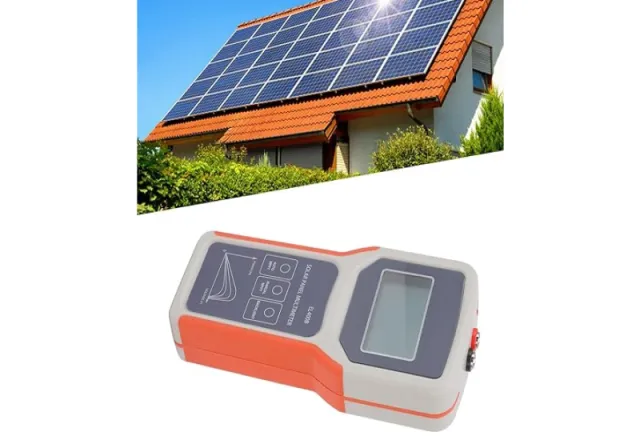
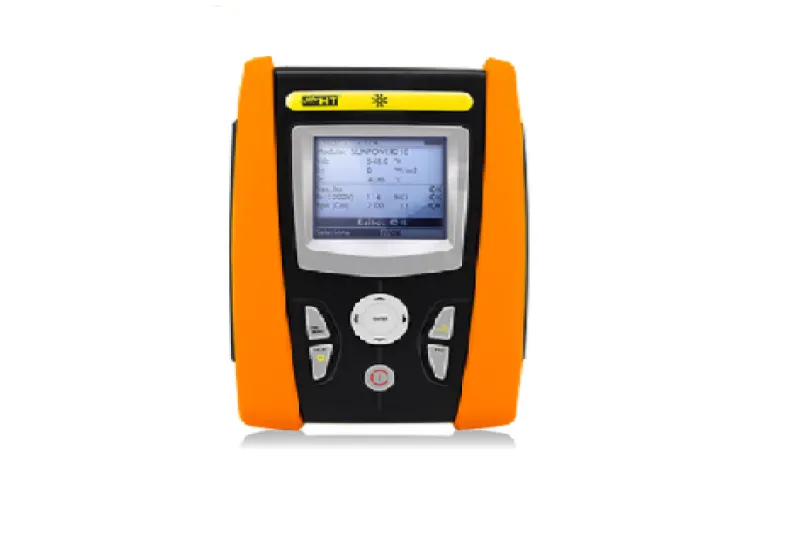
We offer rental of solar panel testers for power quality, irradiance, and I-V curves.
The HT Instruments Solar I-V is an instrument designed specifically for measuring I-V (Current-Voltage) curves in photovoltaic systems. It is ideal for evaluating performance and detecting problems in individual solar panels or module strings.
Main functions of the HT Instruments Solar I-V
1. I-V (Current-Voltage) curve measurement
This is its main function and allows you to analyze the electrical behavior of the panel or string under test.
Measures and plots:
Full I-V curve: Shows the relationship between the panel’s current and voltage.
Maximum power point (MPP): Identifies the point at which the panel delivers its highest output.
Open-circuit voltage (Voc): Shows the maximum voltage when no load is connected.
Short-circuit current (Isc): Measures the maximum current when the panel is short-circuited.
Use: This function is key to detecting:
Damaged cells.
Shading problems.
Bypass diode failures.
Panel performance degradation.
2. Electrical parameter measurement
The Solar I-V also directly measures the system’s electrical parameters.
Measures:
Voltage (V).
Current (A).
Power (W) in DC (direct current).
Use: Lets you verify that the panel or string is operating within the expected values.
3. Solar irradiance and temperature measurement
Because these factors directly affect system performance, the Solar I-V measures:
Measures:
Solar irradiance (W/m²) using a reference cell.
Module temperature using an external probe.
Ambient temperature.
Use: These values are used to calculate the panel’s theoretical performance and compare it with the actual data obtained.
4. Comparison with standard values
The instrument lets you store the measurements obtained and compare them with the photovoltaic panel manufacturer’s technical specifications.
Measures and compares:
Rated power values.
Standard Voc, Isc, and MPP values.
Use: Lets you quickly identify whether the panel or string is operating within the expected parameters.
5. Electrical safety tests
The Solar I-V allows basic safety checks to be performed on the photovoltaic system.
Includes tests of:
Insulation resistance in the panels.
Continuity of electrical connections.
Use: Ensures the installation is safe and free of electrical leakage.
6. Report generation
The Solar I-V includes a data storage system that allows you to generate complete reports for audits or maintenance.
Includes:
Data analysis software.
Reports that compare actual measurements with theoretical values.
Use: Ideal for technicians who need professional documentation of their measurements.
Summary
The HT Instruments Solar I-V is an essential tool for:
Measuring I-V curves and evaluating solar panel performance.
Detecting faults in photovoltaic modules.
Verifying key electrical parameters.
Ensuring system safety.
Generating professional reports for technical documentation.
Procedure for measuring I-V curves with the Solar I-V
1. Equipment preparation
Make sure you have:
The Solar I-V instrument charged.
The irradiance sensor (connected via Bluetooth or cable).
The temperature probe.
The measurement leads with alligator clips.
Optimal measurement conditions:
Perform the test on a sunny day, with irradiance above 600 W/m².
Avoid partial shading on the panels.
Check that the panels are clean to obtain accurate results.
2. Connecting the instrument
Connect the measurement leads:
The red lead to the positive terminal of the panel or string.
The black lead to the negative terminal of the panel or string.
Connect the irradiance sensor in an unshaded location, tilted at the same angle as the panels.
Place the temperature probe on the back of the panel, making sure it has good contact.
3. Instrument setup
Turn on the instrument and select the “I-V Curves” option in the main menu.
Enter the data for the panel or string you are going to measure:
Rated power.
Voc (open-circuit voltage).
Isc (short-circuit current).
Any other data the instrument requests.
The instrument will automatically perform the calculations based on the measured irradiance and temperature.
4. Running the test
Once configured, press the Start button.
The instrument will generate the I-V curve by measuring:
Voc (Open-circuit voltage).
Isc (Short-circuit current).
Pmax (Maximum power point).
The graph will show the full I-V curve and the key performance points.
5. Analyzing the results
Compare the measured values with the manufacturer’s data.
Key results to interpret:
Low Voc → May indicate a problem in the connections or a damaged cell.
Low Isc → Could be a symptom of partial shading, soiling, or deteriorated panels.
Reduced Pmax → Indicates a significant loss of performance, usually due to panel aging or faulty connections.
The instrument will display a message indicating whether the result is within acceptable parameters or whether it detects faults.
6. Report generation
Save the measurements in the instrument’s memory.
Connect the instrument to your PC and use the included software to generate a detailed report.
The report will include:
I-V curve.
Environmental conditions (irradiance and temperature).
Comparison with the manufacturer’s specifications.
System performance diagnosis.
Final recommendations
Always wear personal protective equipment (gloves and safety glasses) for added safety.
If you detect an irregular I-V curve, check the panel connections, the physical condition of the cells, and the cleanliness of the surface.
Take measurements at several times of the day to evaluate how the system behaves under different conditions.
The HT Instruments Solar 300N is a device designed to perform tests and measurements on photovoltaic systems (solar panels). It is a professional tool that lets you verify the performance and safety of solar installations.
Main functions of the Solar 300N
Photovoltaic system performance measurement
Evaluates system efficiency by comparing the power generated with the environmental conditions.
Electrical parameter measurement
Current (A), voltage (V), and power (W) at the solar panels and at the inverter.
Solar irradiance and temperature
Measures sunlight intensity (in W/m²) and the temperature of the modules and the environment.
I-V (Current-Voltage) curves
Lets you analyze the behavior of solar panels to identify faults or performance losses.
Electrical safety tests
Performs insulation, continuity, and ground resistance measurements to ensure the safety of the installation.
Report generation
Can store data and generate detailed reports for analysis and documentation.
Common uses
Installation and maintenance of solar systems.
Troubleshooting photovoltaic panels.
Verification of inverter performance.
Evaluation of the energy efficiency of solar systems.
The HT Instruments Solar 300N is a very complete tool for evaluating and maintaining photovoltaic systems. Below, each of its functions is described in a clear, practical way:
1. Photovoltaic system performance measurement
This function evaluates how efficient your solar system is, comparing the power it is generating with what it should theoretically produce under certain environmental conditions.
Measures:
Output power in direct current (DC) and alternating current (AC).
Ratio between the power generated and the solar power received.
Use: Detect energy losses caused by factors such as shading, soiling, or inverter faults.
2. Electrical parameter measurement
The Solar 300N measures the system’s main electrical variables:
Measures:
Voltage (V): Checking the voltage at the panels and at the inverter.
Current (A): Verifies the flow of electricity in the system.
Power (W): Determines the actual amount of energy generated.
Use: Key to verifying that the system is operating within its optimal parameters.
3. Solar irradiance and temperature measurement
To evaluate the performance of a solar system, it is essential to measure the environmental conditions. The Solar 300N has a reference cell that measures:
Measures:
Solar irradiance (W/m²): Indicates the intensity of sunlight.
Photovoltaic module temperature.
Ambient temperature.
Use: Lets you calculate the system’s theoretical maximum power and compare it with actual output.
4. I-V (Current-Voltage) curve test
I-V curves are a graphical analysis that shows the electrical behavior of the solar panel under different conditions.
Measures:
The voltage as a function of the generated current.
Identifies the panel’s maximum power point (MPP).
Use: Detect internal faults in the panel, such as damaged cells or defective connections.
5. Electrical safety tests
The Solar 300N lets you verify that the installation meets safety standards.
Available tests:
Insulation resistance: Detects electrical leakage in the panels.
Protective conductor (PE) continuity: Verifies that the system has a safe ground connection.
Ground resistance: Evaluates the quality of the grounding system.
Use: Essential for avoiding electrical hazards and ensuring the safety of the installation.
6. Report generation
The Solar 300N has internal memory to store measurement data, which can then be transferred to a computer to create detailed reports.
Includes:
Software to generate complete reports.
Lets you record the data of each inspected panel.
Use: Ideal for installers and technicians who need professional documentation for their customers.
In Summary
The HT Instruments Solar 300N is a powerful tool that lets you:
Verify system performance.
Diagnose electrical problems.
Ensure the safety of the installation.
Generate professional reports for audits or customers.