At our company Creativeit Group we offer permittivity measurement services with different instruments to measure all kinds of dielectric materials.
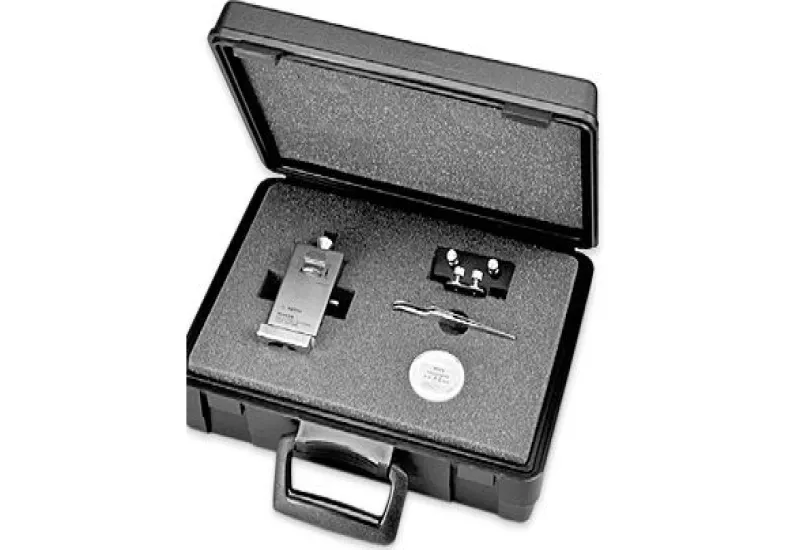
Some examples of this type of material are glass, ceramics, rubber, petroleum, mica, wax, paper, dry wood, porcelain, some greases for industrial and electronic use, and bakelite, among others. Keysight (formerly Agilent Electronic Measurement) 16453A test adapter for measuring dielectric material parameters.
With the test adapter connected to an impedance analyzer, the dielectric material constants can be determined with great accuracy. The material to be measured is clamped between two flat parallel electrodes, thus forming a capacitor. The 16453A test fixture has flexible electrodes that conform to the surface of the material under test.
Permittivity (in the context of electromagnetics) is a fundamental material property that describes how a material will affect, and be affected by, a time-varying electromagnetic field. Permittivity parameters are often treated as a complex function of the applied electromagnetic field, since complex numbers allow the expression of magnitude and phase. The fundamental equation for the complex permittivity of a substance (ε s) is given by ref {1}, where ε’ and ε” are the real and imaginary components, respectively, and ω is the radial frequency (rad/s).
Specifically, the real and imaginary parameters defined within the complex permittivity equation describe how a material will store electromagnetic energy and dissipate that energy as heat. The processes that influence a material’s response to a time-varying electromagnetic field depend on frequency and are generally classified as ionic, dipolar, vibrational, or electronic in nature. These processes stand out as a function of frequency. Ionic processes refer to the general case of a charged ion moving back and forth in response to a time-varying electric field, while dipolar processes correspond to the “flipping” and “twisting” of molecules that have a permanent electric dipole moment, such as that seen with a water molecule in a microwave oven. Examples of vibrational processes include molecular vibrations (for example, symmetric and asymmetric) and associated vibrational-rotational states that are infrared (IR) active. Electronic processes include optical and ultraviolet (UV) absorption and the dispersion phenomenon seen throughout the UV-visible range.
A dielectric permittivity spectrum over a wide range of frequencies. ε′ and ε″ denote the real and imaginary parts of the permittivity, respectively. Various processes are labeled in the image: ionic and dipolar relaxation, and atomic and electronic resonances at higher energies.
The most common relationship scientists have with permittivity is through the concept of relative permittivity: the permittivity of a material relative to the permittivity of vacuum. Also known as the dielectric constant, relative permittivity (ε r) is given by ref {3}, where ε s is the permittivity of the substance and ε 0 is the permittivity of a vacuum (ε 0 = 8.85 x 10 -12 farads/m). Although relative permittivity is in fact dynamic and a function of frequency, dielectric constants are most often expressed for low-frequency electric fields where the electric field is essentially static in nature.
εr = εs/ε0
Dielectric constants can be useful for generic applications in which the high-frequency response can be neglected, although applications such as radio communications, microwave design, and optical system design require a more rigorous and comprehensive analysis. This is especially true for electrical devices such as capacitors, which are circuit elements that store and discharge electric charge in both a static and time-varying manner. Capacitors can be thought of as two parallel-plate electrodes that are separated by a finite distance and “sandwich” a piece of material with characteristic permittivity values. Capacitance is a function of the permittivity of the material between the plates, which in turn depends on frequency. Therefore, for capacitors built into the circuit design for radio communication applications, across the 8.3 kHz — 300 GHz spectrum, the frequency response would be important, as it will determine the capacitors’ ability to charge and discharge, as well as the thermal response of electric fields that dissipate their power as heat through the material.
The evaluation of the electrical characteristics of materials is becoming increasingly popular, especially in the field of electronics, where miniaturization technologies often require the use of materials with high dielectric constants. The composition and chemical variations of materials such as solids and liquids can exhibit characteristic responses, which are directly proportional to the amounts and types of chemical species added to the material. The examples given herein relate to aqueous suspensions in which the electrical permittivity can be easily modulated by the addition of sodium chloride (NaCl).