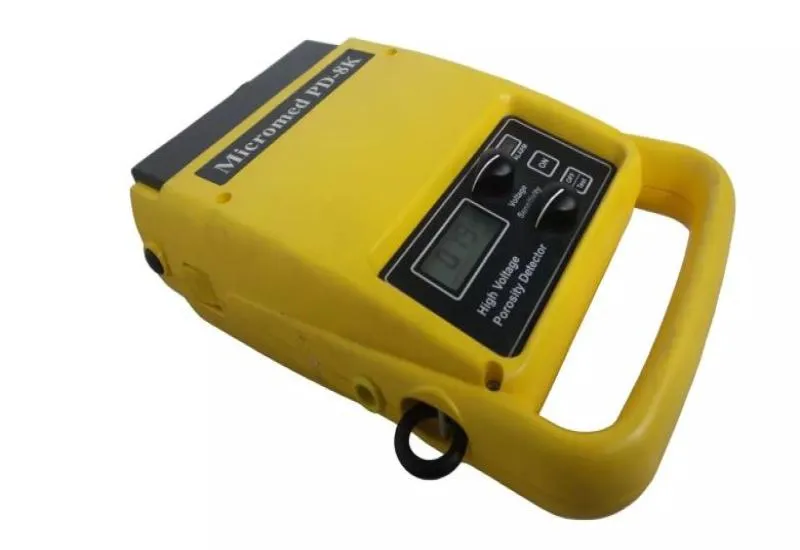
An invisible insulation defect can become a hazard; the McGan MicroMed PD‑8K detects it first.
How can you tell whether a medical instrument is still electrically safe to use? With insulation integrity tests performed using equipment such as the McGan MicroMed PD-8K, which detects microscopic defects in the insulating coating.
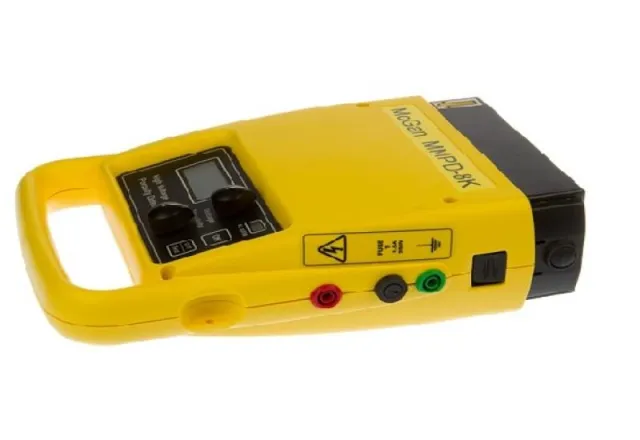
The McGan MicroMed PD‑8K is a portable high-voltage detector designed to identify insulation defects, discontinuities or porosity in dielectric coatings on electrosurgical medical instruments. This equipment is part of hospital electrical safety control systems, since it detects microscopic faults in the insulation of laparoscopic and electrosurgery devices before they are used in clinical procedures.
The equipment applies a controlled voltage through a test electrode and a ground return circuit. When the electrode contacts a defective area of the insulation, a discharge or detectable electrical signal is generated, indicating a dielectric integrity failure in the instrument under evaluation. This process enables fast, reliable inspections during sterilization, biomedical maintenance and pre-surgery verification.
The PD-8K system consists of a portable detector powered by a rechargeable battery, a set of high-voltage and ground leads, interchangeable electrodes and accessories for different instrument geometries. The equipment is designed for non-destructive testing, making it possible to identify faults without altering the functionality of the instrument being evaluated.
The McGan MicroMed PD‑8K operates on the principle of insulation fault detection through the application of a controlled high voltage. The method consists of generating an electric field between a probing electrode and the conductive core of the instrument under evaluation.
The measurement process unfolds as follows:
-
The electrosurgical instrument is grounded using a clamp or return conductor.
-
The operator selects the appropriate voltage level according to the instrument’s coating type.
-
The probing electrode is moved slowly over the insulated surface.
-
If the coating has pores, cracks or areas of insufficient thickness, the electric field passes through the defect and a detectable discharge occurs.
The equipment generates a visual or audible signal indicating the presence of an insulation defect. In this way, specific points where the insulating layer has failed can be located.
Typical tests use approximate voltage levels of:
-
1.0 to 1.5 kV for instruments with powder coatings.
-
2.3 to 2.5 kV for polymeric or sheathed insulation.
-
Up to 4.5 kV with special test electrodes.
The PD-8K detector does not directly measure a physical quantity such as resistance or capacitance. Instead, its function is to identify the presence of dielectric defects in insulating coatings by detecting electrical conduction where insulation should exist.
The goal of the measurement is to identify:
-
Microcracks in the insulation of electrosurgical instruments.
-
Porosity in dielectric coatings.
-
Wear or abrasion of the protective coating.
-
Exposure points of the internal metal conductor.
-
Manufacturing defects or deterioration from use.
These faults can cause unintended electrical discharges during surgery, which could cause internal burns to the patient or interference with other medical devices.
The inspection method used by the PD-8K is based on the interaction between a high-voltage electric field and the dielectric properties of the insulating material.
When the electrode moves over an intact insulated surface, the dielectric material prevents current flow. The electric field remains contained within the material and no conduction occurs.
On the other hand, when there is a defect in the coating:
-
the thickness of the insulation is reduced,
-
the material loses dielectric strength,
-
the electric field passes through the protective layer.
At that point a localized discharge occurs toward the internal conductor of the instrument, which the detector registers immediately.
This phenomenon is based on local dielectric breakdown, widely used in quality testing of insulating coatings in electrical engineering.
Main uses of the McGan MicroMed PD-8K
The equipment is used primarily in hospital environments and biomedical laboratories where the integrity of reusable electrosurgical instruments must be assured.
Main uses include:
Verification of dielectric integrity in laparoscopic instruments.
Preventive inspection in hospital sterile processing departments.
Quality control of medical instruments before surgical procedures.
Preventive maintenance of electrosurgery devices.
Wear assessment of reusable instruments.
In clinical studies of laparoscopic instrumentation, the PD-8K has been used to evaluate insulation failures in reusable surgical instruments, showing that this type of inspection can detect a significant percentage of defects invisible to the naked eye.
Technical specifications
Although exact specifications may vary slightly depending on the version of the equipment, the general technical characteristics include:
Equipment type: high-voltage porosity and insulation fault detector.
Power: built-in rechargeable battery.
Test system: probing electrode with high-voltage generator.
Available electrodes: metal brush, ring and specialized electrodes.
High-voltage cable: approximately 2 m long.
Ground cable with clamp: approximately 2 m.
Adjustable voltage control via front knob.
Status indicators via light and audible signal.
Portable unit with carrying case.
Standards Compliance
FDA 510(k) – K101606: The equipment holds a 510(k) registration and clearance from the United States Food and Drug Administration (FDA), which validates its safety and effectiveness for marketing and use in clinical settings as a Class II device, substantially equivalent to other legally marketed products.
IEC 62353: An international standard that establishes test methods for verifying the electrical safety of medical equipment during maintenance or after repairs. It defines measurements such as leakage currents, ground continuity and insulation integrity. Its purpose is to ensure that medical devices remain safe during clinical use. Inspection equipment such as the McGan MicroMed PD-8K helps meet this standard by detecting insulation defects in electrosurgical instruments, making it possible to identify electrical risks before use.
ISO 13485: An international standard that establishes quality management requirements for the design, manufacture and control of medical devices. Its purpose is to ensure that equipment meets regulatory and safety requirements. It includes inspection, verification and document control processes. Using test equipment such as the McGan MicroMed PD-8K contributes to this standard by making it possible to verify insulation integrity in medical instruments, supporting quality control and maintenance processes.
Technical advantages of the system
Using the McGan MicroMed PD‑8K offers several advantages in biomedical maintenance and hospital safety programs:
High sensitivity for detecting microscopic defects.
Non-destructive test method.
Portability and ease of use in clinical areas.
Reduced inspection time per instrument.
Ability to locate the exact point of failure.
Essential Technical Data
The technical breakdown of the McGan Micromed PD-8K is as follows:
-
Output Voltage: Adjustable range of 0 to 8,000 V DC .
-
Voltage Resolution: 10 V .
-
Maximum Output Current: Limited to 0.1 mA at the probe and under short-circuit conditions, ensuring the non-destructive nature of the test .
-
Power Supply: Internal rechargeable GellCell battery with enough runtime for field use. The system includes a charger with overcharge protection, allowing a full recharge in approximately 3 hours .
-
Indicators: LCD display showing voltage level, battery status and alarm conditions. Visual and audible alarms configurable via a sensitivity control
Need Advice or a Quote?
Contact us today on WhatsApp at 8117860768 for pricing, availability and usage recommendations. At Creativeit Group, our specialized technical team can help you integrate it into your measurement processes.