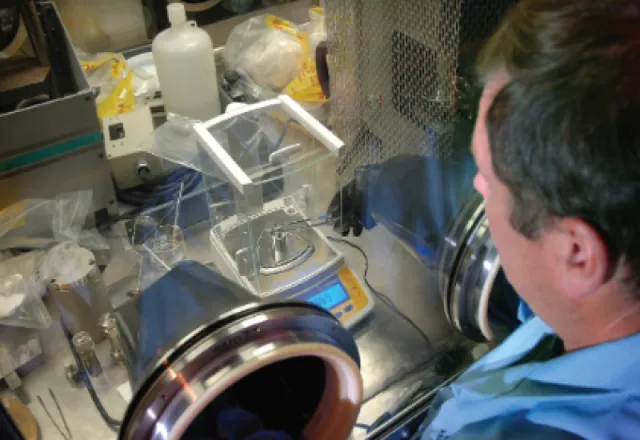
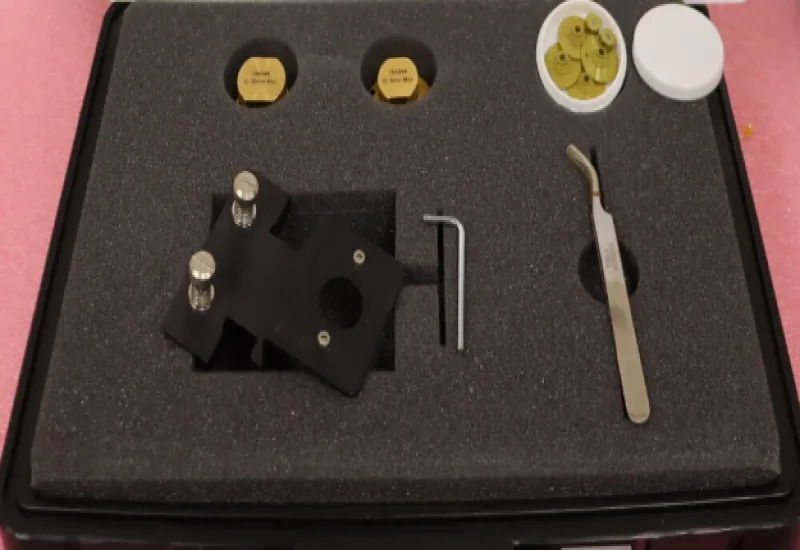
We perform permeability tests on toroids for coil use at our laboratory in Monterrey. We use the Keysight 19454A magnetic fixture, over a frequency range from 1 kHz to 1 GHz.
Sample size (toroids only):
height: ≤ 8.5 mm
inner diameter: ≥ 3.1 mm
outer diameter: ≤ 20 mm
The 16454A is designed for accurate permeability measurements of magnetic materials with a toroidal shape. Because the construction of this fixture creates a single turn around the toroid (with no magnetic flux leakage), there is no need to wind a wire around the toroid. Complex permeability is calculated from the inductance with and without the toroid. When the E4991A/4291B with option 002 is used as the measuring instrument, direct readings of complex permeability are possible. It is also equipped with a small and a large adapter to accommodate a wide range of sizes.
What are toroids?
These come in two types: powdered iron or ferrites. Both introduce permeability, that is, greater inductance for a given number of turns. Toroids look exactly like doughnuts and come in various diameters, thicknesses, permeabilities and types depending on the frequency range of interest. Note the correct spelling: toroid, not toriod.
Some of the advantages of toroids are:
1. High inductance for the physical space occupied.
2. No interaction or coupling with adjacent components (unlike air-wound and other inductors).
3. Several permeabilities are available.
4. Exceptional Q values when properly wound and the optimal core and windings are selected.
5. Wide range of diameters and thicknesses.
6. Relatively low cost
7. Often simple to mount or secure mechanically.
Some of the disadvantages of toroids are:
1. Almost impossible to introduce variable tuning of the inductance.
2. Subject to some thermal drift.
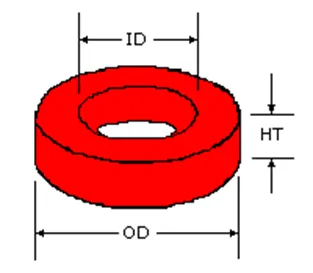
Micrometals offers a typically popular type, and a representative example is the T50-2. This core is lacquered red (so you know the type) and has the following main properties. Being a T50, its outer diameter is 0.5″, the inner diameter is 0.3″ and the thickness is 0.19″. The permeabilities or, in this case, AL factors, that is (inductance per 100 turns2), are:
TYPE COLOR AL Freq. Range,
T50-26 Yel-Wh 320uH Power freq.
T50-3 Gray 175 50 Khz to 500 Khz
T50-1 Blue 100 500 Khz to 5 Mhz
T50-2 Red 57 2 Mhz to 30 Mhz
T50-6 Yellow 47 10 to 50 Mhz
T50-10 Black 32 30 to 100 Mhz
Absolute permeability:
In magnetostatics, permeability is the measure of a material’s ability to allow magnetic lines of force or magnetic fields to form within it.
Absolute permeability refers to the permeability of free space.
Absolute permeability is a constant and its value is given as:

Relative permeability:
Relative permeability is the ratio of the permeability of a substance to the absolute permeability.
The ratio of the permeability of a substance to the permeability of a vacuum is known as relative permeability:
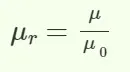
Where µr is the relative permeability, µ is the permeability of the substance, and µ0 is the permeability of a vacuum. Relative permeability is a dimensionless quantity.