In the industrial environment of northeastern Mexico, where sectors such as automotive, electronics, and advanced manufacturing converge, correctly identifying electromagnetic interference (EMI) problems has become a critical technical need. The complexity of today’s electronic systems requires not only measuring emissions but understanding their origin in order to apply effective solutions.
In this context, distinguishing between differential-mode and common-mode currents is an essential step in any EMC diagnostic strategy.
Difference between common-mode and differential-mode currents
Differential currents flow in opposite directions between the supply conductors (line and return), forming the functional circuit of the system. These currents are directly tied to the operation of the equipment.
Common-mode currents, on the other hand, flow in the same direction through the conductors with respect to ground. They are usually generated by capacitive coupling or poor design practices in shielding and grounding.
In automotive applications in the northeast—such as electronic modules, ECUs, or power systems—both modes can coexist, but they require completely different mitigation strategies.
How do you identify the source of the noise?
In the field, a common practice is to apply a clamp-on ferrite to the cabling:
-
If the noise decreases, the problem is predominantly common-mode
-
If there is no significant change, it is likely differential-mode
This method is useful as a quick diagnostic, similar to a process-of-elimination approach in industrial maintenance. However, in more demanding engineering environments—such as automotive validations in Monterrey—this technique is limited.
For a more accurate, professional analysis, it is advisable to use specialized tools that can separate the two components directly.

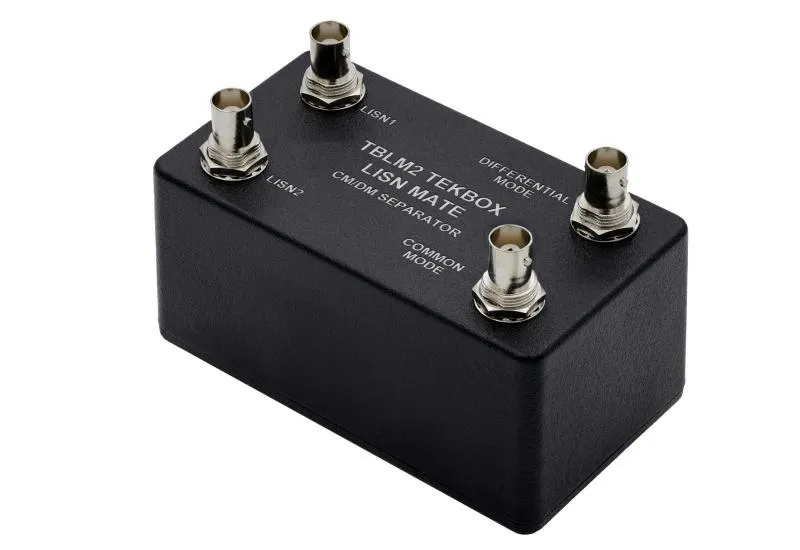
The LISN Mate TBLM1 is a device designed as a complement to LISN systems, whose main function is to separate conducted noise into its components:
-
Common mode
-
Differential mode
In a conventional LISN measurement, the observed noise is the sum of both contributions, which makes it hard to identify the true source of the problem. The TBLM1 overcomes this limitation by delivering each component independently through dedicated ports.
Setup
-
It connects to the output of a LISN on the positive line
-
A second LISN is used on the negative line
-
The TBLM1 processes both signals
-
It delivers two separate outputs (BNC), one for each mode
This allows a spectrum analyzer to be connected directly to view each component independently.
Applications in northeastern Mexico industry
The LISN Mate TBLM1 has direct applications in:
-
EMC validation of ECUs at automotive plants in Nuevo León
-
Noise diagnostics in wiring harness systems
-
Development of DC-DC converters at Tier 1 suppliers
-
Optimization of EMI filters on production lines
-
Failure analysis in compliance tests for export
In Monterrey, where validation and launch times are critical, this tool reduces design iterations and speeds up troubleshooting.
Usefulness for regulatory compliance
Mode separation is key to meeting standards such as:
-
CISPR 25
-
ISO 11452-4
-
ISO 7637-2
These standards not only set emission limits but implicitly require an understanding of the noise source for correct mitigation.
Using the TBLM1 allows targeted solutions to be applied:
-
Filters for differential mode
-
Ferrites and grounding improvements for common mode
This reduces rework and improves the efficiency of the certification process.
LISN Mate TBLM1 specifications
| Parameter | Description |
|---|---|
| Frequency range | 30 kHz – 110 MHz |
| Maximum RF level per BNC port | 27 dBm |
| Maximum DC current per BNC port | 30 mA |
Technical advantage over traditional methods
While empirical methods such as using ferrites provide an initial approximation, the LISN Mate TBLM1 offers:
-
True separation of noise components
-
Quantitative diagnostics
-
Shorter analysis time
-
Greater accuracy in EMC solutions
This makes it a key tool for engineering teams seeking reproducible results aligned with international standards.