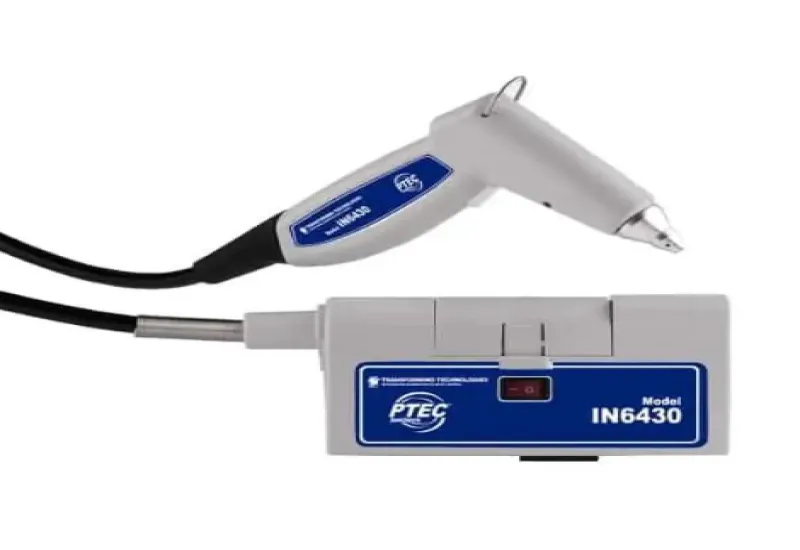
In the industrial environments of northeastern Mexico, particularly in highly productive areas such as Monterrey and its metropolitan area, static control is a critical factor that directly affects product quality, process reliability, and operating efficiency. The IN6430 Ptec™ ionizing air gun is an effective technical solution that combines compressed-air cleaning and active neutralization of electrostatic charges in a single unit.
Its operation rests on a fundamental principle: static electricity, generated mainly by friction (triboelectric charging), attracts particles and can induce damaging discharges. The IN6430 not only physically removes contaminants with compressed air but also eliminates the root cause of the problem by emitting a balanced flow of positive and negative ions, neutralizing the surface charge in real time.
Industrial applications
Painting and coating processes
In automotive, metalworking, and white goods painting applications, electrostatic charge on surfaces promotes the adhesion of dust, fibers, and airborne particles. This results in visible defects such as inclusions, irregularities, or uneven finishes.
One relevant point is that traditional cleaning methods, such as wiping with cloths or using non-ionized air, can increase electrostatic charge through friction. The IN6430 removes particles and charge simultaneously, producing electrostatically neutral surfaces before the paint application process, which reduces rework, material consumption, and part rejects.
Electronics assembly and ESD protection
In electronics manufacturing, electrostatic discharge (ESD) is a significant risk. It can cause immediate damage to components or create latent failures that are hard to detect during initial testing.
The IN6430 is especially useful at workstations where an effective ground connection cannot be ensured, such as with insulating materials or manual handling. Using it neutralizes charges on critical surfaces before assembly, inspection, or packaging.
Sensitive materials and components commonly used in the region include:
- Assembled electronic boards (PCBs)
- Microcontrollers and integrated circuits
- Flash and DRAM memories
- Power devices (MOSFETs, IGBTs)
- Automotive and home appliance sensors
Controlled ionization helps minimize the risk of damage, improve final product reliability, and reduce costs associated with field failures.
Labeling processes and flexible materials
On production lines handling adhesive labels, plastic films, or flexible packaging, electrostatic charge buildup can seriously disrupt process continuity.
Common phenomena include:
- Unwanted adhesion between labels
- Misalignment in automatic application
- Difficulty unwinding rolls
- Irregular interaction with rollers or guides
These problems typically lead to micro-stoppages, constant adjustments, and material waste. Applying ionized air ahead of critical process points stabilizes material behavior, improving accuracy and reducing interruptions.
Technical specifications – IN6430 Ptec™
| Parameter | Specification |
|---|---|
| Electrical power | AC 100–240 V, 50/60 Hz |
| Auxiliary output | Unfused, 0.5 A or 1.0 A maximum |
| Ion emission | AC, 68 kHz |
| Ion balance | ±30 V |
| Discharge time | 1000 V to 100 V in < 2 seconds (at 12”) |
| Operating temperature | 19–25 °C |
| Humidity | 20–60% RH (non-condensing) |
| Air pressure | 20–75 PSI (CDA or N₂) |
| Indicators | Green LED (power on), red LED (alarm) |
| Controls | On/off switch |
| Handheld unit dimensions | 8.5” × 4” × 1” |
| Console dimensions | 3.5” × 6.25” × 1.5” |
| Emitter material | Tungsten alloy |
| Handheld unit weight | 12 oz (with 9.5’ hose) |
| Console weight | 1 lb |
| Gas connection | 1/4” industrial quick disconnect or quick connect |
| Optional filter | 0.01 micron (replaceable) |
Benefits of renting
Renting the IN6430 Ptec™ lets you implement static control solutions without tying up capital in equipment purchases, which is especially convenient in dynamic production scenarios or specific projects.
Its advantages include:
- Immediate implementation on existing lines
- Technical evaluation under real operating conditions
- Defect reduction without complex infrastructure changes
- Flexibility to adapt to changes in production processes
This arrangement makes it easy to validate quality and efficiency improvements before making long-term investment decisions.