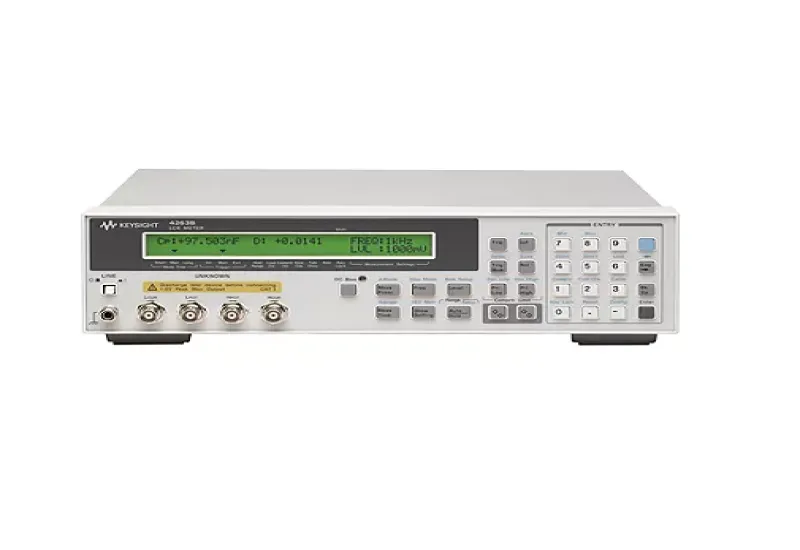
The 4263B LCR meter is designed both for component evaluation on the production line and for fundamental impedance testing in benchtop applications.
The 4263B LCR Meter is a measuring device used mainly to measure inductance (L), capacitance (C) and resistance (R), which makes it an essential tool for testing and analyzing electronic components such as resistors, inductors and capacitors. It is widely used in research, development and maintenance of electronic products.
- 0.1% basic accuracy
· High-speed measurement: 25 ms
· DC and six frequencies (100/120/1 k/10 k/20 k/100 kHz)
· Measurement parameters: Z, Y, Theta, R, X, G, B, C, L, D, Q, Rdc, N, M
More features
- AC test signal level: 20 mV to 1 Vrms in 5 mV steps
· Internal DC bias (1.5 V, 2 V)
· Test signal level monitor function
· High-speed contact check
· Wide capacitance test range
· OPEN/SHORT/LOAD correction
· Cable extension up to 4 m
- Wide availability of test fixtures
Key features of the 4263B LCR Meter:
- Accurate measurement: The 4263B LCR provides accurate measurement of L, C and R over a wide frequency range, which makes it useful for testing components at different frequencies.
- Frequency range: The meter can operate over a frequency range from 100 Hz to 100 kHz, allowing measurements at both low and high frequency.
- High accuracy: This meter offers high measurement accuracy, which is crucial for testing sensitive components and for validating high-quality products.
- Automatic and manual measurements: It offers both automatic and manual options for selecting test conditions, providing flexibility according to the user’s needs.
- Display and visualization: The digital display shows L, C and R values clearly, with the option to select the format best suited for analysis.
- Interfaces: The 4263B LCR meter includes ports for connectivity and remote control, such as USB and GPIB, which makes it easy to integrate into automated test systems.
- Loss measurement capability: In addition to measuring inductance, capacitance and resistance, the meter can evaluate the quality of components by measuring factors such as loss (D factor) in inductors and capacitors.
- Variable test conditions: The meter allows several test parameters, such as test voltage and frequency, to be adjusted to simulate different operating conditions of the components.
Common uses:
- Passive component testing: Used to accurately measure resistors, inductors and capacitors.
- Component quality analysis: Useful in evaluating component quality in the manufacture of electronic devices.
- Production quality control: The 4263B LCR is frequently used for quality control in circuit and electronic component manufacturing processes.
- Research and development: Used in research laboratories to study and analyze the behavior of electronic components under different conditions.