The difference between a reliable contact and a critical failure lies in the micro-ohms.
Can an error of a few micro-ohms affect the quality or safety of your product? Yes. In testing of batteries, electrical connections, copper busbars, relays or solder joints, a minimal variation in resistance can indicate overheating, loss of efficiency or premature failure.
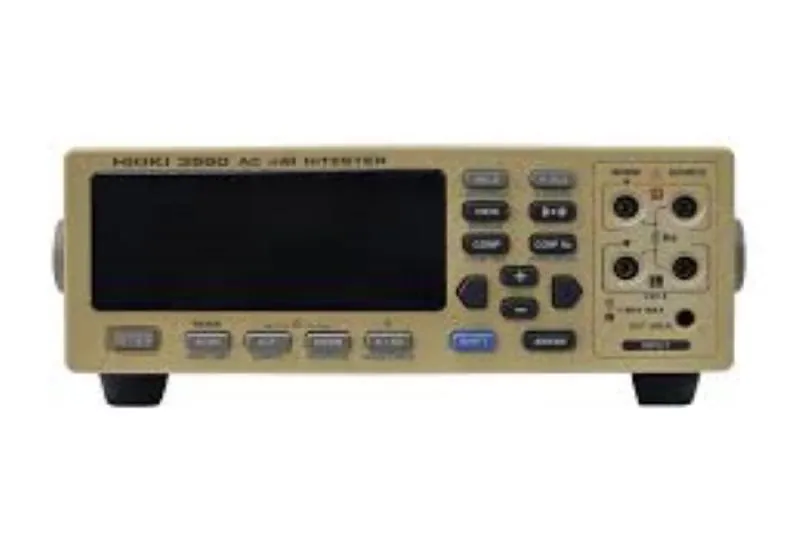
The Hioki 3560 is a precision measuring instrument designed to evaluate very low resistances (mΩ) and battery characteristics, using an AC 1 kHz four-terminal measurement method. This technology eliminates errors due to lead resistance and improves accuracy in industrial and production applications. It also helps us comply with the ASTM B539 standard.
ASTM B539 – Standard Test Methods for Measuring Resistance of Electrical Contacts (Contact Resistance)
The ASTM B539 standard specifies procedures for measuring the contact resistance of metallic materials and coatings, including gold, silver, nickel and other metals used in connectors, relays and electrical components. Its purpose is to establish reproducible results that make it possible to compare the electrical performance and durability of different materials or plating processes. It also describes several measurement methods, such as the constant-current or constant-voltage technique, using four-point equipment or similar configurations. It also includes instructions on sample preparation, environmental conditions and contact forces to minimize measurement errors. These methods make it possible to evaluate effects such as oxidation, wear or surface contamination on contact resistance.
Main Features
Very Low Resistance Measurement: Thanks to its AC four-terminal system, the Hioki 3560 can measure extremely small resistances without being affected by the resistance of the leads or contacts.
High Accuracy and Resolution
-
Resolution of up to 1 µΩ in the 30 mΩ range.
-
Measurement ranges from 30 mΩ to 3 kΩ with multiple scales.
Combined Resistance and Voltage Measurement: The instrument can simultaneously measure resistance and DC voltage of batteries and perform automatic comparisons between internal resistance and open-circuit voltage, making it a versatile tool for battery testing.
Automatic Comparison Functions: The user can program up to 30 sets of upper and lower limits for measurements with the comparator function, enabling automated testing and production quality control.
Communication Interfaces: Includes standard RS-232C for connection to computers or other systems, and supports optional interfaces such as GP-IB and a printer port for automatic recording of results.
Ergonomic Design: The fluorescent character display makes it easy to read even in low-light conditions, and the buttons are arranged for intuitive use.
Technical Specifications
| Parameter | Specification |
|---|---|
| Measurement method | AC 1 kHz, 4 terminals |
| Resistance ranges | 30 mΩ to 3 kΩ (6 ranges) |
| Typical accuracy | ±0.5 % rdg ±8 digits |
| Maximum resolution | 1 µΩ (in 30 mΩ range) |
| Maximum allowable DC voltage | 60 V (DC input) |
| Sampling speed | Up to ~60 measurements/s |
| Display | 31,000 digits (resistance), 50,000 digits (voltage) |
| Interfaces | RS-232C standard, GP-IB |
| Power supply | AC 100–240 V |
| Dimensions (approx.) | 213 × 77 × 320 mm |
| Weight | 2.1 kg |
How Does It Work and What Is It Used For?
1. Contact and Micro-Resistance Measurement
The Hioki 3560 is ideal for evaluating contact resistance in switches, relays and connectors, where an abnormal resistance can indicate wear or failure.
2. Battery Applications
It simultaneously measures internal resistance and battery voltage, which is crucial in battery production, quality testing and evaluation of rechargeable battery packs.
3. Production Quality Control
With its comparator function, the instrument automates pass/fail tests according to programmed criteria, speeding up processes on manufacturing lines.
Four-Terminal AC Measurement Principle
The Hioki 3560 uses an alternating current (AC) measurement technique at 1 kHz with four terminals (4-terminal sensing):
-
Why AC?
AC measurement reduces or eliminates the effects of thermoelectric electromotive forces (EMF) that appear in DC measurements when there are temperature differences. -
Why 4 terminals?
This method separates the force circuit (which applies current) from the sense circuit (which detects voltage). This eliminates resistance losses in cables, test leads and contacts, giving very accurate results even in milliohms or microohms.
Types of Measurements Supported
a) Low Resistance Measurement
This is the main use: determining resistances from tens of microohms to kiloohms (with multiple ranges).
This function is essential for:
-
Welds
-
Relay contacts
-
Connector terminals
-
Busbar resistances
-
Electrical contact quality analysis
b) Simultaneous DC Voltage
The 3560 measures resistance and DC voltage at the same time.
This is key for:
-
Evaluating batteries: knowing the internal resistance and open-circuit voltage makes it possible to estimate the state of health.
-
Systems that require automatic or comparative analysis of both parameters.
Software Download
Software is available to control the 3560 from a PC via RS-232, enabling:
-
Configuration of measurement intervals.
-
Automatic data download.
-
Storage in Excel or CSV formats.
Need Advice or a Quote?
Contact us today on WhatsApp at 8117860768 for pricing, availability and usage recommendations. At Creativeit Group, our specialized technical team can help you integrate it into your measurement processes.