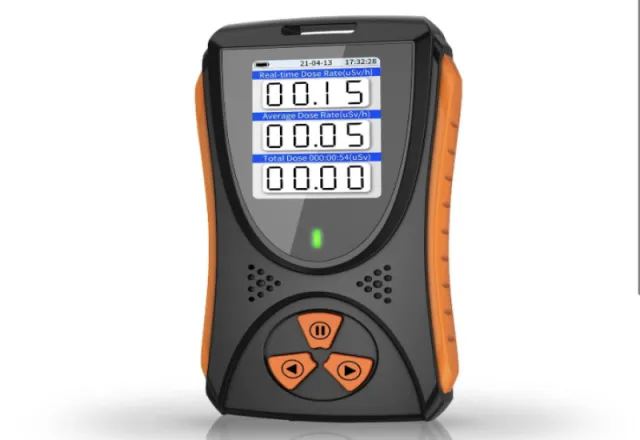
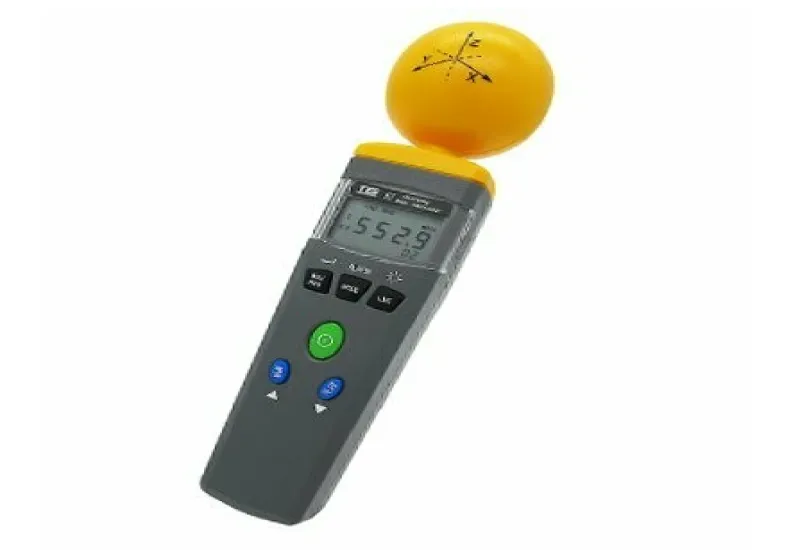
The growing presence of wireless systems—cell towers, Wi-Fi networks, industrial equipment, and electronic devices—makes it necessary to have reliable tools for quantifying exposure to electromagnetic fields. This electrosmog meter evaluates RF radiation levels over a wide frequency range, supporting technical diagnostics, audits, and safety validations.
It is a suitable solution for measurements on:
- Cell phone towers
- Wireless networks (Wi-Fi, DECT, GSM)
- Microwave oven leakage detection
- Evaluation of workplace and residential environments
- Identification of RF sources (transmitters, hidden devices)
Field flux concept and measurement units
The most representative parameter in RF radiation is power density, which describes how much electromagnetic energy passes through a surface.
- It is expressed in W/m² (watts per square meter)
- It represents the energy flux per unit area
- It allows exposure levels to be compared regardless of the type of source
This type of measurement is made with an isotropic electric field (E) sensor, typically triaxial (three-axis), which picks up the signal from all directions without having to orient the instrument manually.
The physical behavior follows an approximate propagation law:
- The greater the distance from the source → the lower the power density
- The decrease is generally proportional to the square of the distance (under ideal conditions)
Typical power density levels
The following table shows approximate reference values for common sources, useful for putting field measurements in context:
| Source | Typical distance | Power density (W/m²) |
|---|---|---|
| Cell tower (urban) | 50 – 200 m | 0.001 – 0.1 |
| Wi-Fi router | 1 – 3 m | 0.0001 – 0.01 |
| Mobile phone (active use) | 1 – 5 cm | 0.1 – 10 |
| Microwave oven (permissible leakage) | 5 cm | < 5 |
| Typical residential environment | — | < 0.01 |
Note: Permissible limits depend on the applicable standard (ICNIRP, FCC, etc.), but in many cases reference values on the order of 1 to 10 W/m² are considered for public exposure in certain frequency bands.
Instrument features
The meter is designed to cover a wide range of RF applications:
- Frequency range: 50 MHz to 3.5 GHz
- Triaxial isotropic sensor (3-dimensional measurement)
- Direct measurement in multiple units (V/m, A/m, W/m²)
- High sensitivity from 1 μW/m² to 30.93 W/m²
- Wide dynamic range (≈75 dB)
This allows detection of both weak signals and high radiation levels.
Operating functions
The instrument includes functions that make field analysis easier:
- Instantaneous, average, and maximum value readings
- Configurable alarm with adjustable threshold
- Internal memory for data logging
- High-resolution digital display
- Fast response time (~1 second)
Its portable design and stand-alone operation make it suitable for technical inspections without complex infrastructure.
Technical specifications
| Parameter | Specification |
|---|---|
| Sensor type | Electric field (E), triaxial isotropic |
| Frequency | 50 MHz – 3.5 GHz |
| Measurement range | 1 μW/m² to 30.93 W/m² |
| Accuracy | ±1.0 dB |
| Resolution | Down to 0.1 μW/m² |
| Dynamic range | ~75 dB |
| Response time | ~1 s |
| Units | V/m, A/m, W/m², μW/cm² |
| Memory | 99 records |
| Power supply | 9V battery (>15 h) |
| Weight | ~200 g |
Benefits of renting
Renting the electrosmog meter allows electromagnetic field assessments without investing in specialized equipment, making it ideal for one-off diagnostics or compliance studies.
- Immediate deployment in the field
- Reliable measurement across multiple RF applications
- Exposure assessment in real environments
- Lower costs on technical projects
A practical tool for quantifying and analyzing electromagnetic radiation levels in modern telecommunications and electronics applications.